



Shortlist Stripe when its self-service setup, prebuilt checkout and published standard pricing fit your launch. Evaluate Adyen when its enterprise onboarding, payment-method coverage and cross-channel workflows match your operation. Both can serve complex businesses. Choose using your actual card mix, channels, settlement needs and integration effort, then test the checkout customers will use.
The core difference in one minute
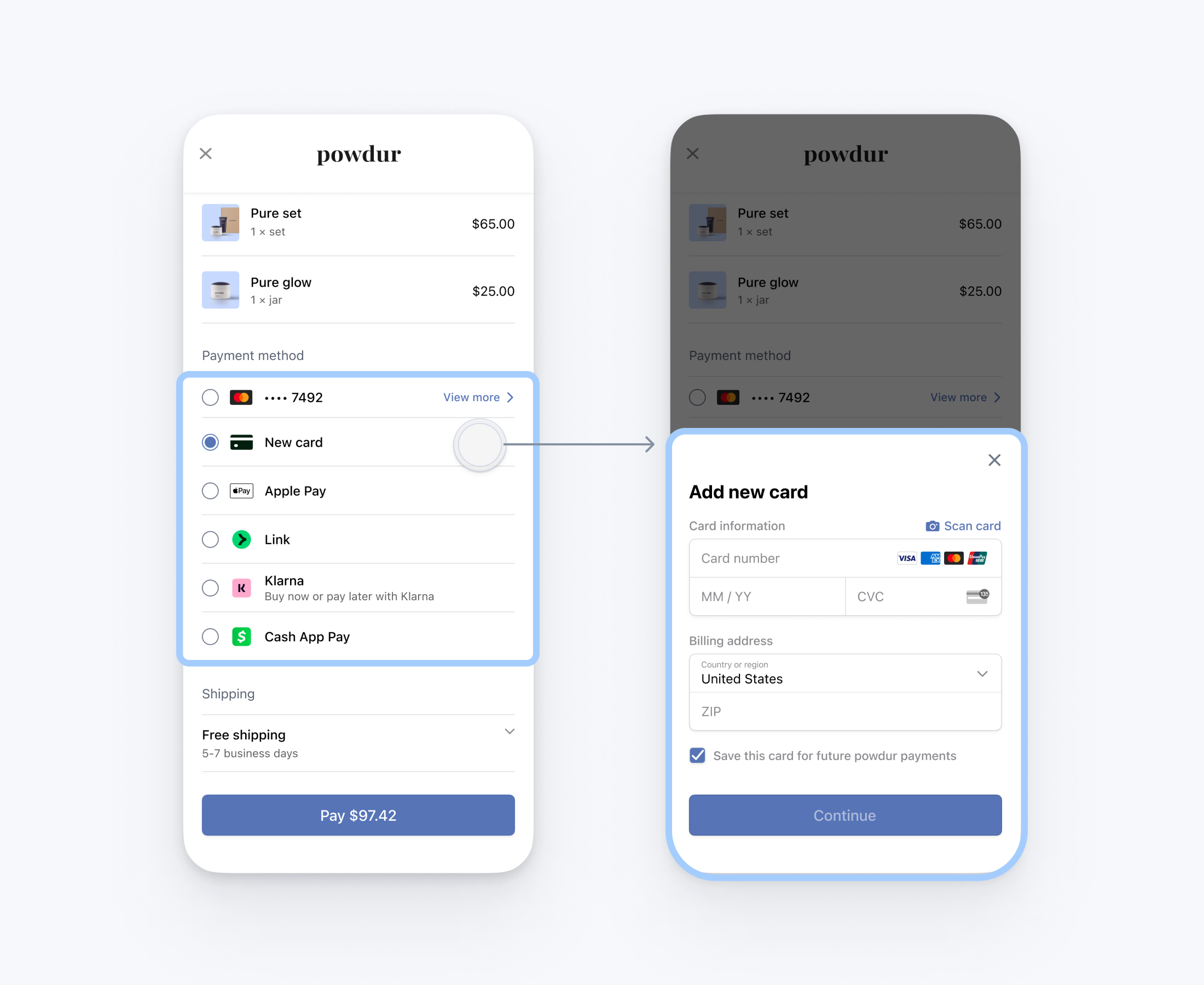
Stripe describes itself as financial infrastructure to grow your revenue, with payments and financial tools you can use on their own or together. Adyen describes itself as an enterprise fintech platform, with one platform covering payments, data insights and financial products, and one API for multiple use cases and channels.
Compare the providers' current Australian terms directly. Stripe publishes standard rates and also offers custom arrangements; Adyen describes a processing fee plus a payment-method fee. Neither pricing model alone establishes which provider will cost less for your business.
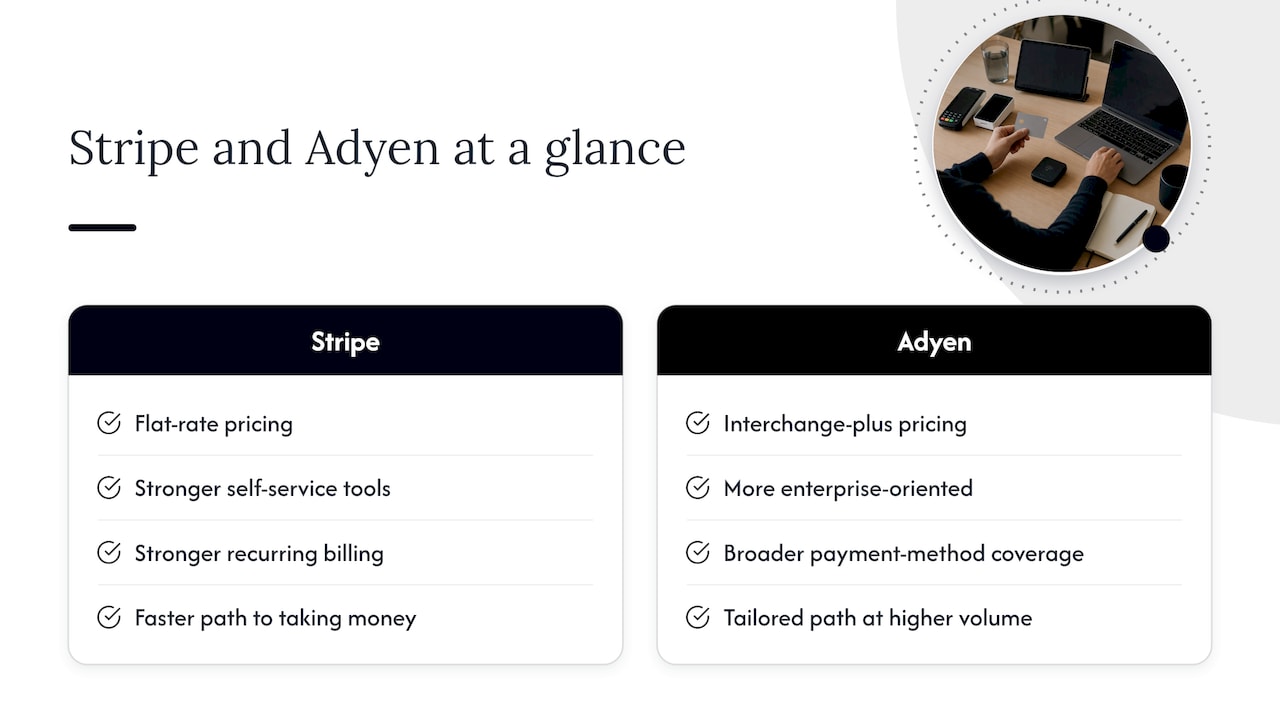
Use that distinction to build a shortlist, then verify eligibility, onboarding time and operational requirements. A small team can have complex payment needs, and an enterprise can still value prebuilt components.
Pricing: flat rate vs interchange-plus
For this comparison, distinguish Stripe's standard online card pricing from Adyen's method-specific quote. Neither should be read as a universal rate across channels, currencies and products.
On Stripe's Australian pricing page, checked on 3 November 2026, standard online card fees are 1.65% + A$0.30 for domestic cards and 3.5% + A$0.30 for international cards, including GST. Currency conversion adds 2% when required. These are online standard rates; in-person, custom agreements and other products differ. The page flags a future international-card change from 1 April 2027, so recheck before budgeting beyond that date.
Adyen's Australian pricing page describes a fixed processing fee plus a payment-method fee, with other products priced separately. Its method display includes a variable interchange-based card component; request the exact AUD quote for your card and channel mix. It states no setup or monthly fees, but a minimum invoice can apply by industry or business model.
Model the full invoice using domestic and international cards, debit and credit mix, average order value, refunds, disputes, FX, payout options and product charges. Add implementation and maintenance costs. There is no universal volume threshold at which interchange-based pricing becomes cheaper, and Stripe also offers custom pricing.
The extra charges worth checking
Headline rates are only part of the invoice. Adyen's own Australian guidance tells businesses to look for less-obvious charges such as setup, monthly and chargeback fees when comparing providers. Here are the ones to put in your spreadsheet.
Disputes
Stripe's page lists A$25 for a received dispute, A$25 for a manually countered dispute and A$25 for an appealed dispute, with different refund conditions. Confirm those conditions and any network fees before modelling cost. Ask Adyen for its dispute and evidence-submission terms; compare like-for-like stages rather than one headline charge.
Currency conversion
Stripe's standard online card pricing lists an additional 2% when currency conversion is required. Settlement-currency options, other FX products and custom arrangements have separate terms. Ask both providers for the charge, settlement and payout currencies you need, including any bank fees. Do not apply an unverified universal 1% settlement fee or 3% Adyen markup to every flow.
Add-on products
Confirm the cost of billing, fraud tools, terminals, platform accounts, reporting and payout services separately from card acceptance. Some base features are included, while other products or usage carry charges. Use a written scope rather than assuming the payment percentage covers the whole stack.
Payment methods and in-person payments
If you take payments in a shop, café, clinic or at events, hardware and eftpos support matter as much as the online rates.
Stripe Terminal supports in-person payments including Visa, Mastercard and eftpos in Australia, with supported readers, compatible Tap to Pay devices and POS integrations. Check the exact reader, SDK, connectivity and offline-payment limitations. The current pricing page lists Reader S710 at A$449 excluding GST; hardware, optional connectivity and in-person processing are separate from online card fees.
Adyen's eftpos page lists online and in-person channels and AUD settlement. Verify the required routing, integration, terminal availability and payout arrangements for your account. A method-specific settlement delay is not a promise that every transaction will reach your bank in that time.
Both cover important Australian use cases. Build a method-by-channel checklist and test your POS, wallets, refunds and reconciliation. Neither a global method count nor a reader specification proves that your particular integration supports the complete workflow.
Setup and developer experience
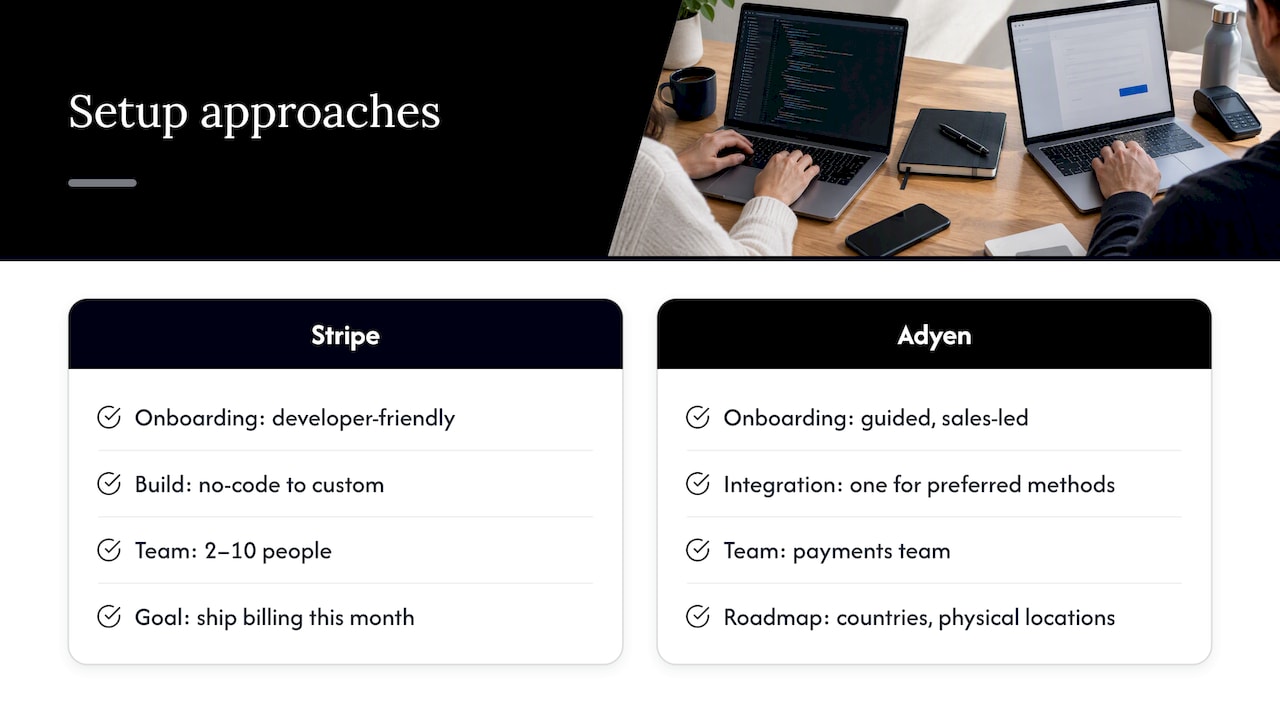
Stripe has built its reputation on developer-friendly onboarding. Stripe states that its Terminal works with Stripe Payments and Connect, and that you can go from no-code to a custom build. If you want to understand why that approach has driven so much adoption, we broke down how Stripe uses developer-first UX principles, from clear documentation to fast API integration and strong error handling.
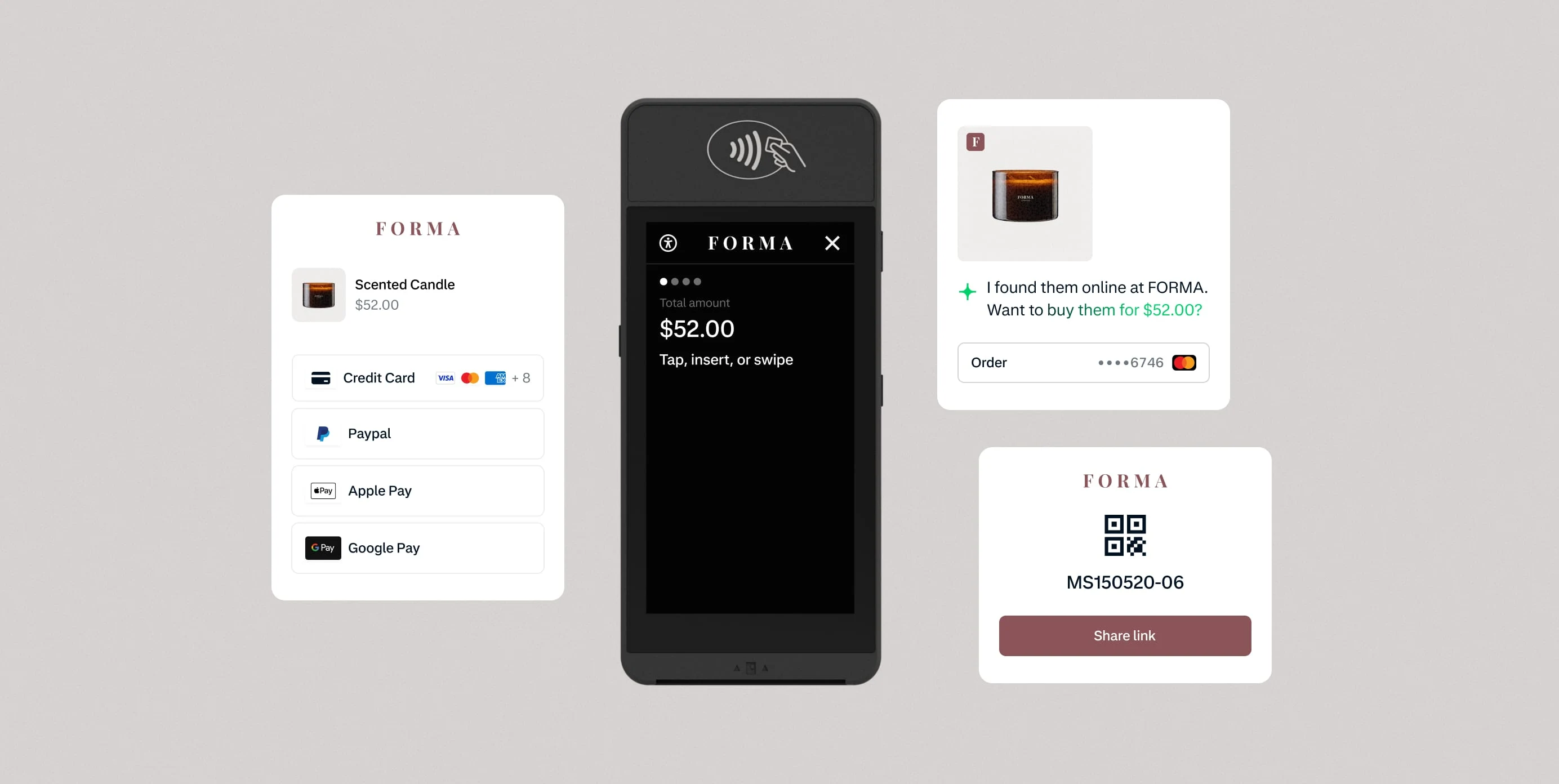
Adyen promotes a single integration across supported payment methods and channels. Confirm onboarding, testing, certification and deployment work for your actual platform. Stripe also unifies online and in-person reporting, so consolidation is not exclusive to Adyen.
Estimate the effort for your chosen implementation, not the provider's reputation. Include checkout customisation, webhooks, idempotency, refunds, dispute handling, accounting exports and support ownership. Trial the riskiest flows before setting a launch date.
Settlement and international payments
Separate shopper reach from merchant availability. Both providers offer international payment capabilities, but merchant country, legal entity, payment method, presentment currency and settlement currency impose different conditions. Verify your actual countries and currencies rather than treating a global headline count as universal access.
Adyen advertises flexible payouts and support for multiple settlement bank accounts and currencies. Availability and the economics depend on your account and contract. Compare both providers' supported settlement options against overseas revenue, costs and banking arrangements; a standard flat rate does not determine every FX outcome.
Which one fits your stage
Startups and early-stage products
Stripe is a practical starting candidate when standard checkout and self-service onboarding meet your requirements. Check underwriting, product charges and payout conditions early. You can also request custom pricing as your business grows rather than assuming a switch is the only route.
Scaling companies
This is the grey zone. Run your actual numbers: card mix, share of international sales, dispute rate and the engineering hours your payments setup consumes. Stripe's guidance to compare pricing transparency, developer effort, pre-built plugins, multiple sales channels, multicurrency processing and consolidated reporting is a sensible checklist. Ask Adyen for a written quote against your own volumes so you are comparing real figures with real figures.
Large or multi-channel enterprises
Compare both for large or multi-channel operations. Evaluate payment acceptance, operational controls, local methods, reconciliation, terminal deployment and support using the same requirements. The best fit follows the tested workflow and contract, not a business-size label.
A quick decision checklist
- Do you need to go live within weeks, with a small team? Lean Stripe.
- Are you processing large monthly volumes and ready to negotiate? Get an Adyen quote.
- Do you have overseas revenue and costs? Compare actual FX and settlement options from both providers.
- Do you run physical locations? Compare the specific readers and eftpos terms from each provider.
- Do you sell subscriptions? Test renewals, retries, proration, cancellation and the cost of billing products.
Our perspective
We are a design studio, not a payments company, so we have no horse in the Stripe vs Adyen race. What we do see, project after project, is that the processor is rarely the reason a checkout underperforms.
Teams spend weeks comparing 0.2% differences in fees and then ship a payment step with unclear error messages, too many form fields and a confusing order summary. A customer who abandons at that point costs you the whole sale, and no fee schedule can fix it. Stripe's own rise is a good lesson: its developer experience works because the documentation, the integration path and the error handling are designed with care.
Our view is that you should pick the provider that fits your volume and team, then invest the saved energy in the experience around it. We start with research and user testing, run focused design sprints to test the riskiest assumptions, and measure the change in conversion rather than guessing. That is how we approach branding, UX/UI and conversion work for startups and established businesses alike.
Where the payment step meets conversion
Once you have chosen a processor, the next gain is usually in the flow around it: how a customer moves from basket to confirmation, how errors are explained, how trustworthy the page feels on mobile.
Our Full UX/CRO Audit starts from $3,500 plus GST as a one-off. The UX/UI Design Team starts from $8,400 per month plus GST. Confirm scope and inclusions before booking, or explore our conversion rate optimisation and UX design services.

If you are building a payments-heavy product, such as a marketplace, a fintech app or a subscription platform, we can also help you validate the flow before you build it. See the full list on our services page, or look at how we work with fintech teams in Australia.