.svg)
.svg)



Social proof is the trust shortcut other people create for you: reviews, testimonials, user counts, and endorsements that tell a hesitant buyer "someone like you already took this risk and it worked out." Used well, it reduces the uncertainty that stalls a purchase decision and can meaningfully lift conversion. Below, we walk through the formats worth copying, where to place them, how to collect them ethically, and how to test whether they're actually working.

1. What are the main types of social proof?
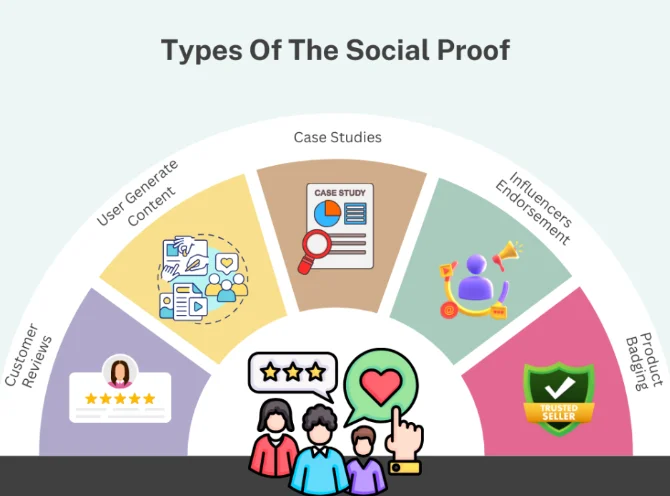
Not all social proof carries the same weight, and knowing which type fits which moment saves you from slapping a testimonial on a page where a trust badge would do more work. Here's the core taxonomy we come back to again and again.
- Reviews and ratings: star scores and written feedback, best on product and category pages where a shopper is comparing options.
- Testimonials: short, quotable endorsements from real customers, strongest on landing pages and pricing pages where someone needs a final nudge.
- Case studies: detailed, metric-backed stories, ideal for B2B demo pages and sales decks where the buyer needs proof of outcome, not just sentiment.
- User-generated content (UGC): photos and videos from real customers, powerful on product pages and in ads because they read as unscripted.
- Expert or influencer endorsements: a credible third party vouching for you, useful early in the funnel to build initial credibility before a shopper trusts your own claims.
- Social counts: subscriber numbers, downloads, or "X people bought this," which work best when the number is genuinely large enough to impress.
- Trust badges and certifications: security seals, payment logos, or industry accreditations, most valuable at checkout where risk feels highest.
- Awards and media mentions: third-party recognition, effective on homepages and About pages to establish baseline legitimacy.
- Before-and-after examples: visual transformation proof, suited to services where the outcome is visibly different, like renovations or fitness programs.
The trade-off is effort versus credibility. A star rating widget takes minutes to install and carries moderate weight. A detailed case study takes weeks to produce but can outperform a dozen testimonials because it shows mechanism, not just opinion. Part of the reason company-led recommendations carry less weight than independent proof is that buyers are naturally skeptical of anything you say about yourself, so the formats that borrow credibility from someone else tend to do more per square inch of page.
2. Copyable social proof formats you can launch this week
These are the seven patterns we see work across industries, with the structure, the psychology behind each, and a quick test you can run once it's live.
- Wall of impact: a grid of logos, metrics, or review snippets stacked together, usually on a homepage or about page. Structure: three to six columns, each showing one metric or logo with minimal text. Headline example: "Trusted by teams who ship faster." It works because repetition of small proof points compounds faster than one big claim. Collect logos and permission upfront, host on a dedicated section above the fold on desktop, below the hero on mobile. Test: logo wall versus a single customer quote in the same slot.
- Testimonial mashup: three to five short quotes grouped by theme (price, support, results) rather than chronologically. Structure: name, role, one sentence, optional headshot. It works because grouped testimonials let a skimming reader find the objection that matches theirs. Collect quotes from post-purchase surveys, tag them by theme before publishing. Test: mashup grouped by theme versus a random carousel.
- UGC gallery: real customer photos or short videos, often pulled from social media or a review platform. Structure: a scrollable grid, lightly moderated, with light captions. It works because unscripted content reads as more honest than studio photography. Platforms like Peers make it straightforward to collect and display video reviews and shopper Q&A without building the infrastructure yourself. Test: UGC gallery added to a product page versus the same page without it.
- Before-and-after: a split image or slider showing the state change your product or service produces. Structure: identical framing and lighting in both shots, a one-line caption stating the timeframe. It works because visible contrast is processed faster than written claims. Collect with consistent photo guidelines so the comparison feels fair, not staged. Test: static before-and-after image versus an interactive slider.
- Trust badges at checkout: payment security icons, money-back guarantees, or delivery guarantees placed near the buy button. Structure: small, recognizable icons in a single row, never more than four or five. It works because a minority of shoppers actively look for security indicators during checkout, and their absence reads as a red flag even to people who weren't consciously looking. Collect only badges you're entitled to display, keep them current. Test: badge row present versus removed, measured on cart abandonment.
- Social counters: a live or periodically updated number, like "12,400 businesses use this" or "built 480 MVPs." Structure: a bold number with a short label underneath, never a vague claim. It works through consensus bias, since people infer quality from popularity, though research on consensus messaging shows buyers can overestimate how much better something is just because many others chose it. Collect numbers you can verify and update honestly. Test: counter visible versus hidden on the hero section.
- Social proof in ads: a review snippet, star rating, or user count embedded directly in paid ad creative. Structure: rating plus review count in the first line of copy or overlaid on the image. It works because it preempts skepticism before the click even happens. Collect your highest-rated, most specific reviews for this, generic praise performs worse in ad formats. Test: ad with a star rating overlay versus the same ad without one.
3. Where to place social proof across the customer journey
Proof placed in the wrong spot gets skimmed past. Placed at the right moment, it answers the exact doubt a visitor is having.
- Homepage: use a wall of impact or logo strip near the top to establish baseline legitimacy before anyone scrolls deeper.
- Product and category pages: lead with ratings and reviews, then layer in UGC photos, since this is where comparison shopping happens.
- Checkout: trust badges and guarantees belong here, where risk perception peaks and a single doubt can kill the sale.
- Landing pages: testimonials and case studies work best mid-page, after the value proposition but before the call to action.
- Emails: a single strong testimonial or a social counter in a follow-up email can recover hesitant browsers.
- Ads: star ratings or short quotes reduce the skepticism a cold audience brings to a first impression.
On mobile, prominence matters more than volume: one well-placed rating badge above the fold beats a buried carousel three scrolls down. A good sequence looks like discovery through a logo wall, evaluation through reviews and case studies, then checkout through badges and guarantees, each stage handing the visitor a slightly different kind of reassurance.
4. Collecting social proof ethically without breaking trust (or the law)
Scaling proof collection only works if the proof stays honest, and regulators are paying closer attention to this than most marketers assume.
- Time your review requests: ask within a few days of delivery or first use, when the experience is still fresh, and follow up once if there's no response.
- Run UGC campaigns with clear rights language: state upfront that submitted content may be used in marketing, and get explicit opt-in rather than assuming a tag counts as permission.
- Brief influencers properly: specify disclosure wording in the contract itself, since vague tags like "sp" or "spon" have been flagged as inadequate by regulators reviewing influencer advertising practices.
- Never fabricate or edit reviews to misrepresent sentiment: the ACCC's guidance on online reviews is explicit that businesses must not create, arrange, or display reviews they know to be fake or misleading, and a recent sweep found that a notable share of businesses examined showed concerning conduct around reviews.
- Disclose incentives plainly: if you offer a discount for a review, say so, since pairing a verified-buyer badge with a hidden incentive undermines the very trust the badge is meant to build.
Pro Tip: Keep a simple log of which reviews were incentivized and which weren't, so you can always answer honestly if someone asks.
5. Measuring whether your social proof actually works
Most social proof changes produce modest lifts on their own, so the goal of testing is to find which modest lifts stack into something real.
- Test ratings-distribution display (a bar chart breakdown) against a plain average score, since Baymard's research on ratings-distribution summaries found that many e-commerce sites omit this UI entirely, despite it being a low-effort, high-impact addition that helps shoppers interpret ratings more accurately.
- Test testimonial placement on the product page versus the checkout page, since the same quote can perform differently depending on what doubt it's answering at that moment.
- Test a UGC gallery against no gallery on your highest-traffic product page before rolling it out site-wide.
- Track conversion rate as your primary metric, with add-to-cart rate and time-on-page as secondary guardrails that tell you whether a change is helping or just moving behavior around.
- Run tests long enough to reach a reasonable sample size for your traffic level, and resist declaring a winner after a few dozen conversions.
- Watch for misattributed wins: a lift during a social-proof test might actually be a seasonal spike or a pricing change running at the same time.
Treat trust signals as cumulative rather than singular. A rating badge alone might move the needle by a small margin, but combined with a testimonial mashup and a visible guarantee at checkout, the effect compounds in a way no single element can replicate alone.
6. What Raw Studio's trust-focused redesigns show about real-world lift
Research explains why social proof works. Client work shows what happens when it's actually implemented well.
In our case study on Booking.com, four psychological triggers, including urgency cues and social validation elements, contributed to an estimated 20% to 30% lift in website conversion.
- Both projects prioritized showing proof at the exact moment of hesitation, not just scattering it across the page.
- Both relied on specific, named interventions rather than a general "add more trust signals" approach.
- Both paired proof elements with urgency or scarcity cues, since trust and urgency tend to reinforce each other rather than compete.
Readers who want the full breakdown of which triggers moved which metric can find the detailed write-up linked above, along with examples of how Shopify structures its homepage around similar proof elements.
7. A realistic rollout plan and the mistakes that undo it
If you're starting with limited resources, don't scatter proof everywhere at once. Add ratings and a distribution summary to your top product pages first, then layer a testimonial mashup onto your highest-traffic landing page, then add checkout trust badges last, since that's where a mistake costs you the most.
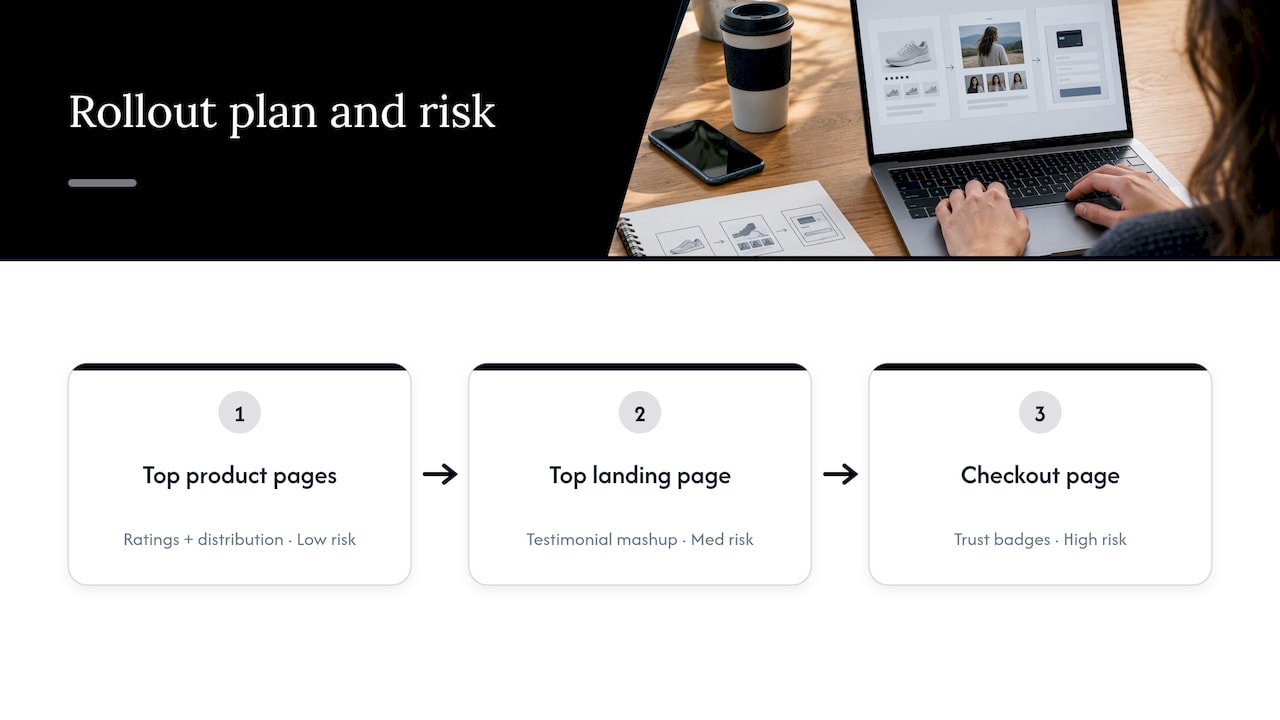
The three mistakes we see most often: badly curated trust badges that look generic or outdated, hiding the ratings distribution because the average looks better alone, and failing to disclose incentivized reviews until someone calls it out publicly. Each one trades a short-term polish for a long-term credibility problem.
Where this gets harder to do alone, particularly around testing and measurement, is often where a conversion rate optimisation engagement earns its cost back fastest.
Discuss Your Conversion Goals
Email Raw Studio to discuss data-driven design solutions for stronger user engagement and conversion-focused digital experiences. Email Raw Studio.