


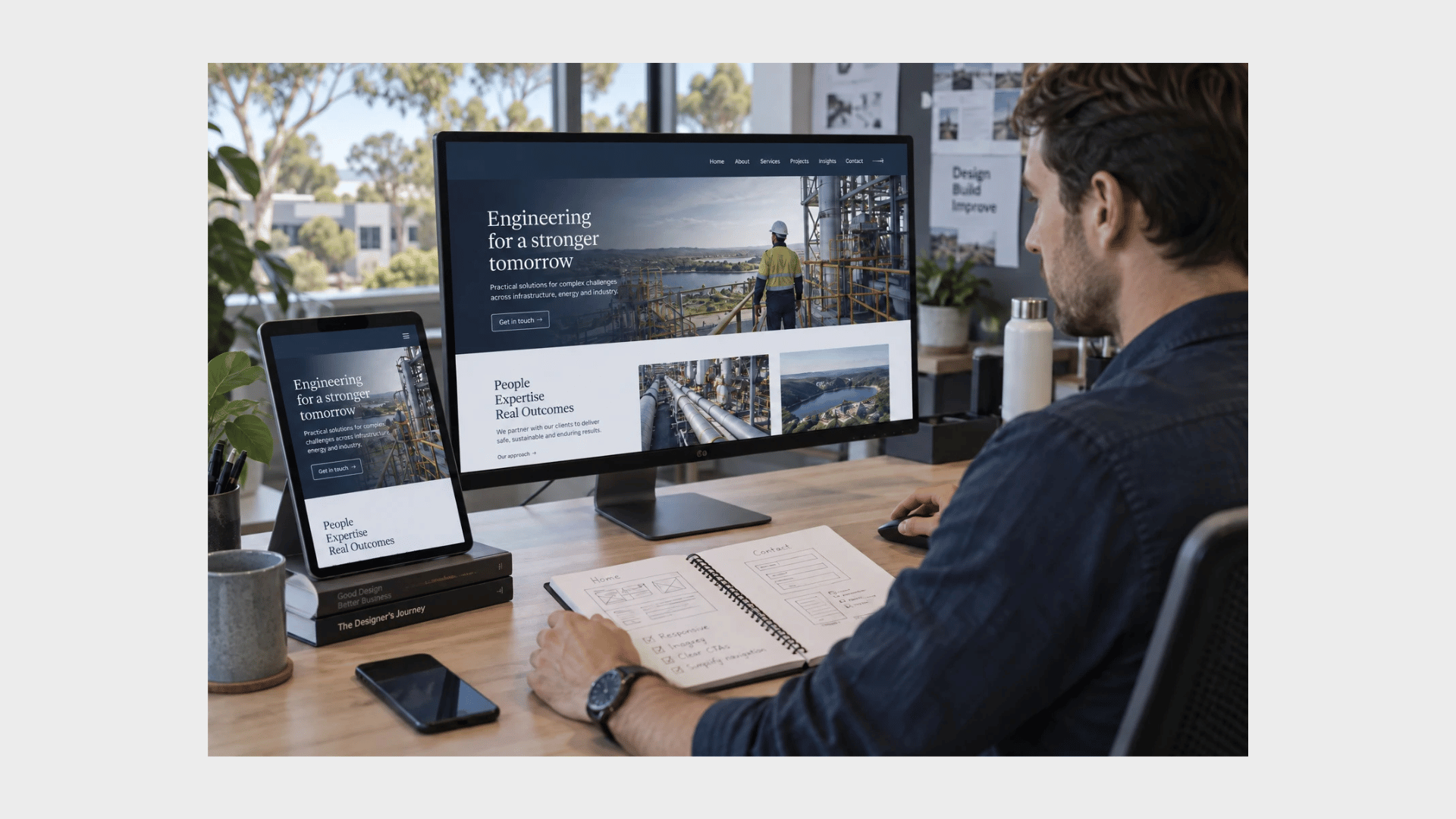

Website budgets in Australia vary with scope, delivery model and ongoing responsibilities. A DIY subscription, a designer-built brochure site and a custom ecommerce project are different purchases. Compare the total work and first-year cost rather than treating a monthly builder fee as the cost of a professional build.
Below, we compare the real options (DIY, freelancer, agency, ongoing design team), show what pushes a quote up or down, and list the running costs people forget. We're Raw Studio, a Sydney agency, so you'll see where we fit too.
The short answer: typical price ranges
Australian guides disagree at the edges, which is normal. A designer who builds a template-based site in a fortnight and an agency running research, custom design and development are not selling the same thing.
GoDaddy's Australian guide lists the following ballpark build estimates. They are one vendor's guide, not a representative 2026 market survey or a Raw Studio quote. Confirm inclusions, currency, GST and a dated proposal for your own scope.
An hourly rate alone does not establish value or quality. Compare estimated hours, deliverables, seniority, review cycles and exclusions. A fixed quote and a time-based estimate allocate risk differently, so ask how changes and overruns are approved.
What about a five-page website?
People search for this one a lot, and honest answers are boring: it depends on what the five pages do. A home page, about, services, contact and one more page, built on a good template with your own copy and photos, sits at the bottom of the brochure range above. The same five pages with custom design, written copy, a booking form wired into your CRM and basic SEO setup sit toward the top.
The page count is a weak driver. A 40-page site built from three repeated templates can cost less than a 5-page site with unique layouts, animation and custom functionality. When you ask for a quote, ask how many unique templates are involved, not just how many pages.
DIY, freelancer or agency: how the options compare
There's no single right route. The question is how much of the work you want to carry yourself, and how much a mistake would cost you.
Provider type does not determine the final price. Compare equivalent deliverables, specialist skills, capacity, support and handover. A freelancer can lead a complex project, while an agency may offer a small fixed scope.
If you're weighing up specific studios, we've put together a list of top website design agencies in Australia covering Sydney and beyond, including how each one positions itself.
What actually changes the price
When two quotes for "a website" differ by $15,000, the gap is almost always in one of these.
Scope and custom functionality
Booking engines, member logins, product configurators, multi-currency checkout and integrations with a CRM or inventory system are where hours pile up. GoDaddy says price varies mainly with project scope, and that is the one rule that holds across every guide we've read.
Research and strategy
A site built on assumptions is cheaper to start and dearer to fix. Competitor review, user interviews, analytics review and usability testing add cost upfront. They also tell you which pages, which message and which flow deserve the money. That's why we put research ahead of pixels in everything we do.
Content and imagery
Who writes the copy, and who takes the photos? Many quotes assume you'll supply both. If you won't, ask for those lines separately so you can compare like with like.
Platform
As business.gov.au explains, a hosted platform can bundle services while a self-hosted CMS may require separate hosting and extensions. Compare actual plan limits, portability, security responsibility and integrations. Neither approach is automatically more flexible or simpler in every project.
Timeline
Rushing costs money, because it displaces other work and compresses reviews. Some agencies add a surcharge for rushed delivery, so ask whether your deadline changes the figure. A structured sprint can be a smarter way to move quickly than a rushed standard build, and we come back to that below.
Compliance
If you collect personal data, take payments or work in finance or health, scoping for privacy and security requirements can be priced as a separate line. Ask about it early rather than discovering it at the end.
The running costs people forget
The build is a one-off. The site isn't. Plan for these before you sign.
- Domain: check registration and renewal prices, eligibility, ownership and any first-year promotion. An included domain may still have a renewal charge.
- Hosting or platform subscription: compare renewal rates, billing commitments, traffic or resource limits, backup features and support. Avoid paying twice for hosting already included in a CMS plan.
- Maintenance: specify updates, backups, monitoring, recovery, security work and response times. A support retainer and ongoing design capacity cover different work.
- Post-launch changes: confirm rates, minimum charges, turnaround and who can edit the CMS. Include third-party apps, email, payment fees and other relevant recurring services in the budget.
- Copywriting and SEO: treat them as separate budget lines unless the quote names them.
A sensible habit: add the first-year running costs to the build quote, then compare totals, not headlines.
How much does a website redesign cost?
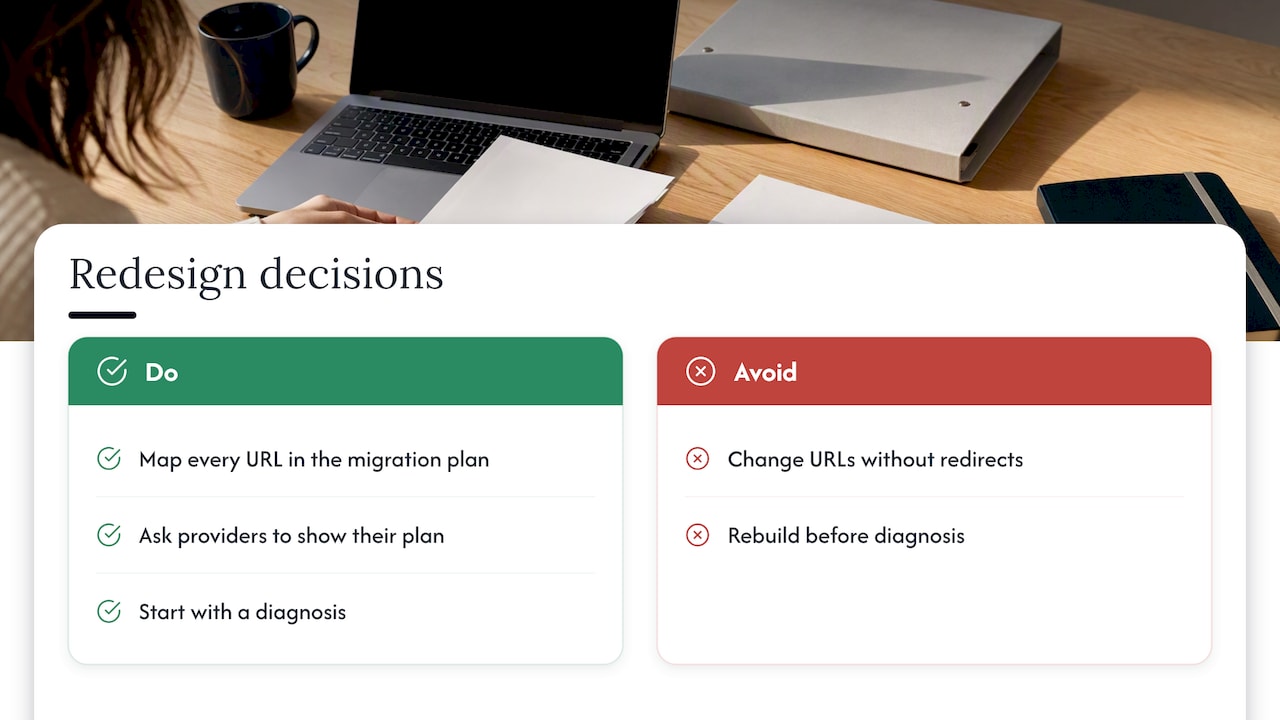
A redesign is rarely cheaper than a new build just because a site already exists. You're paying for the new design plus the work of moving what you already have: content audit, page mapping, redirects and testing.
Migration, custom features, platform changes, content and brand work can increase redesign scope. Keeping usable content or components may reduce it. A diagnosis can help decide whether to rebuild: the Full UX/CRO Audit starts from $3,500 plus GST as a one-off. Confirm its current scope before booking.
Where Raw Studio fits
We're a digital creative agency in Sydney covering branding, UX and UI design, conversion rate optimisation and web development. We don't publish a flat price for a website, because a fair number depends on scope. What we do publish:
An ongoing design team supplies agreed monthly capacity; it is not the same as a fixed website delivery quote. Our Rapid MVP and design sprint approaches can test selected assumptions, with scope and limitations agreed in advance. Neither guarantees complete product validation or a particular financial result. See the UX/UI cost guide for related considerations.
Want a number for your project? Look through our pricing and services and tell us what you need. We'll scope it with you.
Our perspective: pay for decisions, not pages
We've sat on both sides of the quote conversation, and the pattern is consistent. The sites that disappoint are rarely the ones that cost too little or too much. They're the ones where nobody checked the assumptions.
A website is a set of promises to a visitor: you'll find what you need, you'll trust us, you'll know what to do next. Each promise is a design decision, and each decision is cheaper to test before it's built. That's why our process leans on research, user testing and data, and why we like sprints. A week of focused testing can save months of building the wrong thing.
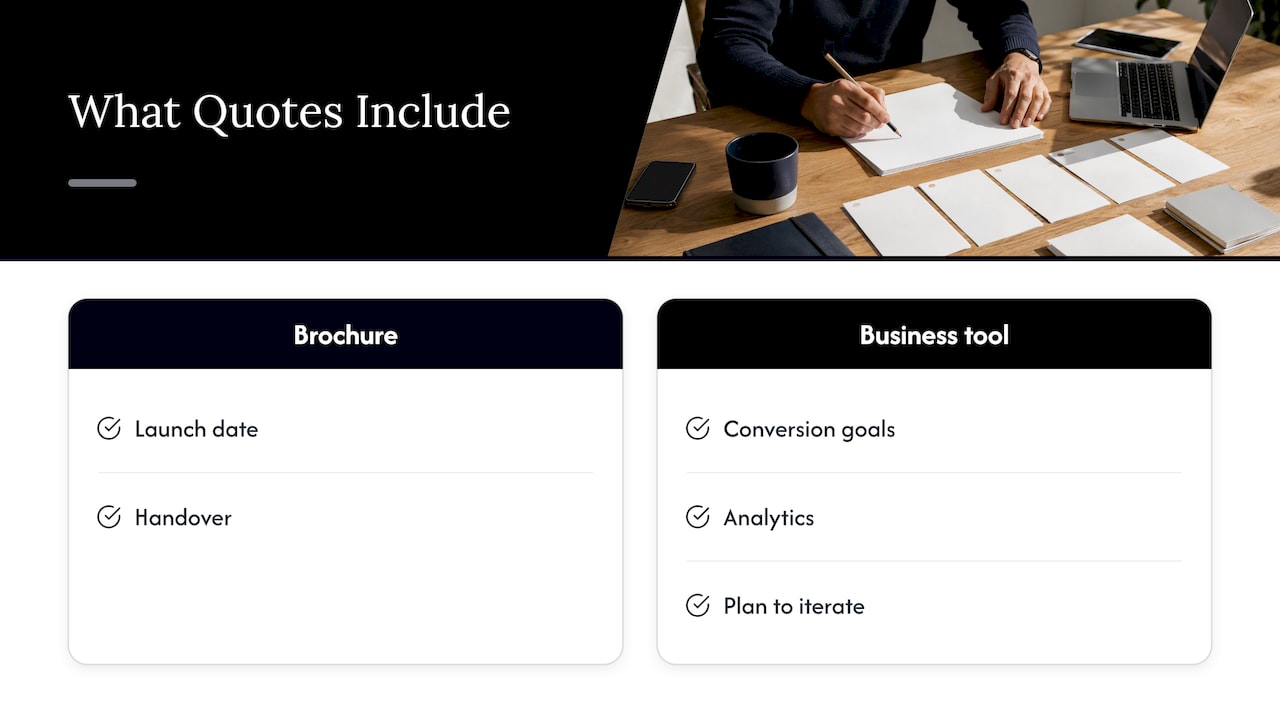
Ask how success will be evaluated after launch: define relevant goals, measurement, ownership and iteration. Conversion changes need an appropriate evaluation design; before-and-after figures can reflect traffic mix, promotions and other changes. This article does not substantiate a promise that design work will double conversion.
The cheapest option is fine when your needs are simple and you have the time to do the work. The most expensive isn't automatically better. The right one matches your risk: the more revenue rides on the site, the more it pays to buy research and testing, not just design.
How to compare quotes properly
- Ask for the scope in writing. Number of unique templates, features, integrations, content responsibilities and revisions.
- Check what's excluded. Copy, photography, migration, redirects, compliance, training.
- Ask about the process. Research, wireframes, testing and what the team does if the results show a problem.
- Get the running costs. Hosting, maintenance and hourly rates for changes after launch.
- Confirm ownership and access. Specify domain control, source files, content, code, intellectual-property rights, third-party licences and export or handover arrangements in writing.
- Confirm GST treatment. Check whether each figure includes or excludes GST so you compare like for like.
- Ask for similar work. Look for projects of the same size and complexity, not just good-looking ones.
A reasonable budgeting rule is to hold back a contingency on top of the quote for the scope changes that almost always appear once real content arrives.