.svg)
.svg)

.png)

Brand messaging is the set of words and ideas a company uses, consistently, to explain who it serves and why it matters. The single most important next step is writing a concise positioning statement and a one-line value proposition before anything else gets drafted. This guide walks through the components, a six-step build process, copy-ready templates, and the testing and governance rules that keep it all from falling apart.

What goes into a brand messaging framework
Positioning and messaging are not the same thing, and mixing them up is where a lot of teams go sideways. Positioning is internal: the honest, specific reason you are different, built around who you serve, the job you do, and the category you compete in. Messaging is what that positioning sounds like once it leaves the building and gets dressed up for a landing page or an ad. Atlassian's guide to brand positioning frames positioning as the anchor and messaging as the flexible, audience-adapted expression of it.
A full framework needs a handful of working parts:
- Positioning brief: one paragraph naming your audience, their job to be done, your category, and what makes your approach different.
- Value proposition and headline: a single sentence stating the outcome you deliver, paired with a headline and subheadline that make it scannable.
- Message pillars: three to five themes, each backed by a proof point. Atlassian recommends anchoring around 3 to 4 main value propositions, while Asana frames pillars as 3 to 5 core themes, and the Australian Government's branding guidelines describe a strong hierarchy as a concise core message supported by a handful of value propositions and proof points, with narrower offers needing fewer pillars and multi-offer organizations needing more.
- Voice and tone rules: three or four voice traits, clear boundaries, and a short list of banned words.
- Templates and matrices: the physical documents, like a pillar-and-proof matrix and an audience message matrix, that make the framework usable rather than theoretical.
That last point matters more than people expect. A positioning statement that lives only in someone's head, or buried in a slide deck nobody reopens, has no operational value. The templates are what turn a good idea into something a copywriter, a sales rep, or an AI tool can actually follow.

A practical 6-step process to create and validate your messaging
Building messaging from scratch does not need months. Here is a sequence that works for a small team, borrowed from how WordStream's messaging framework guide and similar workflows structure the process: strategy, research, hierarchy, voice, rollout, and refinement.
- Audit existing comms and strategy. Pull every website page, ad, pitch deck, and sales script you currently use, and note where the story contradicts itself.
- Map audience segments and capture real language. Talk to actual customers, pull quotes from support tickets and sales calls, and write down the exact phrases they use, not your internal jargon.
- Draft positioning and a one-line core message. Write the positioning brief, then distill it into pillars with one proof point each.
- Build the templates. Turn the draft into a pillar-proof matrix, an audience message matrix, and a voice-and-tone table so the framework has a usable shape.
- Test it. Run the message past people outside your building before you trust it.
- Govern it. Assign ownership, set an approval flow, and schedule a review so the document stays current instead of calcifying.
Pro Tip: Draft your positioning statement in one sitting, then walk away for a day. If you cannot repeat your value proposition from memory the next morning, it is not simple enough yet.
Each step builds on the last, but the sequence only works if step 2 happens before step 3. Teams that skip straight to drafting clever headlines usually end up rewriting everything once real customer language shows up later.
Message hierarchy and templates you can paste into a doc
A message hierarchy moves from one sentence at the top down to channel-specific copy at the bottom. Here is how the layers typically stack, drawing on the template structures Asana outlines:
- Core message (one line): "We help early-stage teams ship validated products without burning months on guesswork."
- Hero headline and subheadline: Headline: "Build what customers actually want." Subheadline: "Design sprints and rapid prototyping that turn assumptions into evidence in weeks, not quarters."
- Pillar-and-proof row example: Pillar: "Speed without guesswork." Proof: "A structured sprint replaces a six-month roadmap debate with a tested prototype."
- Audience message matrix row example: Persona: "Non-technical founder." Pain: "Afraid of wasting budget on the wrong feature." Message: "Test the idea before you build it, so the spend only goes toward what works."
- Microcopy snippets: Home hero: "Stop guessing what to build next." Email subject line: "The prototype that answers your biggest product question." Ad headline: "Validate it before you fund it."
Keep every layer traceable back to the core message. If a piece of ad copy cannot be mapped to a pillar, it does not belong in the library yet.
How to test and measure whether your messaging actually works
Messaging is a hypothesis, not a finished product, until customers confirm it. CXL's guide to messaging strategy treats testing as core to the process rather than an optional polish step at the end.
- Recruit people who have no stake in your internal debates, including prospects who have never seen your pitch.
- Pull language straight from sales call notes and support tickets before you even start testing, since that is where the real objections live.
- Run landing-page A/B tests, measure ad-copy lift, and pair the numbers with qualitative interviews that explain why something worked or did not.
- Track comprehension, relevance, qualified response rate, conversion lift, and how often the same objection comes up.
One of the clearest signals from how teams approach this: testing messaging through interviews and landing-page experiments surfaces comprehension gaps that internal review never catches, because the people writing the copy already understand it.
Run these cycles short, a week or two at most, and treat a result as meaningful only when it shows up across more than one test. A single landing page bump can be noise. A pattern across three channels is a signal worth acting on. For teams already running conversion work, the testing habits from CRO practice translate directly here: the same discipline that catches a confusing checkout flow catches a confusing value proposition.
Rollout, governance, and keeping AI-generated copy on brand
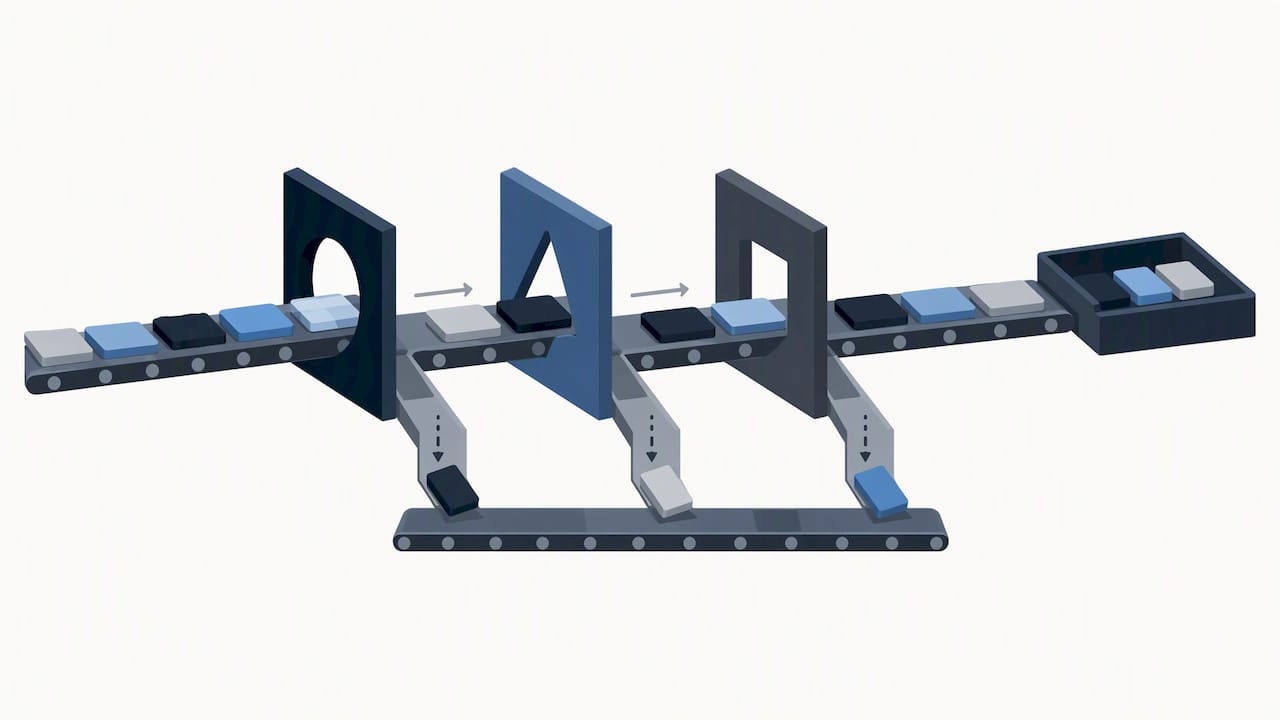
A messaging framework that lives in a forgotten slide deck is functionally the same as not having one. It needs a single home, whether that is a shared doc, a brand portal, or a dedicated tool, and someone has to own keeping it current.
- Name one owner for the document and a short list of people who can approve new claims or pillar changes.
- Set a simple approval flow for marketing copy and social posts: draft, check against the pillar matrix, sign off, publish.
- Write operational rules, not vague adjectives: approved terms, a banned-words list, maximum sentence length, and two or three worked examples of on-brand copy.
- Build a one-page checklist that a new hire or a freelance writer can follow without a briefing call.
Pro Tip: If you are using AI tools to draft copy, feed them the banned-words list and the approved claims directly in the prompt. A documented rule is checkable; an adjective like "innovative" is not.
Encoding the rules this specifically also makes AI-generated drafts easier to audit, since a human reviewer can check output against a list instead of relying on a gut feeling about tone.
Common mistakes and quick fixes
Most messaging failures trace back to a handful of repeat offenders.
- Trying to speak to everyone at once. Pick one hero and one core desire. A framework built around a single customer and a single transformation is sharper than one trying to cover five audiences in one sentence.
- Letting positioning leak into customer-facing copy. Positioning is your internal compass; messaging is what the customer reads. Conflating them produces copy that sounds like a strategy memo.
- Writing before listening. Skipping the customer-language capture step produces polished sentences that do not match how real people talk about the problem.
- Treating the framework as a one-time PDF. A messaging doc that never gets revisited drifts out of date within a year. Schedule a review the same way you would a budget check-in.
How Raw Studio applies messaging frameworks in practice
Design sprints and Rapid MVP work compress validation into days rather than months, letting a positioning hypothesis meet real users fast. When hiring an agency for messaging work, ask what gets tested, who signs off on claims, and how proof points get sourced.
The messaging advice nobody wants to hear
Most of the content on this topic treats the framework as the finish line. It is not. The real work is the governance layer that most guides skip in a rush to get to the fun part, the voice and tone adjectives. A beautifully worded pillar matrix that nobody enforces is decoration.
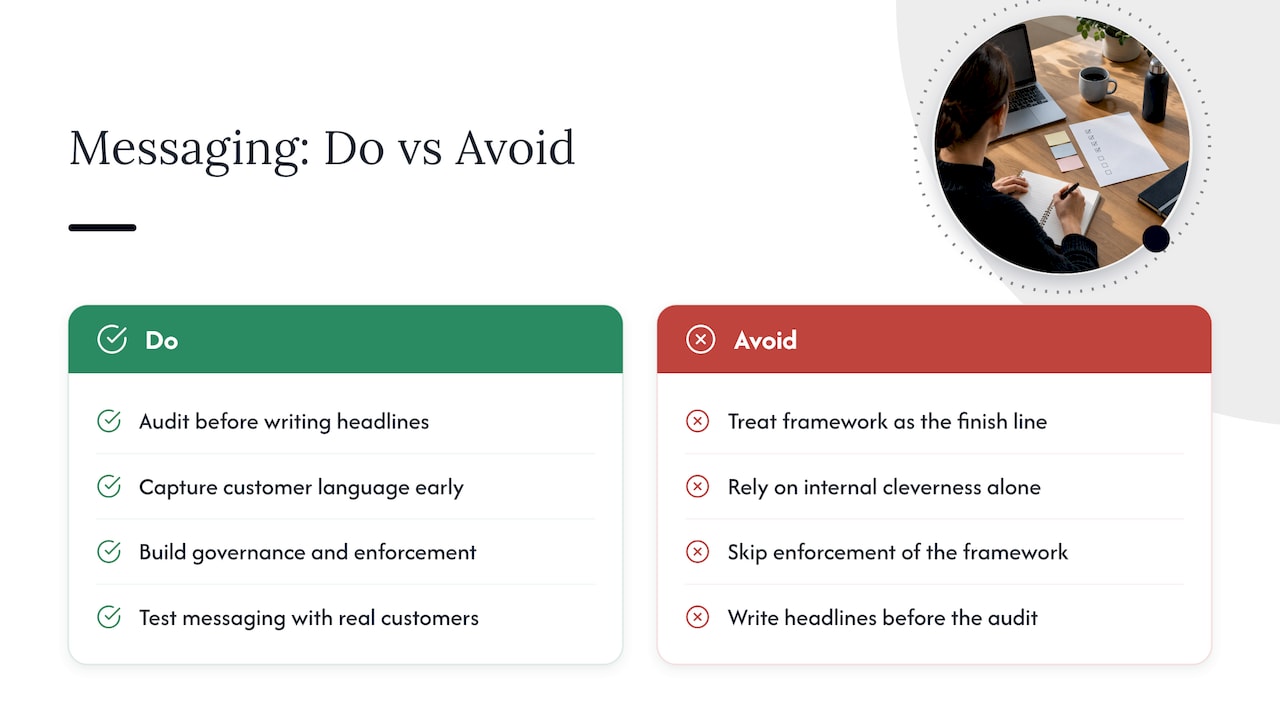
The conventional advice also overrates cleverness. A headline that makes your internal team laugh in a meeting is not the same as a headline that a stranger understands in four seconds. CXL's research on messaging testing makes this plain: comprehension gaps show up in testing that internal review simply cannot catch, because the people who wrote the copy already know what it means.
If you take one thing from this guide, prioritize the audit and the customer-language capture before you write a single headline. Everything downstream, the pillars, the voice rules, the AI prompts, inherits whatever quality went into that first pass. Skip it, and you are just polishing a guess.
Philippe
Where Raw Studio fits if you want help building this
If the six-step process above sounds right but the hours do not, that is exactly where a design sprint earns its keep: compressing weeks of positioning debate into a few structured days with real user input baked in. Raw Studio builds branding, runs Rapid MVP validation, and offers a Full UX/CRO Audit starting at $2,500 for teams that want the testing layer handled rather than DIY'd.
For a lower-commitment starting point, grab the free branding checklist template and work through the positioning brief yourself first. When you are ready for support beyond the template, the services overview lays out where branding, UX design, and conversion work connect.
How long does it take to build a brand messaging framework?
A focused team can move through the audit, drafting, and templating stages in a few weeks using the six-step process above. Testing and governance are ongoing rather than one-time tasks, since the framework needs periodic review to stay current.
Discuss Your Messaging Challenges
Email Raw Studio to discuss research-led branding, UX/UI design, conversion optimisation, or web development for your business. [email protected]