.svg)
.svg)


Why Run a Brand Workshop: Goals Shape the Agenda
A brand workshop only works when the room agrees on why it exists before anyone opens a whiteboard. Most sessions serve one of three goals, and each one reshapes the agenda differently.
An alignment-focused session might run shorter, closer to two hours, because the goal is consensus, not creation. A definition-focused session needs the full four to eight hours because you are building from nothing. Naming your goal out loud in the invite changes which exercises earn their slot and which get cut.
Copyable Agenda Templates: Half-Day, Full-Day, and Remote Sprint
Pick the version that matches your timeline and team availability. Each block below includes the facilitation prompt to open with.
Half-day agenda (4 hours), best for teams refining an existing brand:
- Warm-up (20 min): "What's one word outsiders use to describe us that we'd never use ourselves?"
- Outside-in review (40 min): Walk through customer feedback, reviews, and a quick competitor scan.
- Brand core (90 min): Define mission, audience, and positioning statement together.
- Sharpen (60 min): Run the is/is not exercise and one persona sprint.
- Commitments (30 min): Assign owners and dates to every open decision.
Full-day agenda (7 to 8 hours), best for a from-scratch brand definition:
- Expanded discovery and stakeholder interviews recap (60 min)
- Competitor and category scan, mapped visually (45 min)
- Audience deep dive with two personas built live (90 min)
- Brand foundations: mission, values, positioning (120 min)
- Priority-setting and roadmap sequencing (90 min)
- Synthesis and commitments (45 min)
Remote Sparks' full-day template follows a similar block structure and stresses a synthesis pause between each segment, which keeps a remote or hybrid group from drifting.
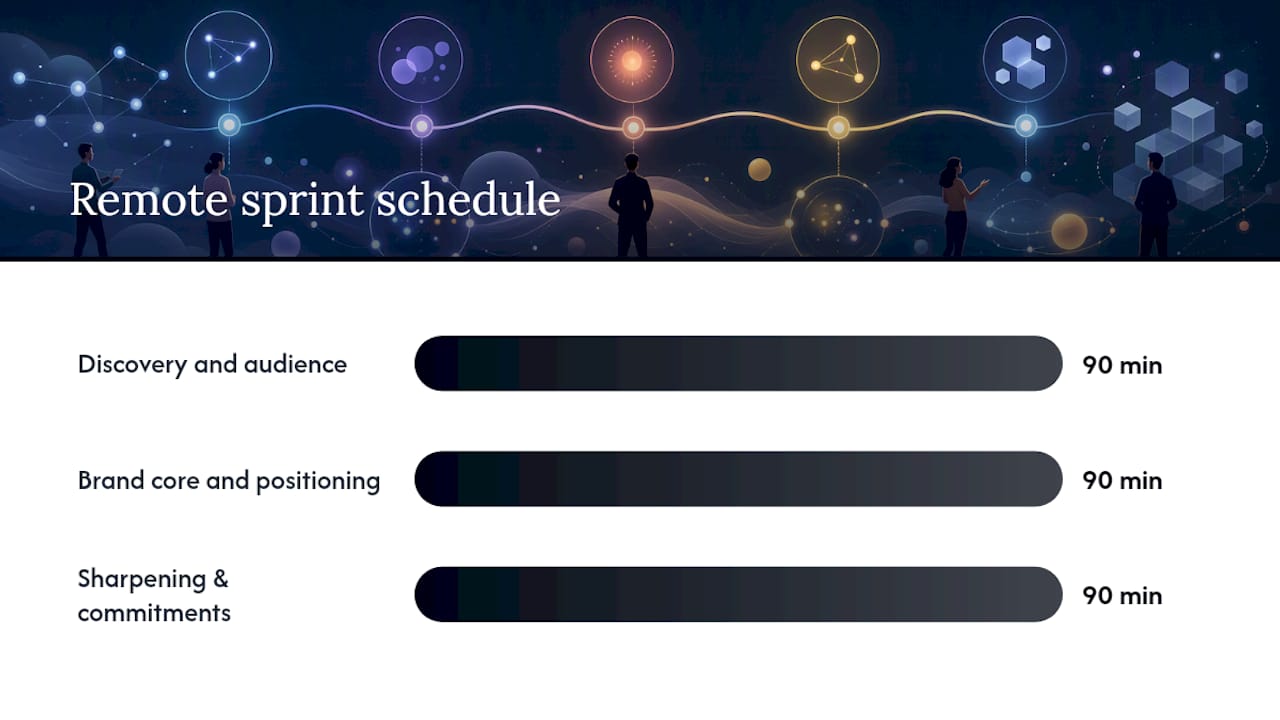
Remote sprint option: three 90-minute sessions. Instead of one long day, split the work across a week. Session one covers discovery and audience; session two covers brand core and positioning; session three covers sharpening exercises and commitments. Send asynchronous pre-work between sessions so no one arrives cold. Miro’s Minimum Viable Brand Workshop template packages a similar structure into a single two-hour remote session with blocks for why, audience, name, values, personality, positioning, and a closing design brief, which works well for early-stage startups that need momentum over polish.
Who to Invite and What to Send Beforehand
The wrong attendee list kills a workshop faster than a bad exercise. You want the decision-maker in the room (a founder or CEO), a product lead, someone from marketing, someone client-facing from sales or support, and a creative or design lead. That’s five people, sometimes six.
- Keep the core group small to maintain decision speed and ownership clarity.
- For bigger organizations, run a core session with the five to eight decision-makers, then hold separate validation sessions with wider teams to react to draft outputs.
- Send pre-work one week ahead: a short brand audit worksheet, three competitor screenshots, and four priming questions.
- Priming questions: What would we lose if we disappeared tomorrow? Who do we secretly envy? What's one word customers use that surprises us? What decision have we been avoiding?
Practitioner guides consistently flag that outputs get overturned later when the actual decision-maker skips the session, so protect that seat above all others.
Exercises That Force Real Decisions
Loose brainstorming produces mood boards nobody acts on. These four exercises produce decisions instead.
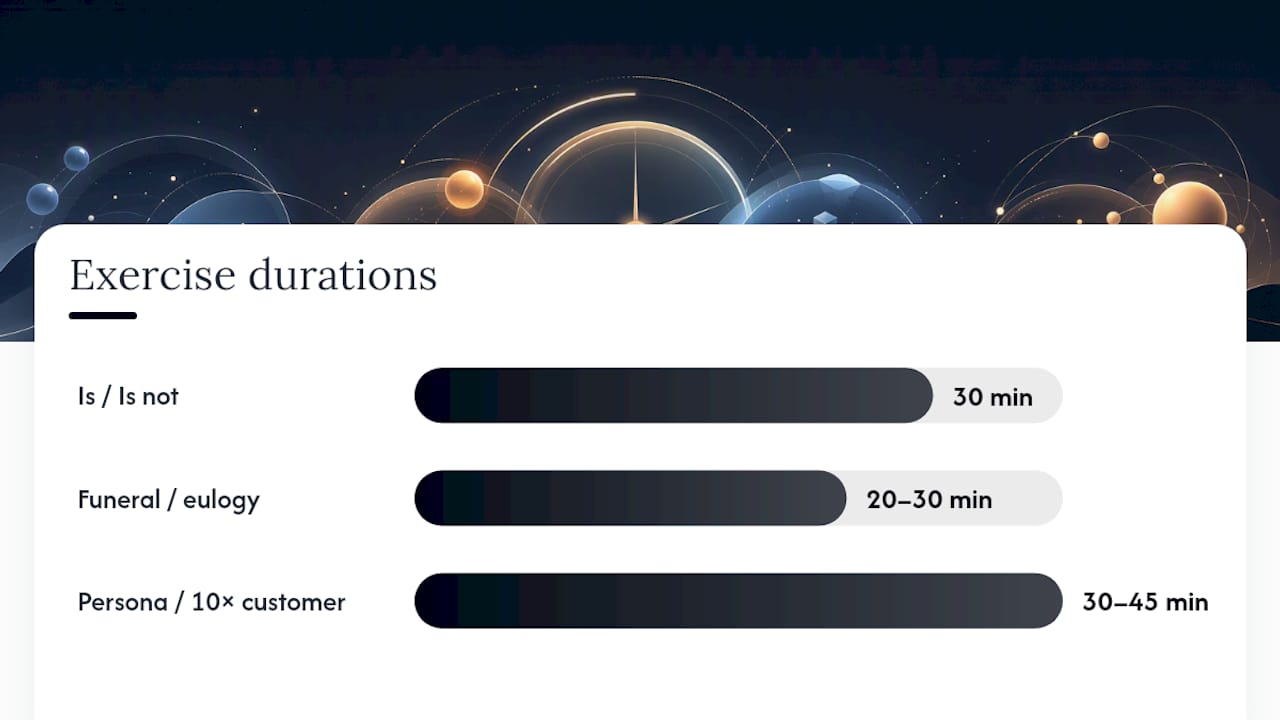
- Is / is not (30 min): Split a board into two columns. The team lists what the brand is and explicitly is not. This forces contrast, which is where positioning actually lives.
- Funeral / eulogy (20 to 30 min): Ask the room to eulogize the brand as if it died tomorrow. What would be missed? This surfaces distinctive value that polite discussion usually buries.
- Persona / 10x customer (30 to 45 min): Build a rapid persona for your best possible customer, not your average one. Interaction Design Foundation's guidance on personas notes that personas work best when grounded in real research rather than assumption, so pull from actual customer interviews if you have them.
- This-not-that spectrums: Visual sliders (playful to serious, minimal to bold) that translate abstract tone words into design direction the creative team can actually use.
Keep the room moving with a parking lot for off-topic ideas, note-and-vote instead of open debate, and a visible timer for every block
Pro Tip: Assign someone other than the facilitator to watch the clock. Facilitators who also timekeep tend to let good conversations run long, and that’s how a four-hour agenda becomes a six-hour slog.
Adapting the Agenda for Remote Teams
A full-day workshop rarely survives being ported straight to video calls. Split it into three 90-minute sprints across a week instead of one marathon session, and build in a five-minute break every 45 minutes
A full-day workshop rarely survives being ported straight to video calls. Split it into three 90-minute sprints across a week instead of one marathon session, and build in a five-minute break every 45 minutes.
- Use a shared board (Miro is the most common choice, according to its Capterra listing) paired with timed breakout rooms for smaller exercises and one central synthesis document that captures decisions in real time.
- Ask everyone to keep cameras on and mute unless speaking; energy drops fast on silent, camera-off calls.
- Shorten every exercise by roughly a third compared to the in-person version. Attention spans on video calls run shorter than they do around a table.
Turning Workshop Decisions Into Action
A brand workshop that ends without a document is a brand workshop that never happened. The minimum viable output is a one-paragraph positioning statement, three core values, two personas, and three priority actions, each with a named owner and a date.
- Document everything in a single one-page brand brief. This becomes the source of truth that design, marketing, and product teams reference instead of relying on memory.
- HBR's framework for mapping brand strategy argues that structured mapping is what actually connects workshop decisions to measurable positioning outcomes, rather than leaving them as good intentions.
- Build a handoff checklist: design needs the visual parameters and this/not-that spectrum results; marketing needs the positioning statement and personas; product needs the priority list with dates.
- Templates like Milanote's brand positioning map and persona worksheets give you a starting structure so the brief doesn't get built from scratch every time.
For teams translating workshop outputs into visual direction, tips on visual storytelling are worth reviewing before your design team starts on the this/not-that spectrum results.
Practitioner Notes From Raw Studio
Philippe has watched enough of these sessions run off the rails to know the agenda matters less than what happens after everyone leaves the room. Raw Studio has built its own workshop practice around exactly that gap, using frameworks like Design Sprint and Rapid MVP to keep sessions decision-focused rather than idea-generating.
- A free downloadable branding checklist for teams prepping their own session.
- A recorded webinar on building brand strategy covering facilitation and follow-up.
- A dedicated Design Workshops service page outlining what a facilitated session with an outside team looks like in practice.
When a Full Workshop Is Overkill
Not every branding problem needs eight hours and a full room. If the problem is narrow, the team is hard to gather, and a decision needs to happen this week, skip the full agenda.
A 2-hour brand sprint works when you need to settle one specific question, like a tagline or a single positioning line. A structured pre-mortem session (60 to 90 minutes) works when you need to stress-test a decision that’s already been made before you commit budget to it. Run the full workshop once, then revisit with a shorter refresh sprint every 12 to 18 months, or sooner if the market shifts under you.
Get Your Brand Workshop Facilitated by Raw Studio
Raw is the alternative to hiring a generalist agency for your brand workshop. Where a broad-service shop treats branding as one line item among many, Raw runs workshops using research-driven frameworks like Design Sprint and Rapid MVP, built specifically to turn a day of conversation into validated decisions rather than another slide deck nobody opens.
When you engage Raw’s Design Workshops, you get a facilitator who keeps the room on schedule, ready-made templates so no one starts from a blank page, and a documented handoff your design and product teams can act on immediately. If you want full brand support after the workshop wraps, Branding and the broader service lineup cover everything from positioning through launch. Grab the free branding checklist to prep your team before the session, or check current workshop pricing on the pricing page to get a facilitated session on the calendar