



Before choosing between Next.js and "Remix", identify the project you mean. Remix v2's React framework lineage continued in React Router framework mode, while Remix 3 is a distinct project with its own UI runtime. This guide compares Next.js with that React Router lineage for React teams, and explains why the names cannot be used interchangeably in 2026. Choose around the required routes, data flow, hosting and maintenance, then test a representative feature.
What Next.js and Remix actually are
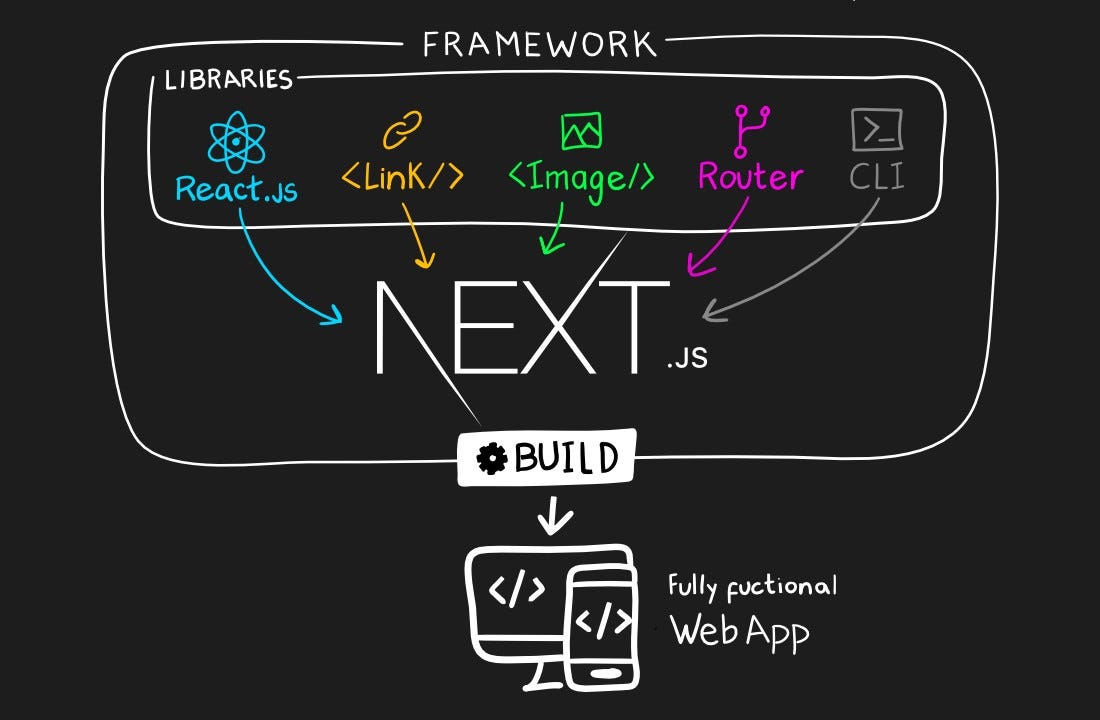
Next.js is a React framework. React Router framework mode supplies route modules, data loading and rendering strategies for React apps and carries forward the Remix v2 approach. The newer Remix 3 must be evaluated separately; it is not simply another name for React Router.
Both React frameworks support content-led and interactive applications. The useful distinction is how a team wants to organise reads, writes, rendering and caching, not a universal rule that one is for websites and the other for forms.
The Remix and React Router question
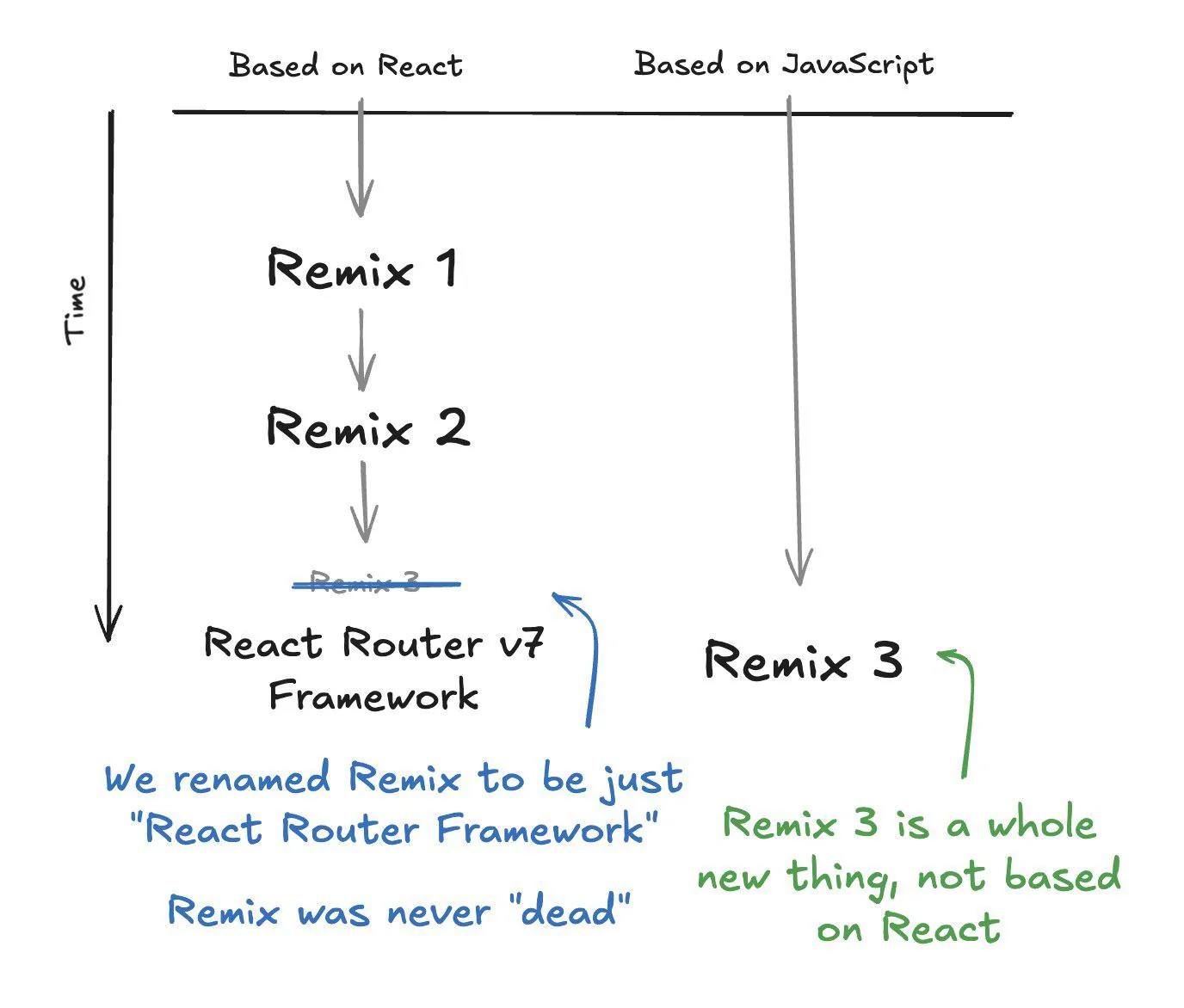
The 2024 merger announcement explains the Remix v2 migration to React Router v7, but it is historical guidance. React Router subsequently released v8. Separately, the Remix 3 release-candidate announcement describes a new full-stack framework and UI runtime. Check current release notes, dependencies and stability for the exact package before starting a project; a planned release date is not proof of a completed release.
In the technical comparison below, "Remix-style" means the Remix v2 route-module approach as carried forward by React Router framework mode. It does not describe Remix 3's APIs. Existing projects should follow their version-specific upgrade guide rather than assuming a migration is only import changes.
Routing: two routers versus nested routes
Next.js has the App Router and Pages Router. The App Router uses React Server Components and supports nested layouts; the Pages Router remains relevant in existing projects. Inspect the actual codebase and chosen version before deciding how to fetch data or migrate routes.
Remix leans on nested routing. Each route is a module that can export its own loader, action and UI, and parent routes wrap children. The React Router route module documentation describes the framework mode as organised around route modules, loaders and actions, with loader data revalidated automatically after an action.
What this means day to day:
- In Remix-style routing, a page is a composition of route segments, each loading its own data in parallel. It is easy to reason about where a piece of data comes from.
- In Next.js App Router, a page is a tree of server and client components, and data can be fetched in the component that needs it. It is flexible, and it asks the team to agree on conventions.
Data loading and forms
This is where the two feel most different to work in.
React Router route modules support server loaders and actions, with revalidation after mutations. They can also define browser-side client loaders and client actions. Standard forms targeting server actions can progressively enhance; client-only actions and SPA deployments have different JavaScript dependencies. Test the actual flow without JavaScript before claiming it works.
In Next.js App Router, Server Components can read data on the server. Mutations can use Server Functions invoked as actions or Route Handlers; Pages Router APIs follow a different model. Define validation, authorisation, caching and revalidation explicitly. Next.js can also support progressively enhanced server-rendered forms, so this capability is not exclusive to the Remix lineage.
Build the same representative read-and-write flow in each shortlisted stack. Compare error handling, pending UI, validation, revalidation and developer effort. Familiarity and application requirements matter more than a content-versus-forms label.
Performance and user experience
Both frameworks can produce fast sites. They get there differently.
Next.js can combine rendering and streaming strategies, with behaviour depending on version, configuration and deployment. The self-hosting guide explains the operational work for shared caching, streaming and multiple instances. A compiler speed claim is not a benchmark of your application's page load or interaction performance.
Remix-style apps focus on the interaction. React Router's documentation shows fetcher forms with independent pending state and says application code controls the pending UI. That is a gift for designers: you can design a precise loading, saving and optimistic state for each action rather than accepting a global spinner.
This is the point where design and engineering meet, and we have written about it before in how to balance performance and design. A framework gives you the tools. Whether the experience feels fast is decided by what you choose to show, and when.
SEO and metadata
Next.js provides metadata APIs and file conventions for common SEO assets. React Router can also serve indexable HTML and route metadata. Test status codes, canonicals, redirects, robots directives, sitemaps and rendered content in either build. Neither framework guarantees rankings, and metadata convenience alone does not establish an SEO winner.
If you pair either framework with a headless CMS, rendering choices matter for crawlability. This headless CMS SEO checklist walks through rendering strategies and the technical checks worth running before launch. And if you are still choosing the CMS itself, see our comparison of Sanity, Contentful and Strapi.
Hosting and deployment for Australian teams
Latency to your users matters, and most of your users may be in Sydney, Melbourne or Brisbane. So hosting is worth a real look.
Next.js can run on managed platforms, Node.js or Docker, with static exports for compatible applications. Check the current deployment requirements: streaming, image handling, cache persistence, invalidation and rolling releases need deliberate configuration. A Node container does not automatically provide production cache coordination.
React Router supports client rendering, server rendering and static prerendering. Choose the deployment template or request-handler integration that fits the host and version. Static sites do not require a runtime server, while server loaders and actions do. Avoid deploying a current framework app using an old remix-serve tutorial without checking the supported runtime and build output.
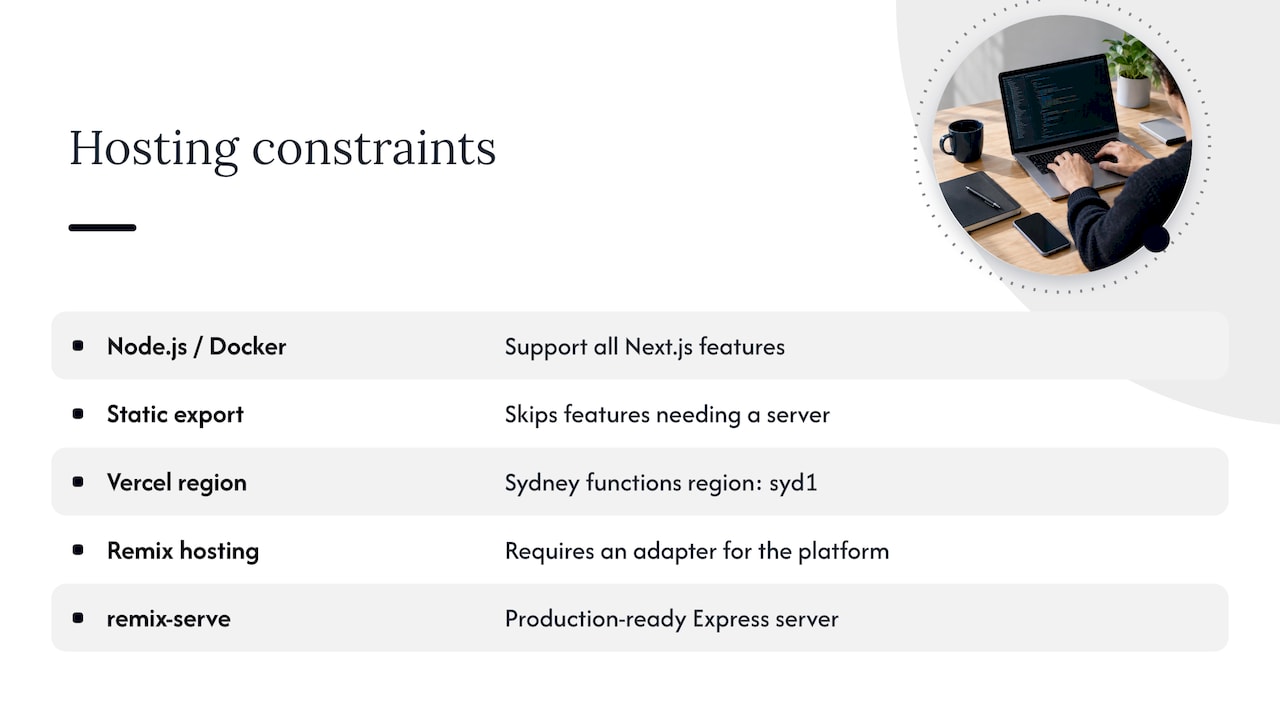
Shortlist hosting and framework together. Place compute and databases appropriately for the audience, and test latency from Australian locations. Also inspect cold starts, egress, cache behaviour and operational ownership. Our Vercel vs Netlify comparison offers related selection questions.
Side-by-side comparison
Version references change quickly. Use the current official documentation and security advisories for the exact framework and host you intend to ship. The historical Remix merger post is not a current release catalogue.
How to choose: five questions
- Is organic search a core channel? Test rendered content and technical SEO in either framework; compare editorial needs and metadata tooling.
- Is the product mostly forms and mutations? Trial validation, server actions, pending states and error recovery in the team's preferred model.
- Does your team already know Server Components? Then Next.js will be quick to ramp up. If your developers think in routes and HTTP, the Remix model will feel natural.
- Where will it run? Pin down hosting and region first. Both work, but your platform shortlist may favour one.
- How long will it live? Check current maintenance, runtime requirements and upgrade work, distinguishing React Router framework mode from Remix 3.
Notice that none of these questions is "which framework is better?". That question has no useful answer in the abstract.
Our perspective
We get asked this a lot, usually by founders who have been told by a developer friend that one framework is obviously right. In our experience, the framework is rarely what decides whether a product works. What decides it is whether you validated the idea, understood your users, and designed flows that make sense to them.
That is why we start with research and a Design Sprint or Rapid MVP. Prototype the riskiest workflow, then use its data, interaction and deployment requirements to compare stacks. A content-led site does not automatically require Next.js, and a form-heavy app does not automatically require React Router.
We design with the build in mind. Our team works with developers on component structure, loading states and handoff, so the design you approve is the one that ships. Whichever framework you land on, we want the experience to feel purposeful: fast where it matters, clear where users hesitate, and measurable once it is live.
Working with Raw Studio on your build
If you are choosing a stack for a new product or a redesign, we can help you decide with evidence rather than opinion. Our Rapid MVP and Design Sprint frameworks are built to validate an idea quickly, and our web development service takes the result to production.

Start with our free UX audit if you want an initial view. Our Full UX/CRO Audit starts from $3,500 plus GST as a one-off, and the UX/UI Design Team starts from $8,400 per month plus GST. Confirm scope before booking. For migration, map redirects and validate the result using our CMS migration checklist; redirects reduce risk but do not guarantee unchanged rankings.