


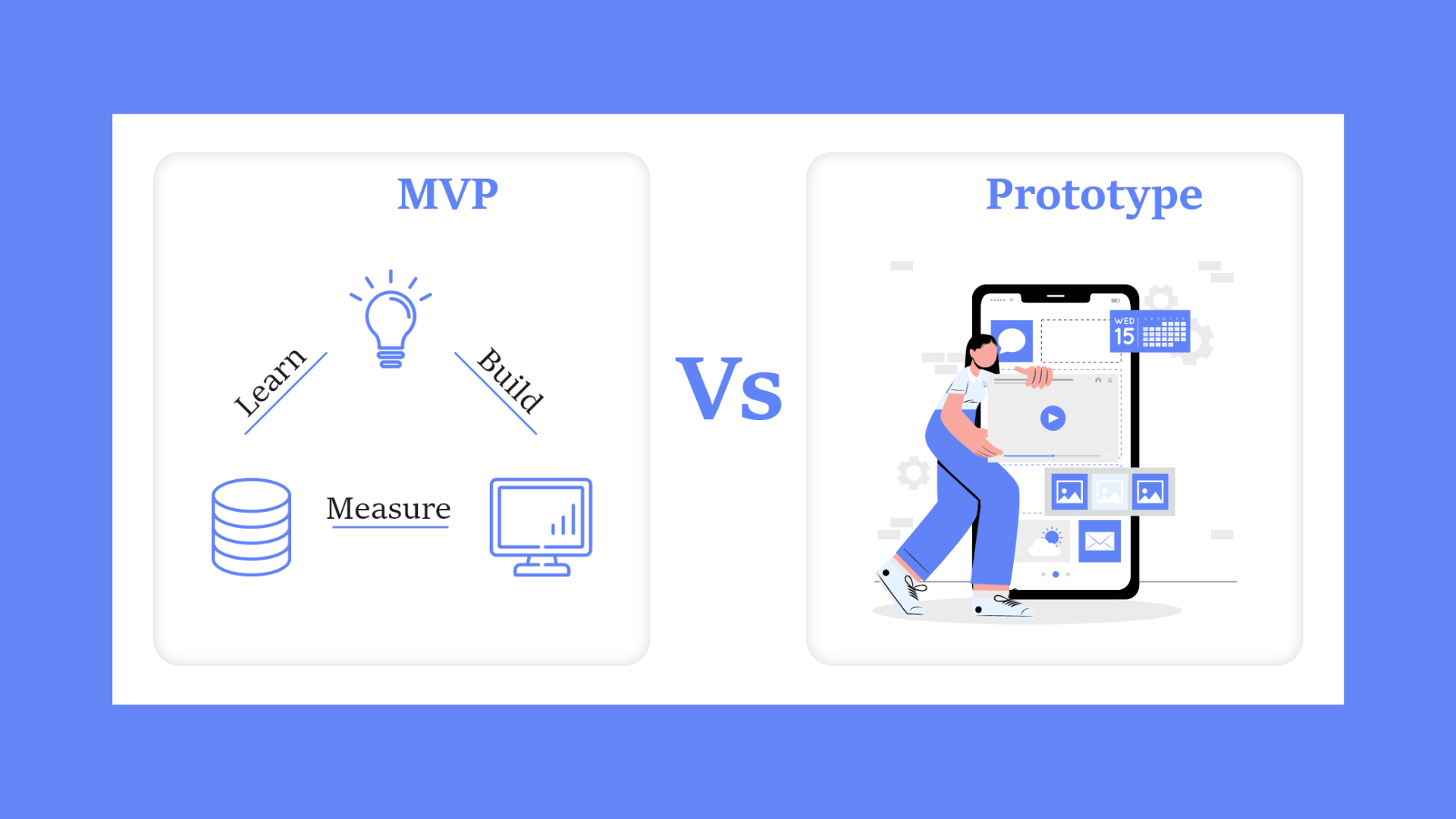

A prototype shows how your idea could work. An MVP shows whether real people will use it, and eventually pay for it. That is the whole difference in one line. A prototype is built to be looked at, tested and often thrown away. An MVP is built to be launched, used and learned from. Most founders who burn through budget in the first year skipped one of the two, or built one while believing it was the other.
This guide separates the two, places proof of concept, beta and pilot alongside them, and gives you a simple way to decide what to build first. We work on this at Raw Studio through our Design Sprint and RapidMVP offers, so we will also show where each stage is easiest to get wrong.
The short answer: two tools for two different risks
Every new product carries risks that are easy to mix up. Can it be built? Can people figure out how to use it? Do they want it enough to switch from what they have now?
A prototype is the cheapest way to answer the second question. Microsoft for Startups describes a prototype as exploratory, intentionally rough and built to be thrown away, the thing you make to ask "can we build this?". It describes an MVP as the earliest version that delivers real value, supports real users and generates real data.
That last phrase matters. An MVP produces data from behavior in the market: sign-ups, repeat use, payments. A prototype produces opinions and observations from a handful of people in a controlled setting. Both are useful. They are not interchangeable.
Prototype vs MVP, side by side
Product School frames the gap as scope, commitment and audience. Prototypes take little effort and can be crumpled up and redone, while an MVP commits resources and is painful to scrap. Prototypes stay mostly internal. An MVP goes to your target market, and that market judges you on it.
Here is how that plays out in practice.
The table hides one nuance. An MVP is not a sloppy product. Atlassian points out that an MVP should be intentionally scoped, stable enough to test and tied to a learning goal. "Minimum" refers to the number of features, not the quality of the ones you include.
What a prototype is good for
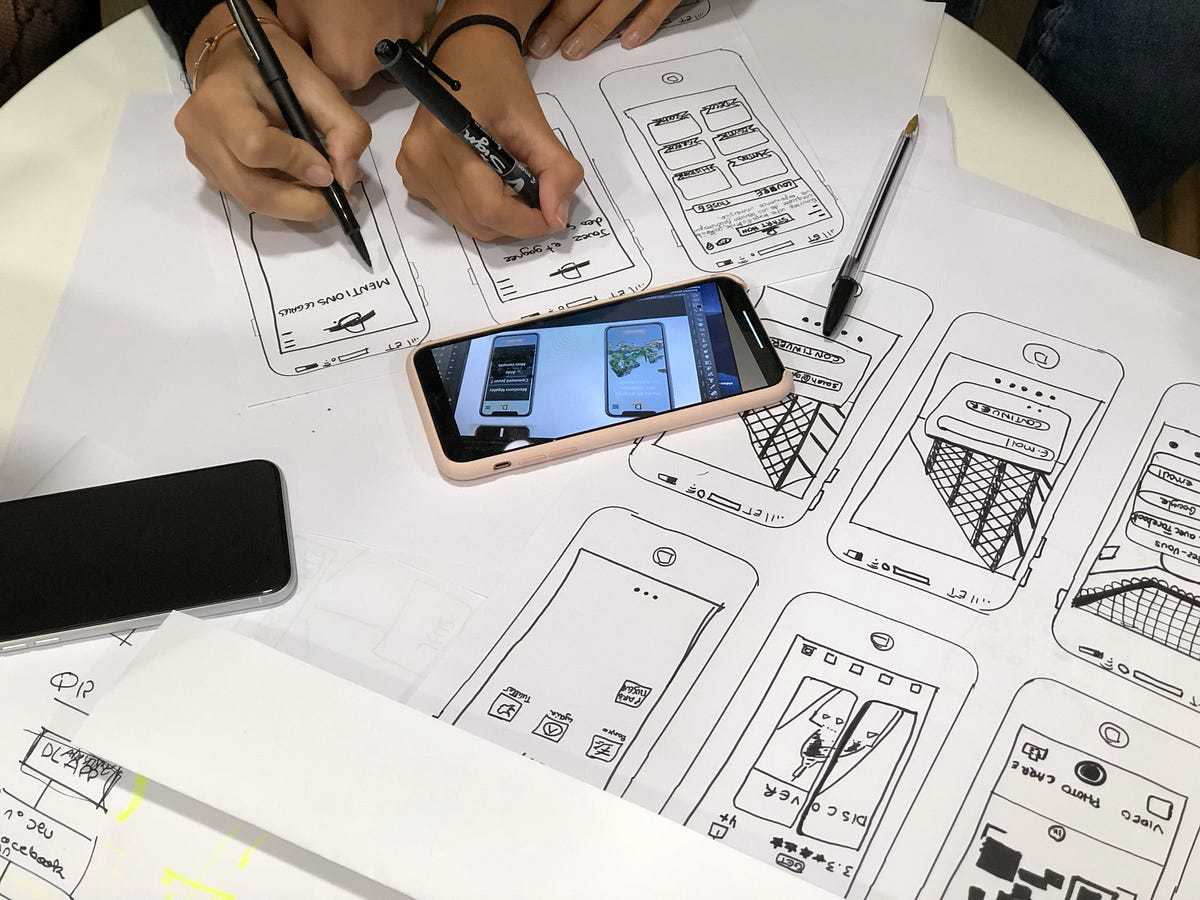
Think of a prototype as a conversation starter you can put in someone's hands. For a digital product it is often a clickable set of screens that looks real but runs on no code at all. Behind it there is no database and no payment processing, just enough illusion for someone to try the journey.
Australia's own business guidance describes the spirit well. business.gov.au tells new product developers to build a basic prototype that demonstrates the main idea rather than a perfect one, to watch potential customers use it, and to try to break it by using it the wrong way.
That last step is where prototypes earn their keep. Watching a stranger get stuck on your onboarding screen costs an afternoon. Discovering it after launch costs months of churn.
A useful prototype test has three parts:
- One flow, not the whole product. Pick the journey that matters most, such as signing up, booking or checking out.
- Five or so real target users. Not friends, not colleagues. People who have the problem you are solving.
- A written question you want answered. For example: "Can a new user find and complete the booking in under two minutes?"
If you want a deeper look at fidelity levels and techniques, our guide to prototyping for startup founders covers sketching through to interactive builds.
What an MVP is good for
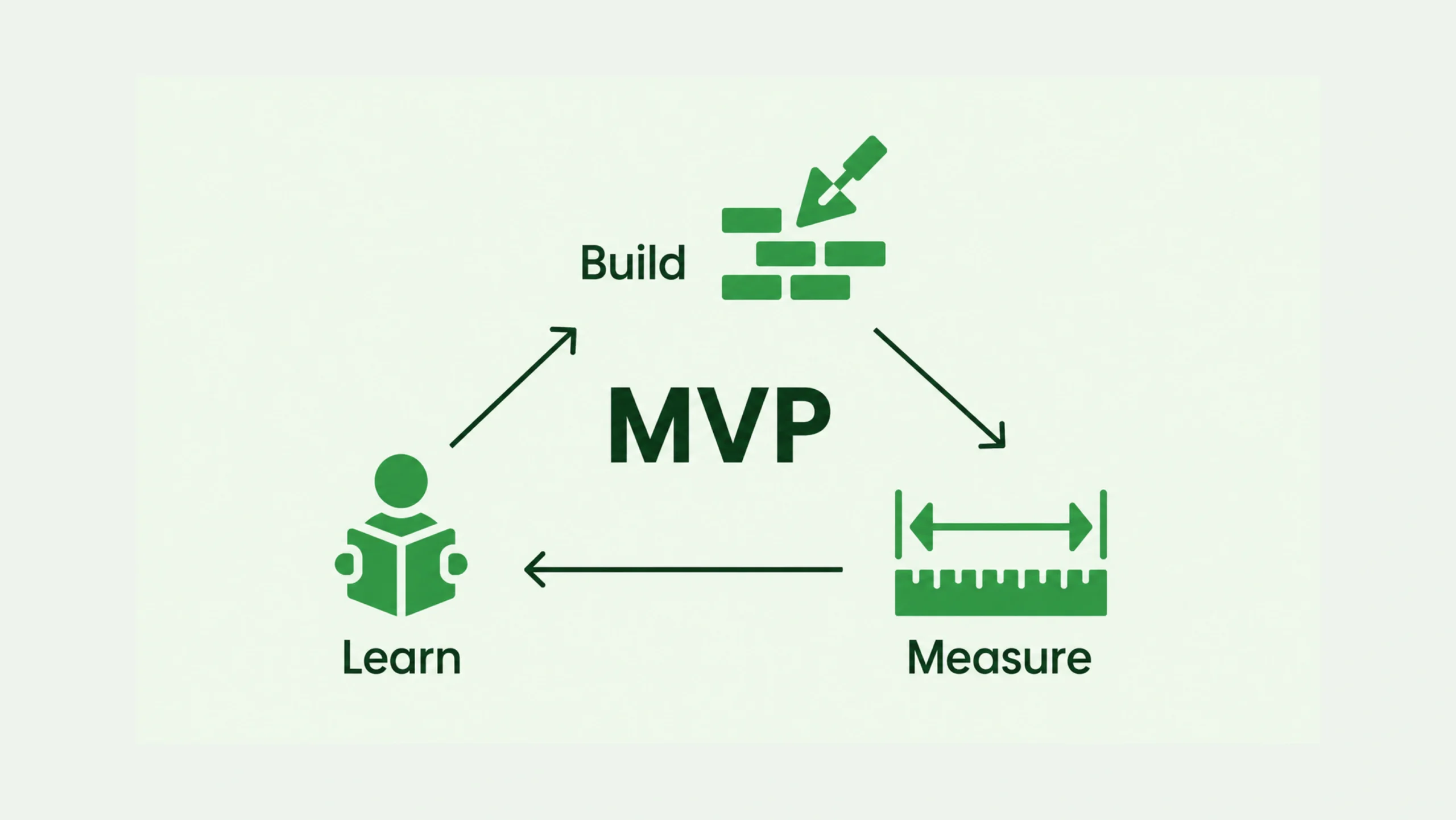
An MVP is how you find out whether the business exists. Microsoft's definition is the smallest thing that works end-to-end: authentication, data flow, the core user journeys and, at minimum, a path to revenue. It argues that treating revenue capability as a baseline changes how you scope everything that follows, and that confusing an MVP with a prototype or a demo leads teams to build the wrong thing or launch something that cannot support users.
The Australian startup scene has a well-known story here. In the 2016 Tech Pioneers report, Envato co-founder Collis Ta'eed estimated that building every bell and whistle without testing multiplied time and cash costs by a factor of four. Shoes of Prey founder Jodie Fox said she had to learn to release imperfect things for testing and to iterate. Neither describes a prototype. They describe putting something real in front of customers early.
An MVP is also where design quality still matters. A narrow product with confusing navigation will fail the demand test for the wrong reason, and you will read the result as "nobody wants this" when the truth is "nobody could work it out". That is why we pair MVP work with research and UX, not just engineering.
If you are weighing a lean build, our walkthrough on building a first MVP with no-code lays out the steps.
Where proof of concept fits
A proof of concept (PoC) is the earliest and narrowest test. It asks whether a core idea is technically possible at all. AneCom puts it as "can this work?" for a PoC, versus "does this work the way we intend it to, in conditions that reflect actual use?" for a prototype. The PoC isolates the one variable the concept depends on. The prototype has to cope with interacting parts and realistic conditions.
The National Inventors Hall of Fame makes the same sequencing point: a PoC proves a basic idea or feature is possible before a prototype is created.
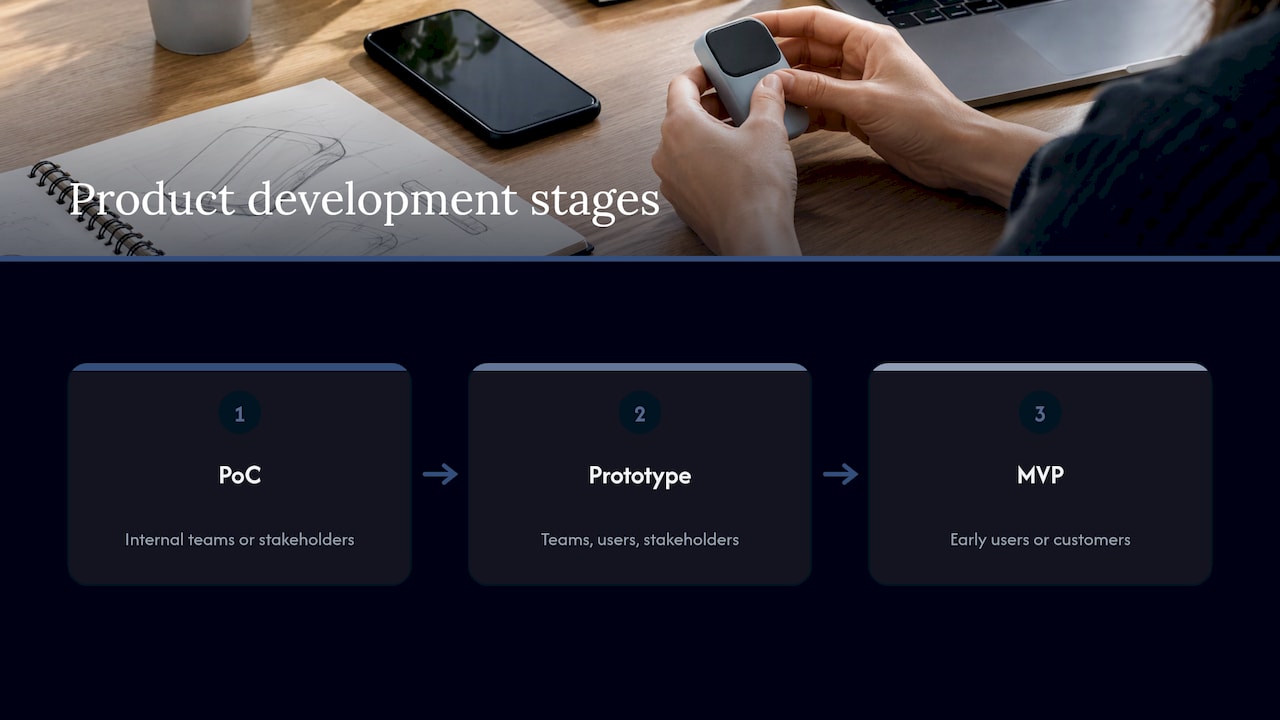
In software, a PoC might be a script that proves two systems can exchange data, or a model that shows an algorithm can reach the accuracy you need. Nobody outside your team needs to see it. Atlassian's comparison lists the audience for a PoC as internal teams or stakeholders, for a prototype as internal teams, users or stakeholders, and for an MVP as early users or customers.
Some ideas skip the PoC because the technology is well understood. A booking tool or a content platform rarely needs one. Others lean on it heavily. Airtasker co-founder Tim Fung explained on the Add to Cart podcast that a marketplace built on network effects could not be validated with a simple landing page, so the founders funded engineers to build a proof of concept themselves before raising capital.
The ladder in one view
You do not need every rung. You need the rung that tests your riskiest assumption.
MVP vs beta: product-market learning vs polish
Founders often say "beta" when they mean "MVP", and the confusion is understandable. Both involve real users and imperfect software. The goal is what differs.
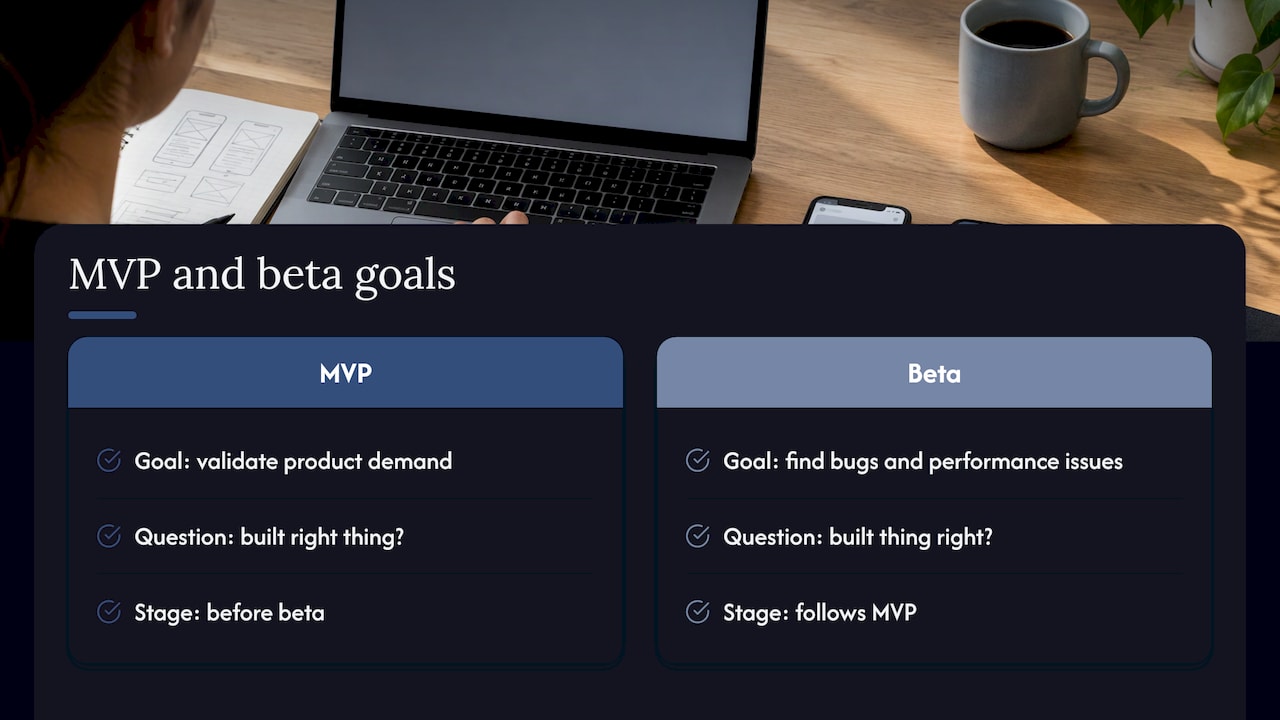
An MVP is about whether you built the right thing. A beta is about whether you built the thing right. A beta release is usually a near-complete product given to a broader group, so you can find bugs and performance problems under real conditions. It follows the MVP, and it assumes the core idea has already been validated.
The Australian Government's Digital Experience Toolkit shows the order clearly. In its process, the Beta stage is where a team builds the minimum viable product defined at the end of Alpha, the simplest thing that meets the user need. It also warns against the temptation to turn the Alpha prototype into a polished version. So even in government delivery, the prototype comes first and the MVP is a fresh build with a clearer scope.
The same toolkit notes that a public beta is open to any member of the public alongside the existing service, sometimes on its own subdomain or sub-directory. Product teams in other fields run staged rollouts the same way, for instance beta testing on testnets before a wider launch, which separates technical shake-out from market validation.
A simple rule: if you are still unsure that anyone wants the product, you are at MVP. If you know they do and you are hunting defects before a wider release, you are at beta.
MVP vs pilot: market test vs operational test
A pilot is a trial run of a solution inside a defined setting: one customer, one team, one region, for a set period. It tests how the solution fits into someone's real operations, including their data, staff, processes and approvals.
The distinction in plain terms:
- MVP: you are testing the idea with the market. Many different users, minimal features, learning about demand.
- Pilot: you are testing the solution with a specific organisation. One customer, a fuller feature set, learning about integration, adoption and results against agreed measures.
Pilots are common in B2B and enterprise sales, where a large customer wants to see the product work in its own environment before signing a wider contract. They usually follow an MVP, because there is little point piloting something nobody has validated. Define success measures before the pilot starts, and agree what happens at the end, such as extension, rollout or stop.
How to decide what to build first
Start from risk, not from the artefact. Ask which assumption, if wrong, would sink the business, then choose the cheapest test that could prove it wrong.
- "We are not sure it can be built." Run a proof of concept on the single hardest technical piece.
- "We are not sure people can use it, or we have several design directions." Build a prototype and test it with five target users. Iterate until the main flow is clear.
- "We believe it is usable but have no proof anyone will pay." Build an MVP, scoped to the one job your customer is hiring it for, with a path to revenue.
- "We have paying users and need stability before scaling." Run a beta.
- "A large customer wants to see it in their environment." Agree a pilot with clear measures.
Two common errors are worth naming. The first is building an MVP when a prototype would have answered the question for a fraction of the cost. The second is the reverse: treating positive prototype feedback as demand. People are polite when shown mockups. Asking someone to sign up, pay or change their routine is a different test.
A worked example
Imagine a founder planning a booking app for independent physiotherapists. The riskiest assumptions are, in order: that clinics will change how they take bookings, that the booking flow is quick enough, and that the calendar sync works. Sync is well-understood technology, so no PoC. The flow question is cheap to settle with a clickable prototype and five clinic owners. After two rounds of changes the flow works. The demand question remains, so the founder builds an MVP: sign-up, a booking page, calendar sync and payment, nothing else, and offers it to twenty clinics. Four months later retention and payment data decide whether to build further. Each artefact answered one question, in order of risk.
Perspective
We think the prototype-versus-MVP debate is usually a question about sequence, not a contest. The prototype is how you find out cheaply whether the idea makes sense to a human being. The MVP is how you find out whether the market agrees. Skipping the first often means an expensive MVP that fails on usability, and skipping the second means a lovely design with no customers.
What we see people underestimate is how much design matters inside an MVP. A minimum product still needs a clear journey, a coherent brand and a way to measure what users do. That is why our Design Sprint and RapidMVP offers sit side by side: the sprint settles the design questions fast, and the MVP puts the validated direction in front of real users, with research and data guiding each decision.
If you are at the stage where the idea is clear but the evidence is not, that is exactly where we like to work.
Getting help with the right first step
If you are deciding between a prototype and an MVP, we can help you scope the one that answers your biggest question. Our pricing page lists our Design Sprint and RapidMVP offers alongside Idea to Vision, a Full UX/CRO Audit from $2,500 one-off and the Design Team (Platinum) plan at $8,400 per month, for teams that want ongoing design support after launch.
If you already have a live product and want to see where users get stuck, you can also request a free UX audit.
Do I need a prototype before building an MVP?
Usually it helps, because a prototype settles flow and design questions at a fraction of the cost of code. If your idea involves a simple, familiar interaction and you already have strong user evidence, you can go straight to an MVP. When in doubt, test the design first.
Sources
- 2016 Tech Pioneers report, Australia and New Zealand
- What Is a Minimum Viable Product?, Atlassian
- The Difference: Prototype vs MVP, Product School
- What Is a Minimum Viable Product (MVP)?, Microsoft for Startups
- Prototype vs proof of concept, AneCom
- What is a Prototype?, National Inventors Hall of Fame
- The Airtasker Story, Add to Cart
- Beta stage, Digital Experience Toolkit, Australian Government
- Develop a new product, business.gov.au
- Primex Finance Beta 0.3.0 on new testnets
Recommended