


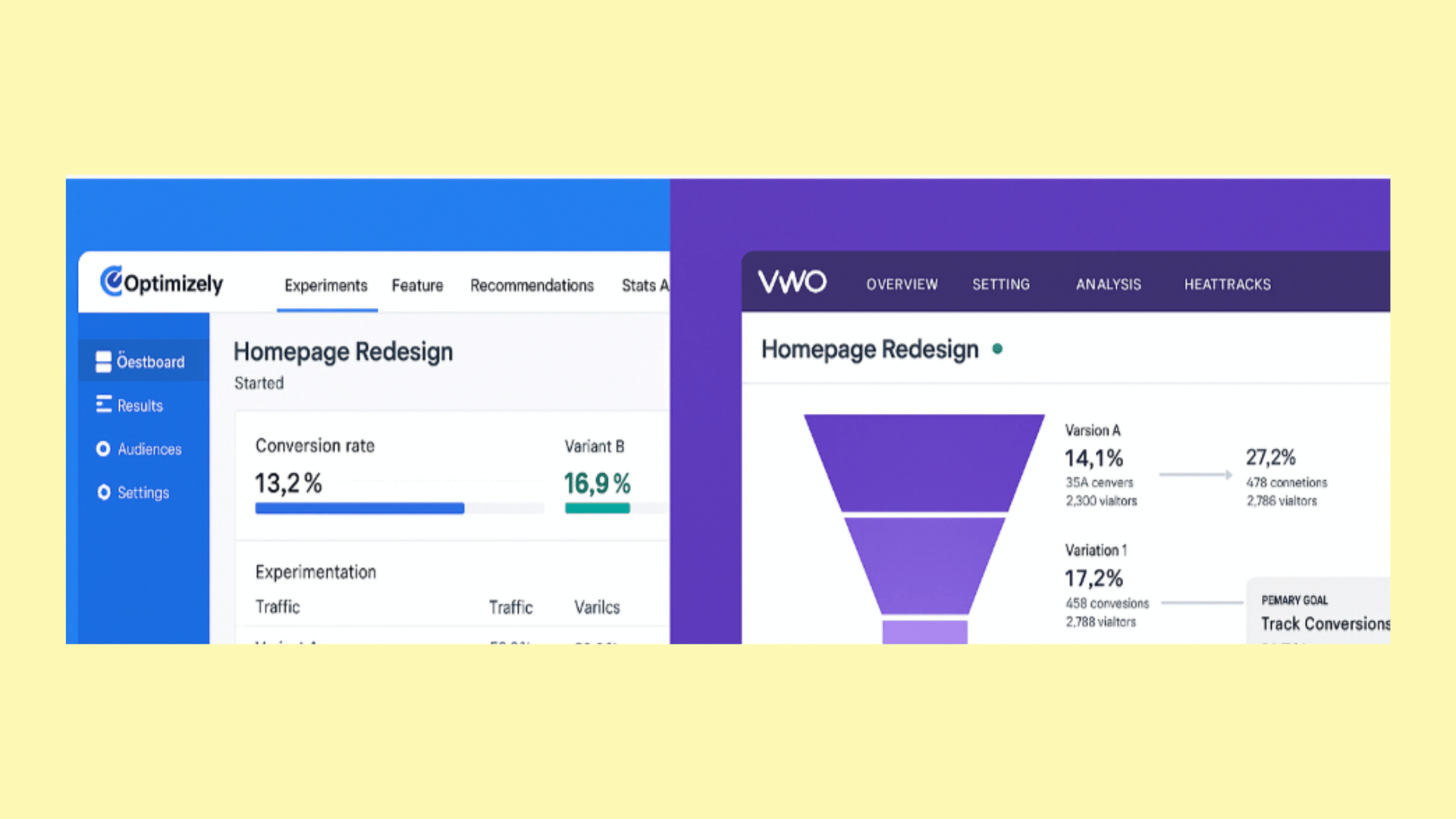

Compare Optimizely and VWO around the exact product, deployment surface and people who will run experiments. Both have capabilities beyond a simple marketing-versus-engineering split. VWO and AB Tasty now sit under the Wingify brand, so check the current offering rather than relying on an older feature or price comparison.
We're a Sydney design and conversion agency, so we see both tools from the side of the people who use them to ship real tests. Below is how they differ in practice, where each one hurts, and how to choose without burning a quarter on the wrong contract.
The short version: two tools built for different teams
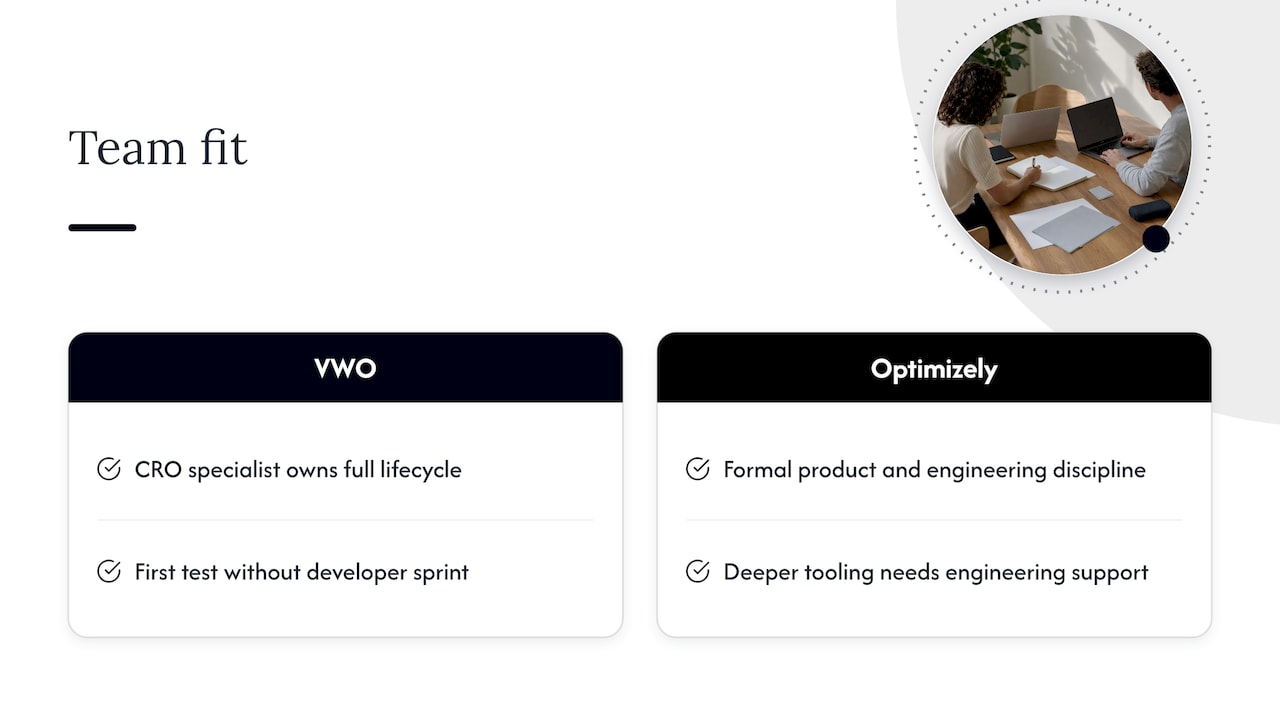
Both platforms support experimentation, but web testing, feature delivery, behavioural research and governance may be packaged separately. Treat ownership as a starting point: identify who builds variants, validates instrumentation, interprets results and ships the decision.
A marketer may prefer a visual-editor workflow, while an engineer may need SDK-based assignment and rollout. Test those workflows on your application: neither vendor name guarantees a developer-free launch or a particular implementation time.
Side-by-side comparison
Use this as an evaluation checklist, not a universal ranking. Verify the product, module, plan and current contract against your requirements.
Feature packaging changes. Ask each vendor to demonstrate the required workflow and identify which capabilities are included in the proposed contract.
Statistics: how each tool tells you a test has won
This is the most underrated difference, and it changes how your team behaves.
Optimizely's sequential Stats Engine addresses repeated looks under its statistical procedure. Current Feature Experimentation documentation also describes fixed-horizon and Bayesian options. Confirm the engine available in your product and configuration; sequential analysis does not remove the need to plan detectable effects, traffic, conversion delays and decision criteria.
VWO's SmartStats has used Bayesian reporting, including the probability that a variation beats a baseline. Verify the current engine, assumptions and decision thresholds in your Wingify account. A probability depends on the model and observed data; it is not a guarantee of future lift.
What this means in practice
- Match the stopping rule to the method. Fixed-horizon, sequential and Bayesian decisions have different assumptions.
- Plan meaningful effects and guardrails. A readable dashboard does not make a test adequately informative.
- Check data quality. Validate assignment, exposure, metric definitions and unexpected sample-ratio differences before interpreting lift.
No engine rescues a weak hypothesis or faulty measurement. Feasibility depends on baseline rate, effect size, traffic, assignment unit and observation period, not a universal monthly-visitor cutoff.
Features: where each platform pulls ahead
Optimizely
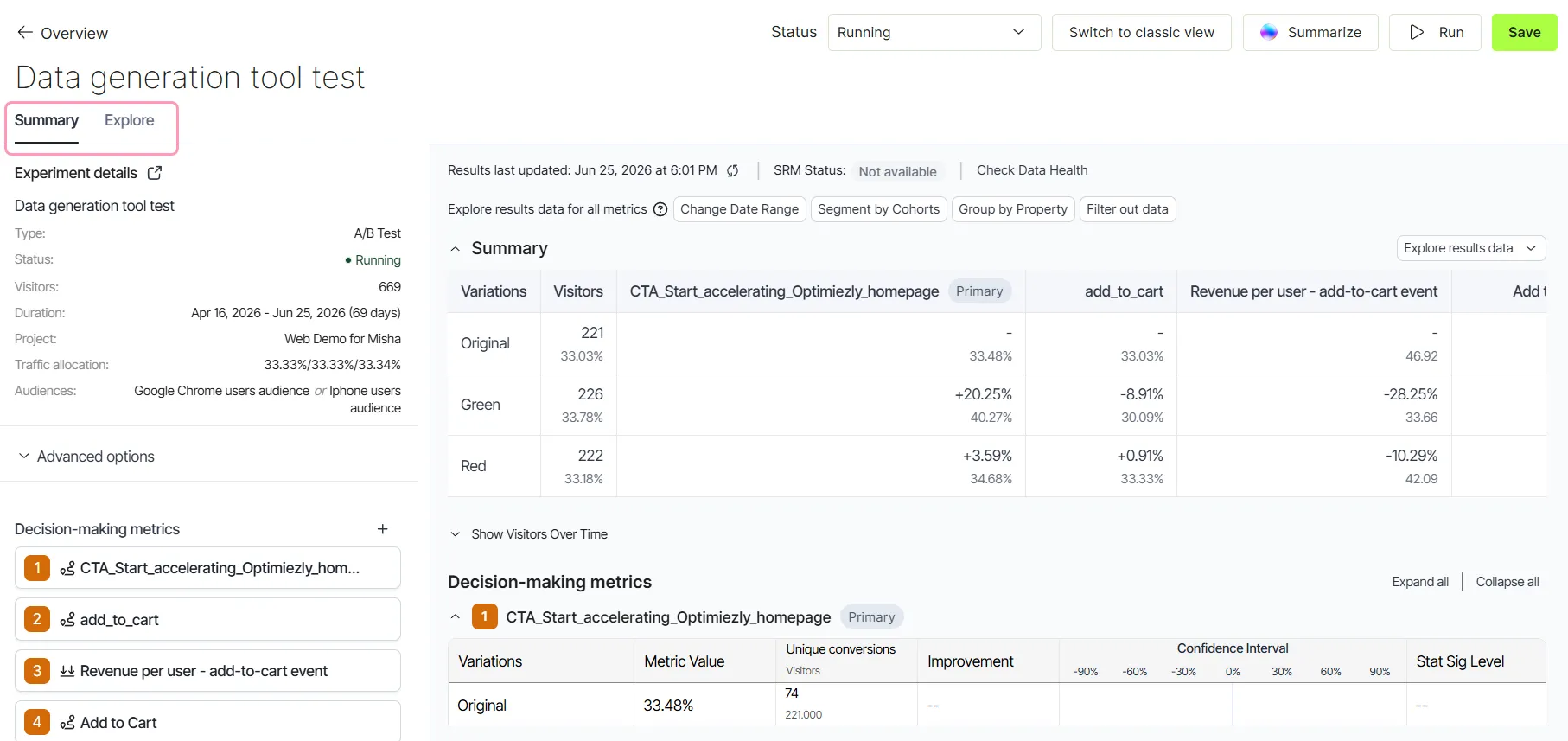
Optimizely's strength is depth. Its Feature Experimentation product is a feature flagging and experimentation platform covering websites, mobile apps, APIs and other connected surfaces. If you want to roll out a new checkout to 5% of users, measure it, and ramp it up without a redeploy, this is the sort of workflow it exists for.
It also fits organizations that need approval workflows, multiple projects and tight governance across many teams.
VWO
The current Wingify offering lists experimentation, behavioural analytics and feature-management capabilities. Confirm the modules, limits, SDKs and integrations in your proposal rather than assuming all research and testing features share one subscription.
For a lean team, that loop is the real feature. Fewer tools means fewer integrations to maintain and faster ideas-to-test cycles.
What each one costs
Neither vendor makes pricing simple, so budget with ranges and get written quotes.
VWO / Wingify: request current pricing for the required modules, traffic definition, usage limits, retention and support. Do not use legacy third-party Starter, Growth or Pro figures as a current quote.
Optimizely: use the official plans page and a written proposal specifying products, traffic or usage, seats, support and contract terms. Compare like-for-like scope rather than an estimated enterprise floor.
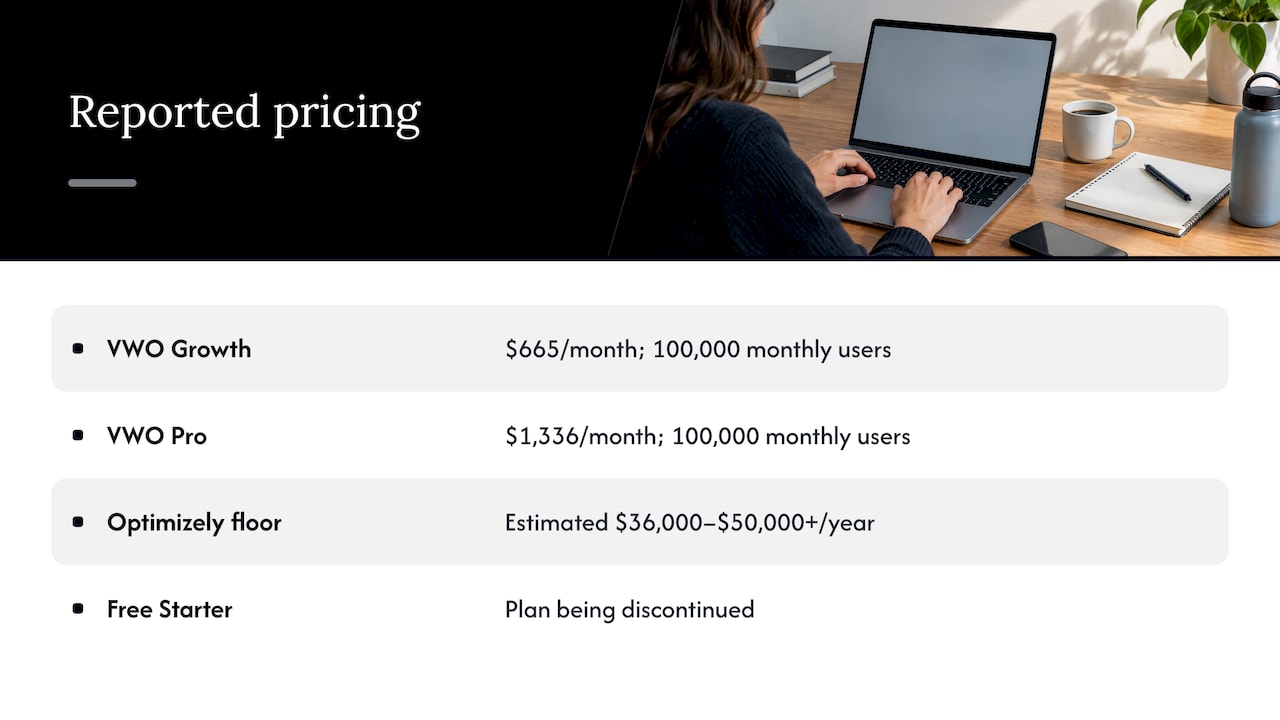
A price comparison is useful only when the scope matches. Include implementation, QA, analysis, training and renewal terms alongside the licence.
The hidden costs people forget
- Developer time. Deeper tools need more engineering hours to implement and maintain.
- Design and copy. Every test needs a variation someone has to design well.
- Analytics add-ons. If the platform lacks session recordings, you buy another tool.
- Traffic. Cheap software does not create sample size. Low-traffic sites should test bigger, bolder changes and lean on qualitative research.

A change worth knowing about: VWO and AB Tasty
Wingify announced its unified brand in September 2026 following the VWO and AB Tasty combination. Ask how your existing or proposed product, support, migration and contract terms map to the combined platform; a brand announcement does not by itself settle each customer's roadmap.
Also remember that vendor comparison pages, including the ones each company publishes about the other, are marketing. Use them to build your question list, not to decide.
Which one fits your team?
Choose Optimizely when
- Engineers or product managers own experimentation and want feature flags tied to releases.
- You run tests across web, mobile and backend services.
- Governance, approvals and audit trails matter, for example in finance or health.
- You have the budget and the traffic to justify an enterprise contract.
Choose VWO when
- A CRO specialist or marketing team runs the program day to day.
- You want heatmaps, recordings and surveys feeding your test ideas.
- You need to be live in weeks, not quarters.
- Your budget sits closer to a monthly SaaS subscription than an enterprise license.
Consider neither yet when
- Your site gets only a few thousand visits a month. Qualitative research, usability testing and fixing obvious friction will move the needle faster than a testing platform.
- You have no backlog of well-researched hypotheses.
A useful sanity check is our own guide on how to run A/B tests as a founder, which covers sample size, prioritization and what to test first.
Questions to ask before you sign
- How is pricing calculated, and what happens when traffic spikes?
- What is the contract term, and what are the renewal uplifts?
- Which features in the demo sit in higher tiers?
- What is the measured impact on page speed? Ask for numbers on your stack.
- How does it handle consent and privacy under Australian requirements and the markets you sell into?
- Who handles implementation, and how long until the first test is live?
- Can we export raw data to our warehouse?
Run a trial on one real page with one real hypothesis. Compare how long it took to launch, how readable the results were and how your team felt using it.
Our perspective: the tool is the smaller decision
We get asked about this pairing often, usually by someone who has been told to "get a testing tool" and wants the answer by Friday. Here is what we have learned working on conversion projects.
The platform is the cheapest part of a CRO program to change and the least likely to be why results stall. What stalls programs is a thin research base, test ideas picked by opinion, designs that change one pixel when the problem is the whole value proposition, and nobody owning the backlog. We would rather see a team run six well-researched tests in VWO than two tests a quarter in an enterprise platform nobody has time to configure.
So we start before the software: user research, funnel analysis and a UX and CRO audit to find where visitors actually drop off. Then we pick the tool that matches the team, not the other way around. Sometimes that is VWO, sometimes it is Optimizely, and sometimes it is a lighter option because the traffic does not justify either. If you want a wider view of the market, our complete guide to conversion rate optimisation tools goes beyond these two.
One more thing: a winning test is only a win if the design behind it is good. Data tells you where the leak is. Design, copy and research decide how to fix it. That pairing is the whole reason we work the way we do.
Getting more from whichever tool you choose
A few habits matter more than any feature list:
- Start with research. Use recordings, surveys and analytics to find friction, then write hypotheses. Our post on diagnosing your top page in 30 to 90 days shows one way to do it.
- Map the funnel first. A funnel analysis tells you which step deserves your first test.
- Prioritize by impact and effort. Score every idea so the loudest opinion does not win.
- Document every result, including the losers. Losing tests are where your best insights come from.
- Read the practical tips. This is a handy companion for building a steady test cadence.
Need help running the program?
Our Full UX/CRO Audit starts from $3,500 plus GST as a one-off, and the UX/UI Design Team starts from $8,400 per month plus GST. Confirm scope and current options on our pricing page, or explore our conversion rate optimisation service.