



Segment and RudderStack both collect, govern and route customer events. Segment offers managed collection, profiles and activation; RudderStack emphasises warehouse-native modelling and activation, with managed services and a self-hosted data-plane option. Both need implementation and governance. Choose by your required integrations, data architecture, team capacity and operating cost rather than a simple marketing-versus-engineering divide.
We are a design and conversion agency in Sydney, not a CDP vendor, so we have no horse in this race. But we see the consequences of tracking choices in almost every conversion project: a messy event schema quietly ruins good UX research. That is the lens here.
What each tool actually does
Both products solve the same plumbing problem. Your website, app and backend produce events (page views, sign-ups, purchases). Your analytics, advertising, email and support tools all want those events, each in a slightly different format. Without a CDP, you wire every connection by hand. With one, you collect once and route everywhere.
Segment
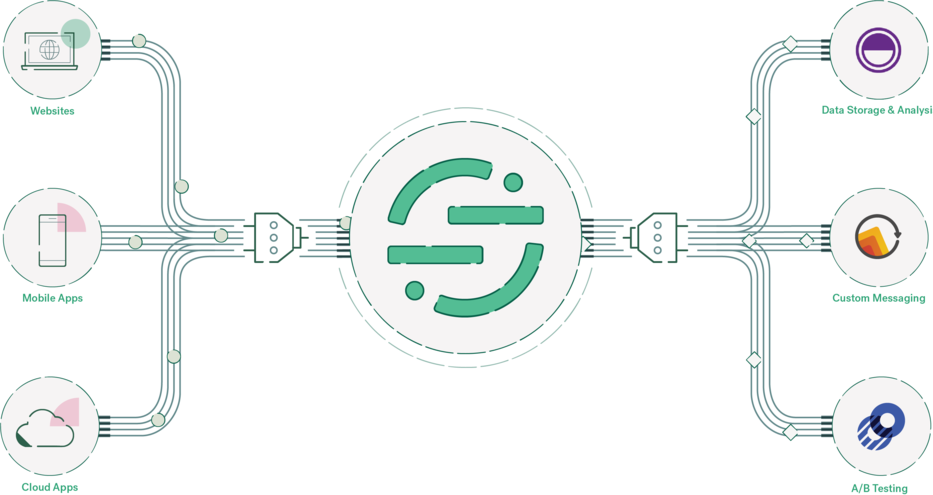
Segment is now part of Twilio, and its site notes that it is moving to Twilio.com while products, services and documentation stay available and supported. It collects first-party data from every touchpoint and activates it to a warehouse or 550+ destinations. Twilio's documentation describes the core service as a pipeline: capture data from sources, govern it with schemas, resolve identities and activate it through downstream tools. The pitch is that you do not build each integration yourself.
Map what each configured service processes, stores and forwards. Segment supports managed event storage and profiles as well as warehouse delivery. RudderStack's warehouse-native positioning does not mean no data is ever buffered, logged or processed outside your warehouse. Review retention, failure queues, backups and control-plane metadata for the exact deployment.
RudderStack
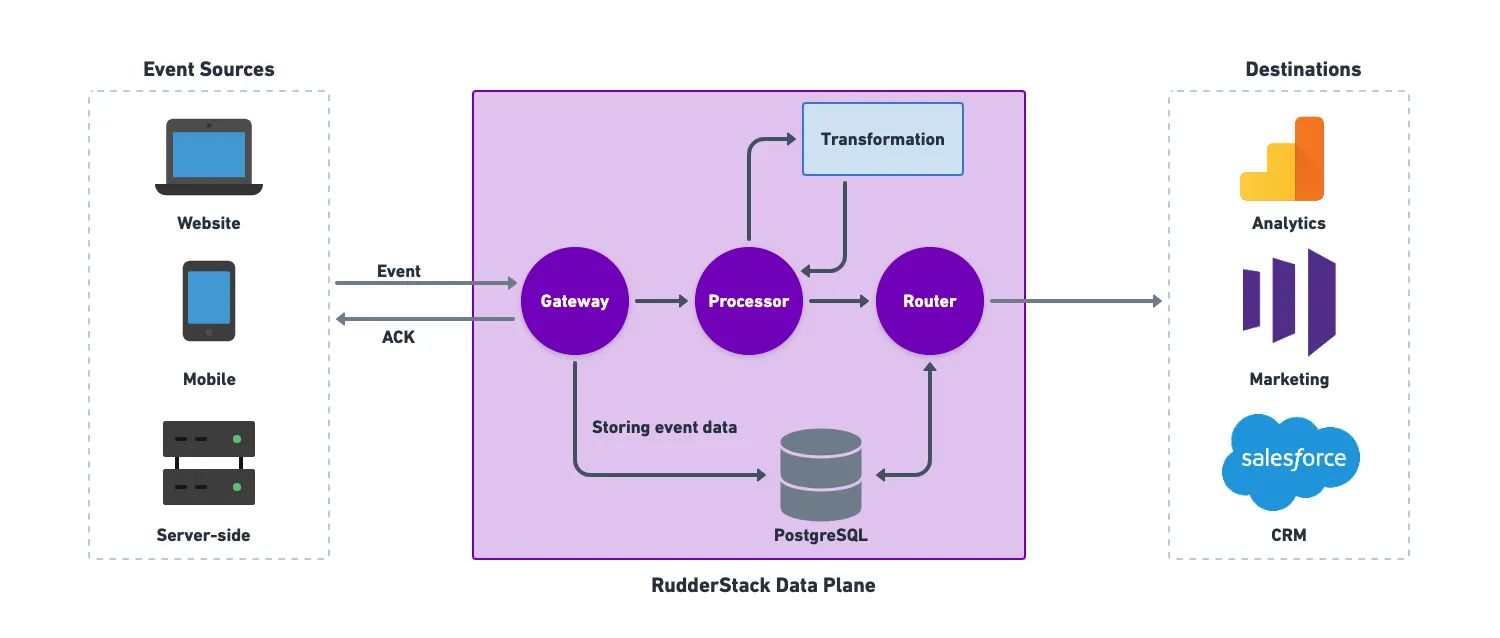
RudderStack offers event collection and routing alongside warehouse-based modelling and activation. Its documentation describes SDK and cloud sources, transformations, governance and downstream delivery. Feature access depends on the product, plan and deployment.
RudderStack's deployment comparison distinguishes managed hosting from a self-hosted data plane using its managed control plane. The latter does not provide all managed features. Review the licence of each repository and component; a product labelled "Open Source" should not be assumed to have a permissive licence or full feature parity.
A quick note on ownership
For procurement, confirm the contracting entity, ownership disclosures and subprocessors in current vendor documentation. Segment is a Twilio product. Corporate ownership alone does not establish hosting location, access rights or security.
Side-by-side comparison
Connector counts are not an equal measure of coverage. Check each required destination, supported actions, delivery mode, region and maintenance status, then test real payloads.
Features and integrations in practice
Destination catalog
Both vendors maintain destination catalogs. Match your actual analytics, advertising, messaging and support tools against each catalog. A connector name does not guarantee support for every event or API version. Custom webhooks or warehouse-based activation can fill some gaps, but add implementation and maintenance work.
Collection and SDKs
Check SDK support against your web, mobile and backend environments. Similar identify, track and page APIs can reduce migration work, but do not guarantee identical behaviour. Test identities, consent flags, timestamps, retries, deduplication and destination mappings before repointing production sources.
Warehouse timing
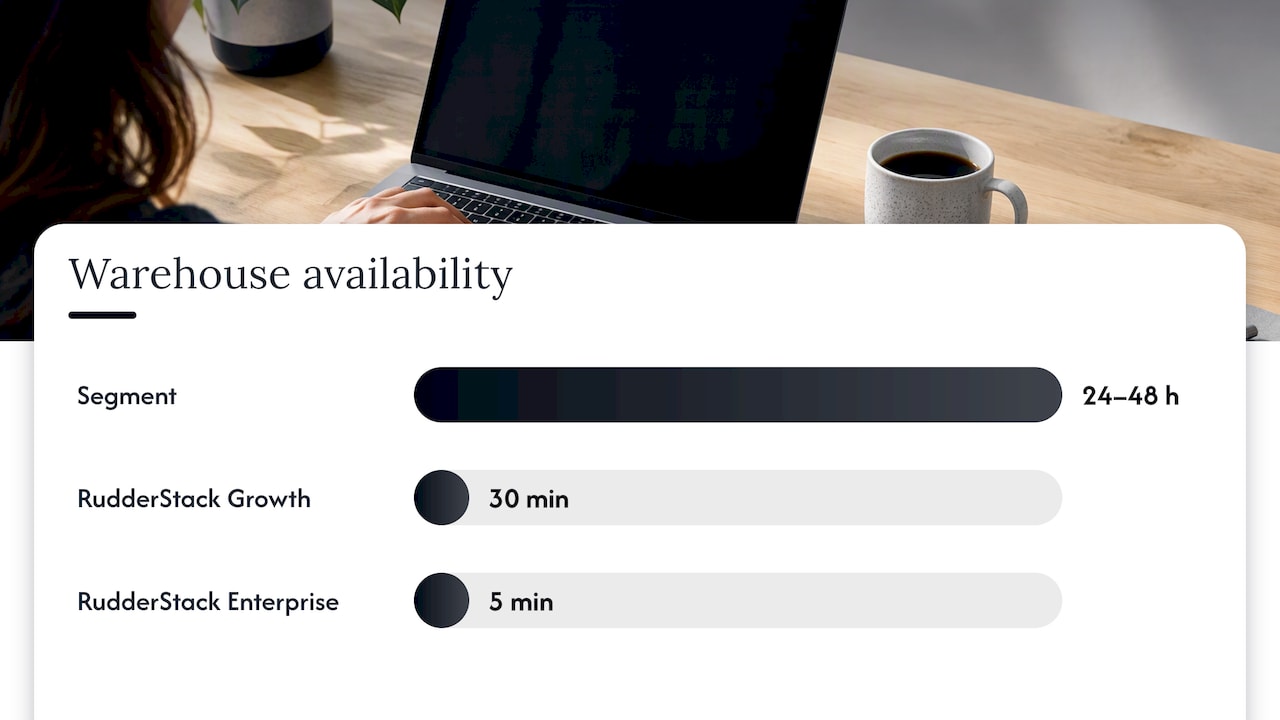
Warehouse sync frequency and end-to-end availability are different measurements. RudderStack's current plan page lists three-hour syncs on Free, 30 minutes on Growth and five minutes on Enterprise; these are not guaranteed end-to-end latencies. For Segment, check the selected warehouse connector, plan, initial load and scheduled sync settings. Measure freshness with representative traffic instead of treating 24-48 hours as a universal comparison.
Audiences for non-technical teams
Trial audience creation with the people who will operate it. Segment has audience and journey products; RudderStack offers warehouse-based activation and plan-dependent Profiles and Data Apps. Confirm who builds models, manages permissions and publishes audiences, and which separately priced capabilities are needed.
What they cost
Compare a current quote for the same workload and required products. Segment has historically used monthly tracked users for parts of its offering; billing can vary by product and contract. RudderStack's published Event Stream plans use event allowances. Do not assume one billing unit describes the entire platform.
RudderStack's pricing page lists three tiers:
Pricing checked on 28 October 2026. RudderStack displays Growth at $265 per month for one million events per month, with an annual-billing discount option. Confirm currency, taxes, billing commitment, overages and add-ons. See Twilio's current customer-data pricing for Segment products and a workload-specific quote.
Why the pricing model changes your bill
Think about two businesses. A consumer app with a huge number of casual visitors who each trigger a few events has a high MTU count and low events per user. A B2B SaaS product with a few thousand power users firing hundreds of events each has few MTUs and many events. The first may find MTU pricing expensive, and the second may find event pricing expensive. Model your own traffic: count monthly unique visitors (anonymous ones included) and monthly events, then price both.
Include warehouse storage and compute, integration work, operations, observability, support and migration. Managed services still need instrumentation and ownership, while self-hosting adds infrastructure, updates, incident response and security responsibilities. Neither architecture guarantees a lower total bill.
Privacy, governance and Australian compliance
This is the section most comparison pages skip, and for an Australian business it is often the deciding one.
For organisations covered by the Australian Privacy Principles, APP 8 generally requires reasonable steps before disclosing personal information to an overseas recipient, subject to exceptions. The OAIC distinguishes use from disclosure: offshore routing or contracted storage does not automatically constitute disclosure in every circumstance. Assess effective control, access, contracts and downstream handling for your actual design.
How the two tools line up:
- Where data lives. Map collection endpoints, processing, warehouse storage, queues, logs, backups and subprocessors for either vendor. Choosing an Australian warehouse alone does not establish that all handling occurs in Australia.
- Regions. Confirm current regions and feature-specific restrictions in the contract. Do not rely on a 2022 comparison to establish residency or support access.
- Retention. Review Segment's retention policy and the applicable RudderStack settings. Distinguish event archives, profiles, logs and backups, and test deletion propagation through destinations.
- Consent. Verify consent enforcement for each source, destination and delivery mode. Plan gates, implementation and downstream behaviour matter; a consent feature does not make the whole pipeline compliant automatically.
Assess downstream recipients and subprocessors too. Coverage of APP 8 depends on the entities and handling involved; map the full chain rather than labelling every offshore hop a disclosure automatically.
If your data includes health or financial information, talk to a privacy lawyer or your internal privacy officer before you finalise the architecture. This is not legal advice.
When to choose which
Choose Segment when its managed services, integrations and activation workflow match your needs and quote. Choose RudderStack when warehouse-centred modelling and routing fit your architecture and team. Neither is exclusively for one department, and neither removes the need for an accountable technical owner.
Choose Segment if:
- Your marketers, not your engineers, will own day-to-day routing.
- You use many third-party tools, some of them niche.
- You have no warehouse yet and do not want to build one first.
- You can budget for the higher tiers where governance features sit.
Choose RudderStack if:
- You already have Snowflake, BigQuery, Redshift or a lake, and a team that lives in it.
- You want the warehouse to be the source of truth, with Reverse ETL pushing data out.
- You have evaluated the self-hosted data-plane option, licence, managed-control-plane dependency and operational responsibilities.
- Your measured event volume, required features and warehouse costs fit the quote and its allowance and overage rules.
Vendor comparison material describes a sales position. Require evidence for cost, security and latency claims in your workload, and compare contracts and implementation effort before choosing.
Our perspective: the pipeline is not the product
Here is what we see from the design side. Teams spend weeks debating Segment versus RudderStack and then send events named "click1", "click2" and "button_new". Two years later nobody trusts the funnel report, and every conversion test starts with an argument about the data.
The tool matters less than three habits:
- Write the tracking plan before you pick the tool. List the ten to fifteen events that map to real decisions: sign-up started, sign-up completed, plan viewed, checkout started. Name them once, consistently.
- Tie events to questions. Every event should answer something a designer or marketer will actually ask. If it does not, do not collect it. It adds cost and privacy exposure.
- Pair numbers with people. Event data tells you where users drop. It does not tell you why. We pair analytics with user research and testing so a drop-off becomes a hypothesis you can test.
Our rule of thumb is to choose the architecture your team can operate well. A warehouse and data engineer can make warehouse-native activation practical; managed workflows may reduce some operational work. Compare the total implementation rather than promising a lighter bill at scale. Our notes on research-first personas explain how to connect behavioural data with user understanding.
Where we can help
Our Data Intelligence work helps teams decide what to measure, and our Conversion Rate Optimisation service helps turn findings into tests. The Full UX/CRO Audit starts from $3,500 plus GST as a one-off; the UX/UI Design Team starts from $8,400 per month plus GST. Confirm current scope and inclusions.
A practical way to decide in one week
Use this as an initial one-week shortlist exercise, not a guaranteed procurement or migration deadline. Complex security, legal or integration requirements may need a longer evaluation.
- Day 1: List every tool that must receive data, and tick each against both destination catalogs.
- Day 2: Pull last month's unique visitors and event counts. Price both models.
- Day 3: Ask your privacy lead where the data may be stored and which overseas recipients are involved, with APP 8 in mind.
- Day 4 and 5: Run RudderStack's free tier or a Segment trial with one real source, such as your marketing site, and send events to one real destination.
- Day 6: Check that the events match your tracking plan and that your analyst can query them.
- Day 7: Decide, and write down why. You will want that note when the contract renews.
If you are mid-migration, the shared API vocabulary means you can often run both side by side while you move sources one at a time.