



Choose React if you want the largest ecosystem and the deepest hiring pool. Choose Vue if you want a gentler learning curve, official defaults and a smaller starting bundle. Both are fast enough that raw speed rarely decides the matter. Your team’s skills, your hiring plans and how much structure you want out of the box usually do.
The rest of this article shows the evidence behind that answer: what differs, what the benchmarks show, how the ecosystems compare, and how to decide for your product.
What actually separates React and Vue
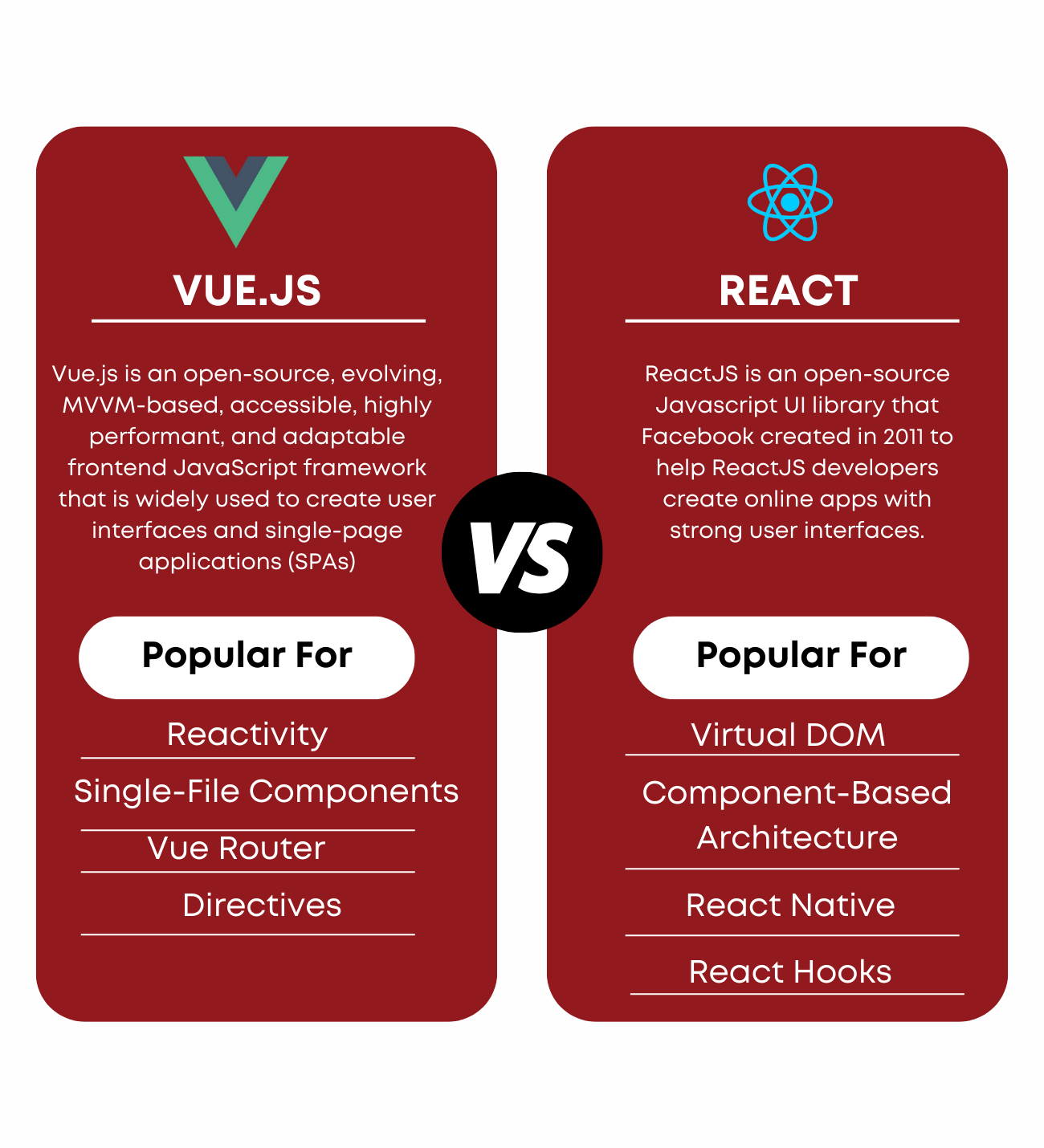
React describes itself as a library for building user interfaces. Vue calls itself a progressive framework. Hostinger’s Australian tutorial puts React forward for interactive sites and apps where content changes often, such as dashboards, social platforms or e-commerce. It suggests Vue for small to medium projects or for adding interactivity to an existing site.
The day-to-day difference is in how you write components. Vercel’s 2026 comparison describes Vue 3 as using HTML templates and React 19 as using JSX embedded in JavaScript. If your team is comfortable treating the view as JavaScript, JSX feels natural. If your people come from HTML and CSS, Vue’s templates and single-file components feel like home.
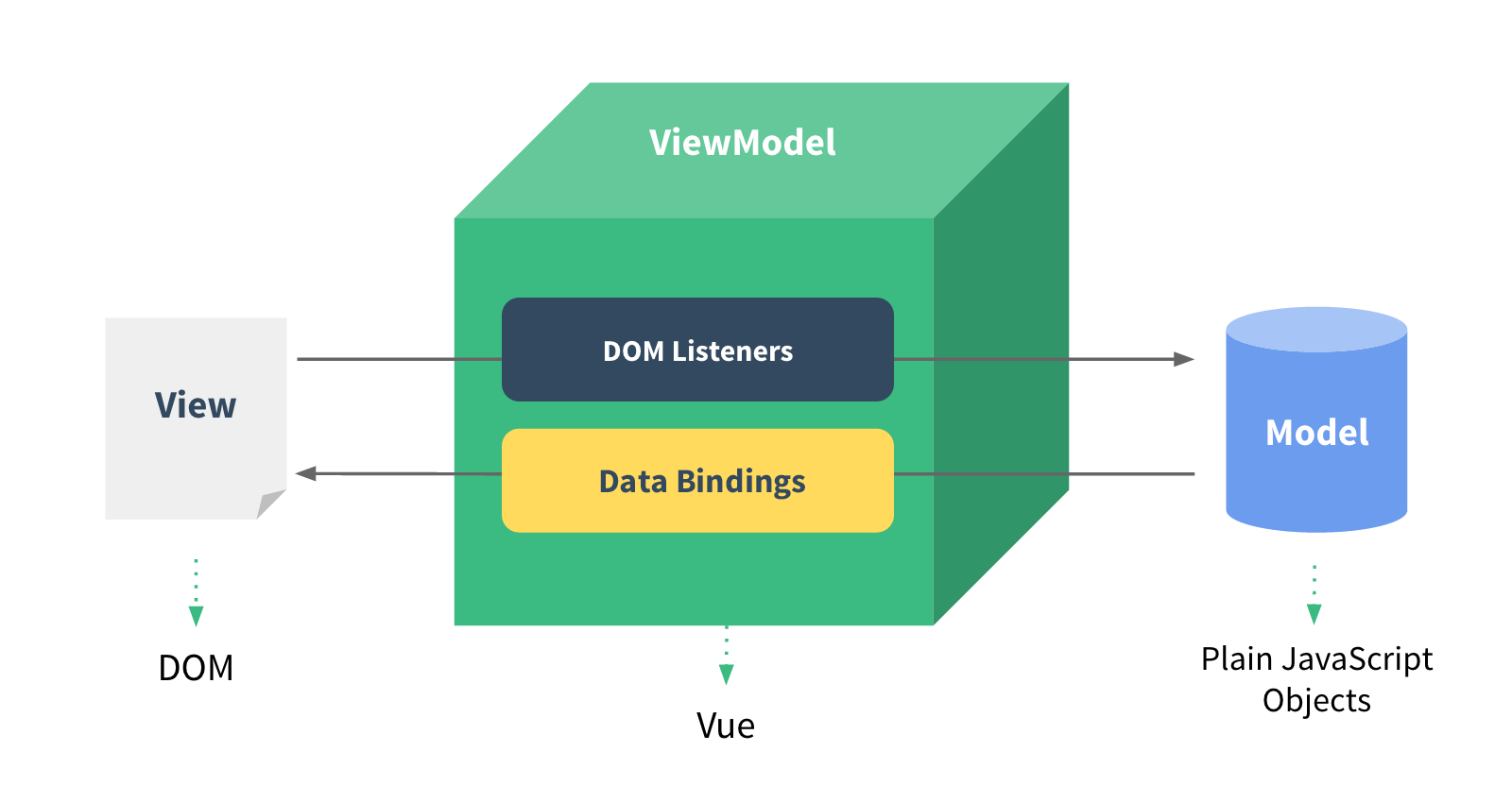
The similarities matter just as much. Vue’s official comparison says both projects provide reactive, composable view components and leave routing and global state to companion libraries. MDN notes that both use a virtual-DOM model, though their diffing and rendering logic is not identical. A developer who knows one can learn the other in weeks, not months.
The state-management row and the meta-framework row come from Vercel’s comparison.
Performance: what the benchmarks show
The question “which is faster?” gets a confident answer on a lot of blogs. The evidence is less tidy.
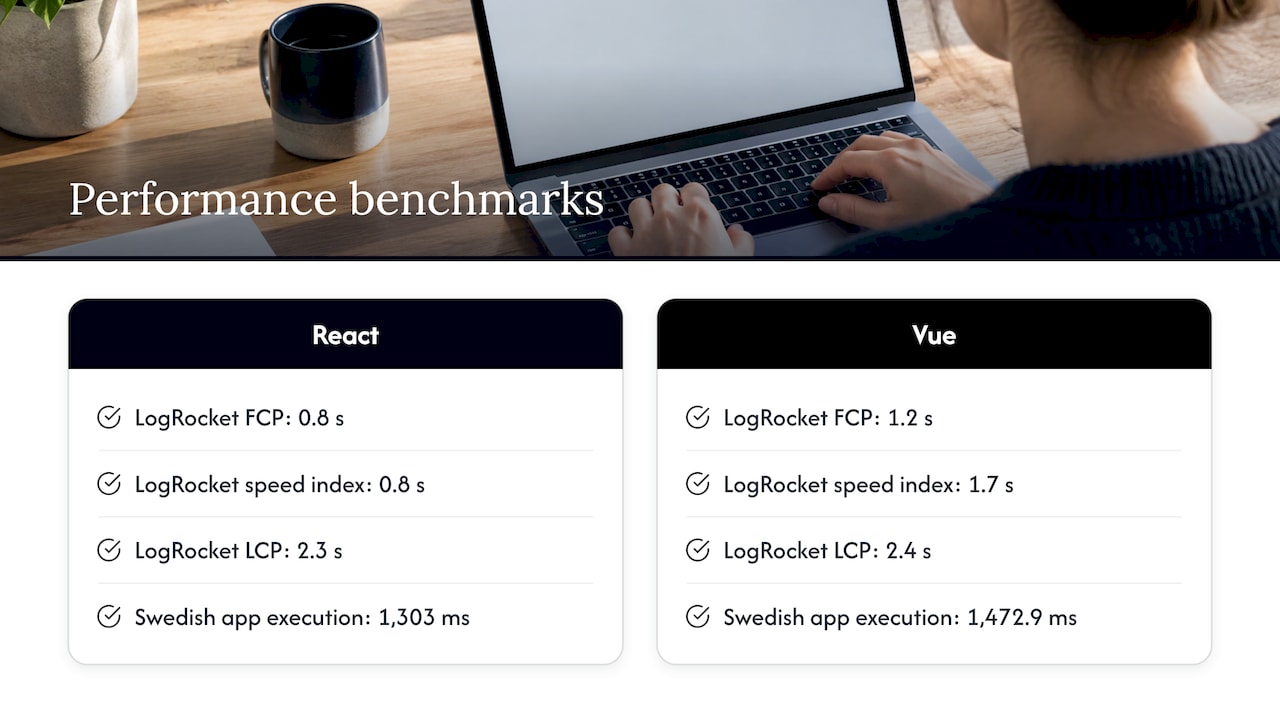
Tests that favor React. LogRocket’s December 2025 landing-page test measured React’s first contentful paint at 0.8 seconds against 1.2 seconds for Vue. React’s speed index was 0.8 seconds against 1.7. Largest contentful paint was almost level: 2.3 seconds for React and 2.4 for Vue. A Swedish thesis comparing small beginner apps measured React’s total execution at 1,303 ms and Vue’s at 1,472.9 ms. React was faster in loading, scripting and rendering, while Vue was faster in painting. Memory allocation differed by about 4%, which the author judged too small to name a winner.
Tests that favor Vue. A 2024 study from Poland tested Angular 17.1.0, React 18.2.0 and Vue 3.3.4 on data-table operations. It reported slightly better performance for Vue than for React.
Bundle size. Vercel reports a minimal Vite bundle of about 54 KB minified for Vue against about 140 KB for React. It also warns that your own application code can narrow that gap in practice.
Patterns matter more than the badge. A peer-reviewed ACM study found that design patterns significantly reduced CPU consumption and rendering time in React, with smaller gains in Vue. It found no statistically significant difference in memory use. MDN’s explanation of the virtual DOM points the same way: “virtual DOM” alone doesn’t describe performance, because implementation details in diffing and rendering count.
So what should you take from this? Vue’s documentation says React and Vue are both exceptionally and similarly fast, so speed alone is unlikely to decide between them. The bigger lever is how you build. Image weight, third-party scripts, hydration strategy and data fetching shape what users feel far more than the framework logo. If you want to see how loading speed ties to search and sales, this piece on website speed and conversions covers the link. For the practical fixes, our guide to fixing LCP and website speed walks through them.
Learning curve and developer experience
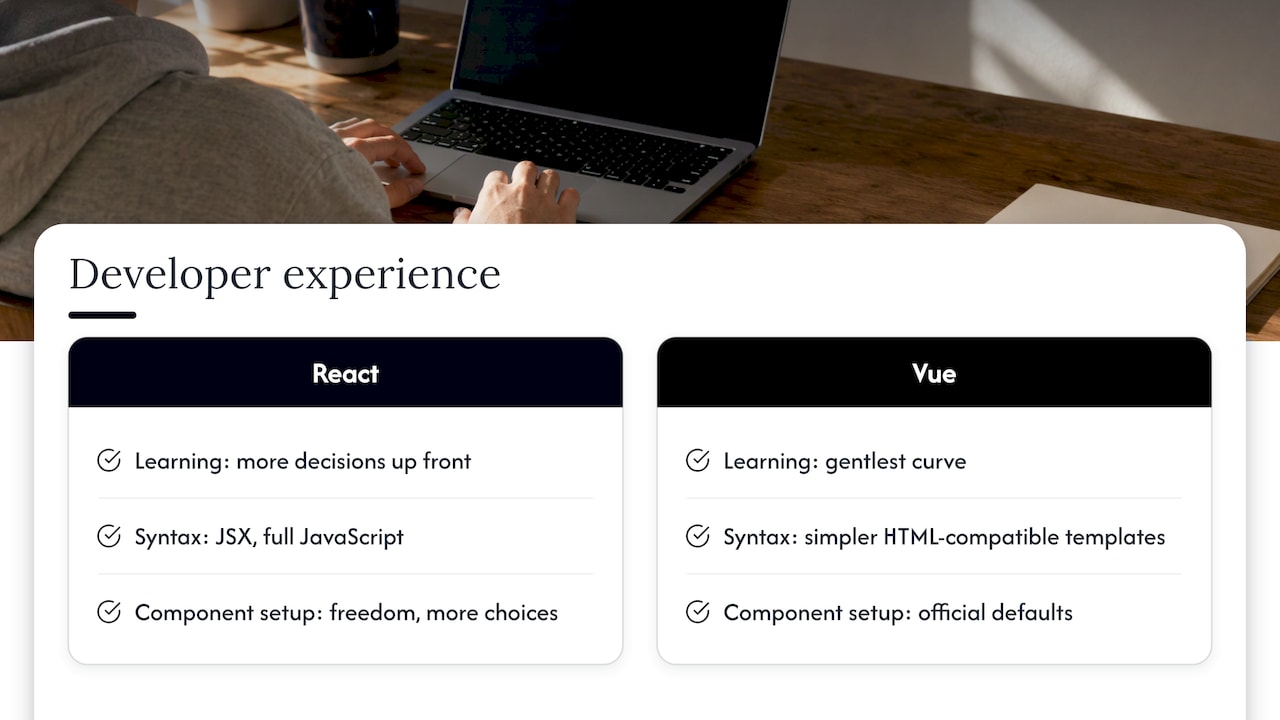
Vue usually wins the first week. Vercel’s guide credits HTML-like templates, single-file components and official defaults for a gentler initial experience. React gives you more freedom through JSX and a wider choice of routing, state and data libraries. That freedom creates more architectural decisions, and it makes team conventions especially important.
Full Scale’s 2026 hiring-focused comparison states the trade-off the same way. React is the safe default, but a large team without conventions can make a mess, because it is a library rather than a framework. Vue is the approachable middle with the gentlest curve and the smallest bundle.
Vue’s documentation is candid about the other side. It describes JSX as a full JavaScript expression environment and Vue templates as a simpler, HTML-compatible alternative. It also notes that JSX tooling can be more advanced in some respects.
One caution applies to both. Designveloper points out that a Vue production architecture still needs decisions about data, rendering, caching and deployment, even though the component-level curve is friendly. The same is true of React. If you’re weighing the layer above the component library, our comparison of Next.js and Remix shows how those decisions play out, and Vercel vs Netlify covers hosting.
Ecosystem, adoption and hiring
This is where the gap is widest. Vue’s own documentation says React’s community ecosystem is considerably richer. It adds that Vue’s companion libraries are officially supported and kept aligned with the core project. That trade is real: more choice on one side, more coherence on the other.
The usage numbers confirm the size difference:
- W3Techs, as of 10 November 2026, reports React on 6.0% of all websites and Vue.js on 0.6%.
- Monterail cites weekly npm downloads for 6 to 12 October 2026 of 17,643,787 for Vue and 187,962,192 for React.
Size isn’t the whole story, though. The same Monterail piece reports that 93% of surveyed Vue developers rated themselves highly likely to use Vue on their next project. It also reports that Vue’s admiration score in Stack Overflow’s 2026 survey, 47.2%, was about on par with React’s 46.7%. People who use Vue tend to like it.
Hiring is the practical consequence. Full Scale describes React as having the largest talent pool by a wide margin and the deepest library catalog. For Vue, it says the cost in the US is hiring, because the Western talent pool is small, though Vue is much bigger across Asia. That’s a US-based view, so check your own local market. Australian job boards and your recruiter will tell you what the candidate pool looks like in Sydney, Melbourne or remote.
Is Vue still relevant in 2026?
Yes. The numbers above show a smaller but active community, and Vue 3 is the current major line. Vue also has Nuxt, which Vercel describes as its meta-framework for server rendering, static generation and incremental static regeneration, the counterpart to Next.js on the React side. Vue is not going away, and it’s a sensible choice for the right team. It simply isn’t the default that React is.
Is Vue the same as React, and are they frontend or backend?
They are different tools that solve the same problem. Neither is the same as the other, and both are frontend technologies. Hostinger lists both among front-end technologies and treats back-end development separately. ACAGroup explains that React and Vue need some back-end technology, such as FastAPI, Flask or Node.js, to provide an API so that what they show can be dynamic. Full-stack capability comes from Next.js or Nuxt paired with a server runtime.
When React fits, and when Vue fits
Designveloper’s 2026 guide recommends React for broad ecosystem depth and long-term hiring options, and Vue for approachable development and gradual adoption. Turn that into questions about your own situation.
React is a strong fit when:
- You expect to hire several frontend developers over the next two years.
- Your product needs a rich dashboard, real-time views or a wide range of third-party components.
- You want the widest choice of libraries for state, data fetching and routing, and you have a lead who will set conventions.
- You plan to build on Next.js.
Vue is a strong fit when:
- Your team has HTML and CSS strengths and wants to ship quickly.
- You want to add interactivity to an existing site step by step.
- You prefer official, aligned tooling (Vue Router, Pinia) over assembling your own.
- Bundle size at the starting line matters for your audience.
If you’re a founder validating an idea, the framework matters less than the speed to a testable product. A first version needs to reach users, not win a debate. Our guide to no-code tools for building an MVP covers the lighter routes before you commit to code.
A quick decision guide
No row says “because it’s faster”, and that’s deliberate. Given how close the independent tests are, a team that picks on speed alone is picking on noise.
Perspective: the framework is the smaller decision
We get asked this question a lot, usually at the start of a project, and usually with a little anxiety attached. People worry they’ll pick wrong and be stuck. Here’s our honest view: the framework is rarely what makes or breaks a product.
What we see matter far more is whether the interface is purposeful. Does it make the next step obvious? Does it load quickly on the device your customer actually holds? Does it match what real users told us in research? A beautifully engineered React app with a confusing checkout will lose to a modest Vue app with a clear one, and the reverse is just as true.
That’s why we start from research and testing rather than from the stack. Our Design Sprint and RapidMVP frameworks exist so you can learn what works before you commit months of engineering to it. Once the direction is validated, choosing React or Vue becomes a practical question about your team, your hiring and your timeline. It stops being a leap of faith.
So pick the tool your team can use well, and put your energy into the experience on top of it. Performance and design pull on each other, and balancing them is a craft of its own. We’ve written about balancing performance and design because it comes up in every build.
Where Raw Studio fits in
If you’re deciding on a stack, you’re probably also deciding what to build and how it should feel. That’s where we work. We’re a Sydney digital agency covering UX and UI design, branding, conversion rate optimisation and web development, with research behind each decision.
For teams that want to move without hiring, our Design Team (Platinum) plan is $8,400 per month. If you have a live product and want to know why it isn’t converting, a Full UX/CRO Audit starts from $2,500 as a one-off. Both are on our pricing page, alongside Idea to Vision, RapidMVP and Design Sprint for validating ideas before you build.
Not sure where to start? Our free UX audit is a low-effort first step, and our services overview shows how the pieces fit together.