



The best payment gateway in Australia depends on how you sell. Stripe suits online and software businesses. Square and Tyro suit shops and venues. eWay and Pin Payments suit merchants who want a simple local flat rate. PayPal earns its place as a trust signal at checkout. But the gateway only moves the money. Whether a shopper gets as far as paying is decided by the checkout design around it, and that is where we work at Raw.
This guide compares the gateways Australian businesses actually shortlist, with their published fees, what they suit and what to check before you commit. It then shows how to turn the gateway you pick into a checkout that converts.
What a payment gateway does, and what it does not
A payment gateway is the service that securely passes a customer's card or wallet details from your checkout to the banks and confirms whether the payment went through. Some providers, such as Stripe and Square, bundle the gateway with the merchant account that receives the money. Others, such as SecurePay and eWay, are gateways that connect to a bank-backed merchant facility.
For most businesses the distinction matters less than three practical questions: what does each sale cost, which payment methods can customers use, and how easily does it plug into your store, booking system or accounting software.
The gateway also shapes risk. A hosted checkout or embedded payment fields keep raw card data off your own systems, which reduces your PCI DSS burden. PCI DSS is the card industry's security standard for anyone handling cardholder data. A Remitbee guide explains that using a hosted or API-hosted gateway means the provider, not you, stores and processes the raw card data. It also explains that tokenisation swaps card numbers for tokens, so a breached database yields nothing a thief can use.
The main Australian gateways at a glance
Fees below are the published headline rates for domestic cards at the time each source was written. They change, so confirm against the provider's own page before you sign. GST treatment and extra lines (international cards, disputes, instant payouts) vary by provider.
Sources for the table are named in the sections below. Rates for Stripe come from Stripe's Australian pricing page; most others come from eWay's 2026 comparison, the Growth Digital comparison and the CodeDrips comparison.
Stripe: the default for online and subscription businesses
Stripe's Australian page lists pay-as-you-go pricing with no setup or monthly fees: 1.65% + A$0.30 for domestic cards and 3.5% + A$0.30 for international cards, plus 2% if currency conversion is needed. It lists 5.49% + A$0.30 for buy now, pay later and 1% + A$0.30, capped at A$3.50, for PayTo and BECS direct debit. Fees include GST, and Stripe notes lower international pricing from 1 April 2027.
The breadth is the draw. Stripe says it supports 125+ payment methods and 135+ currencies, so the same account can take cards, wallets, bank debits and local methods as you grow. AW Labs positions it as the default for online software, thanks to strong APIs, PayTo, BECS direct debit and Connect, the last being the tool for marketplaces that pay out to sellers.
If you are weighing Stripe against a larger enterprise processor, our Stripe vs Adyen comparison for Australia goes through that decision in detail.
Stripe's fee schedule has many lines, so model your real mix of domestic cards, international cards, disputes and payouts instead of relying on the headline rate alone.

eWay: local support and a low headline rate
eWay publishes 1.5% + 25c for Visa, Mastercard and Amex, which Growth Digital reports as the lowest headline domestic rate in its six-gateway comparison, with no monthly fee or lock-in on the pay-as-you-go product. International credit cards carry an extra 1.99%, according to eWay's own site, which also lists 250+ integrations, PCI DSS Level 1 protection, free Fraud Lite with upgrade options and 24/7 emergency technical support.
That integration count matters if your stack is mixed. eWay's own guidance is to check how a gateway connects with Shopify or WooCommerce, accounting software such as Xero, and any CRM or booking systems, because poor integration creates manual work that merchants tend to underestimate.
Square and Tyro: when you also sell in person
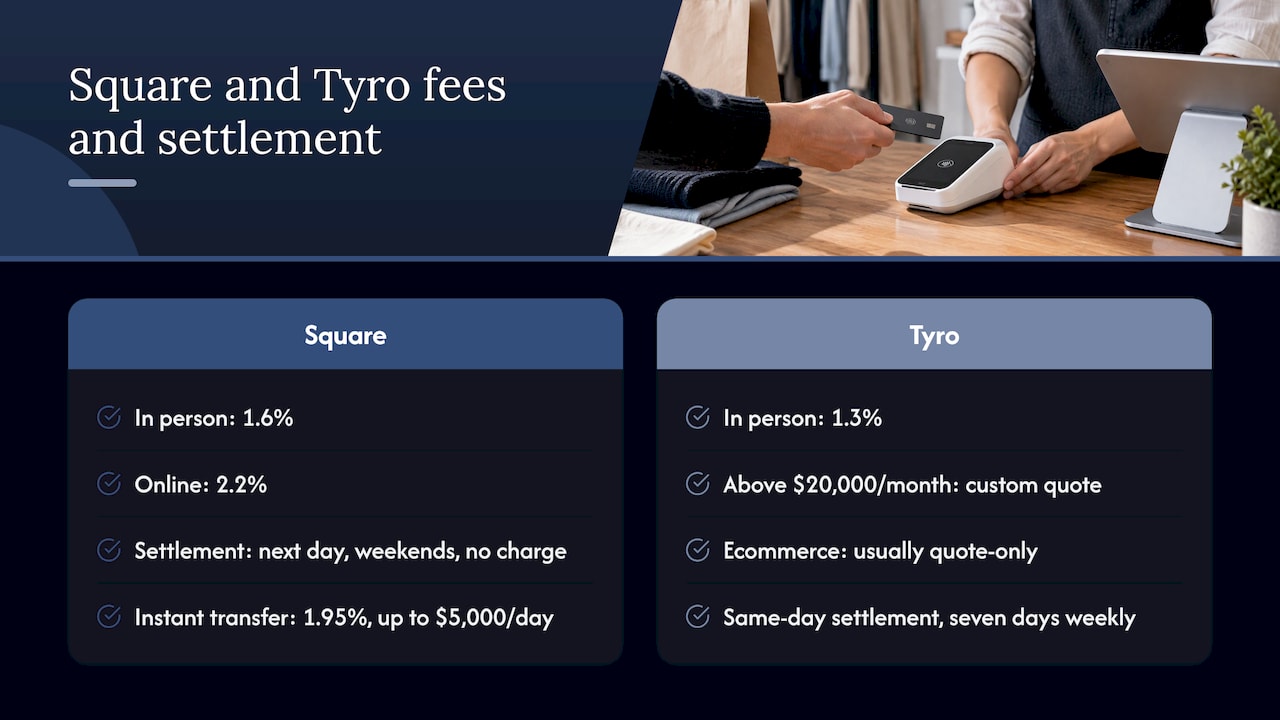
Square charges 1.6% in person and 2.2% online, settles next day including weekends at no charge, and offers instant transfers at 1.95% (up to $5,000 a day). One flat structure across both channels is why AW Labs points small retailers selling in store and online to Square.
Tyro is Australian-owned and best known for eftpos terminals. The same CodeDrips comparison reports 1.3% in person, with a custom quote above $20,000 a month, hardware rental from $19 a month, and 580+ third-party POS integrations. Same-day settlement seven days a week applies when takings settle into a Tyro transaction account. That suits a venue paying suppliers and wages weekly, as long as holding a second account alongside your main bank is acceptable. Growth Digital adds that Tyro's ecommerce product is usually priced through a conversation rather than a public list, and that least-cost routing, which sends each card payment down the cheapest available network, matters when every fraction of a percent counts.
PayPal: a trust signal more than a cost saver
PayPal is not the cheapest line on the table. Wise's May 2026 guide lists PayPal at 2.90% plus a fixed fee domestically, with 1% extra on international payments. Its value is recognition. PayPal's own 2026 Australian eCommerce Index, a survey of 1,012 consumers and 410 businesses by Fifth Quadrant, finds that 65% of Australians use PayPal for secure online purchases. It also reports that offering Pay in 4 at checkout delivers a 79% relative uplift in purchase likelihood.
If your shoppers buy once from an unfamiliar store, the wallet can do real work as reassurance. We looked at the design side of that in how PayPal used three trust-building UX elements to lift conversions.
SecurePay, Pin Payments, Shopify Payments, Airwallex and GoCardless
- SecurePay is now part of Fat Zebra. It accepts Visa, Mastercard, Eftpos, Amex, Apple Pay and Google Pay, with 3DS2, network tokenisation and REST APIs. ExpertMarket lists 1.75% + $0.30 domestic and about 2.90% + $0.30 international, with monthly fees that depend on business type and revenue.
- Pin Payments is the Australian flat-rate option at 1.75% + 30c, with WooCommerce and Magento integrations.
- Shopify Payments is built into Shopify, at 1.75% + $0.30 for Australian cards. If you are still choosing your platform, see our guides to Shopify vs WooCommerce and the best ecommerce platforms in Australia.
- Airwallex was founded in Australia and is aimed at cross-border sellers: 1.65% + A$0.30 domestic and 3.40% + A$0.30 international, with multi-currency balances.
- GoCardless takes bank-to-bank direct debit at 1% + 40c, which suits recurring billing.
How to choose: five checks that matter
- Work out your all-in cost, not the headline. Wise's September guide tells merchants to weigh per-transaction, monthly, refund, settlement, termination and currency conversion fees together. Multiply your average order value and your mix of domestic and international cards through each schedule.
- Remember the surcharge change. Since 1 October 2026, card surcharges on eftpos, Mastercard and Visa are no longer allowed, so a point of fee is a point of margin you cannot pass on.
- Match the channel. Online only points to Stripe, eWay or Pin Payments. Counter trade points to Square or Tyro. Overseas customers point to Stripe or Airwallex.
- Check integrations and payout timing. Confirm native links to your store, accounting and booking tools, plus settlement speed and how disputes are handled.
- Plan for fraud and disputes. Turn on 3D Secure, which can shift liability for some fraudulent chargebacks but adds a step you should watch against conversion. Keep order confirmations and delivery proof. Growth Digital also flags neglected payment plugins on WordPress and WooCommerce stores as a classic way into a hacked shop.
Why the checkout matters as much as the gateway
Two stores can use the same gateway at the same fee and convert very differently. In PayPal's survey, 72% of Australians have abandoned an online purchase. The top reasons were:
- preferred payment method not available (40%)
- being forced to create an account (38%)
- security concerns (35%)
- a card that did not work (31%)
Every one of those is a design and configuration problem as much as a processing one.
The 2025 Ecommerce Payments Experience report adds that about 17% abandon because of hidden fees and surcharges, and that 68% say secure payments are the top way to build trust. Showing trusted payment names such as Zip, Afterpay and PayPal helps for 50%. On mobile, Smart SMS Solutions reports that over 65% of Australian online shopping sessions start on a phone, and that enabling Apple Pay and Google Pay is consistently measured at a 15% to 25% mobile conversion uplift.
So the working order is: pick the gateway for cost and fit, then design the page where the money changes hands. Single-page flow, guest checkout, visible wallet buttons, clear error messages and honest totals all sit on your side of the integration. Our piece on reducing checkout abandonment through micro UX walks through the small interface details that decide whether a card gets entered or a tab gets closed.
We build checkouts for a living, so we see the gateway debate a little differently. Founders spend weeks comparing 1.65% with 1.75%, then ship a payment page that asks for an account, hides the delivery cost until the last step and shows one payment option.
A tenth of a percent on fees is real money, but a checkout that loses a third of its buyers costs far more. That is why our CRO work starts with research and data on how people actually move through the flow, and why we treat payment as a design problem with a processing layer underneath, not the other way round.
Our advice: shortlist two gateways on fit and cost, make sure the one you pick supports the wallets your customers already use, and then test the checkout like a product. Design Sprints and RapidMVP exist for exactly this, validating a flow before you commit to building all of it.
Turning your gateway into a checkout that converts
Once the gateway is chosen, the next question is whether your checkout earns its keep. Our Full UX/CRO Audit starts from $2,500 as a one-off and reviews where visitors drop out and why. If you want an ongoing team on the flow, the Design Team (Platinum) plan is $8,400 per month. Both are on our pricing page.

We also cover conversion rate optimisation, UI design and web development, so the same team can design, test and build the payment step. To see how we approach a store, look at the Everdure ecommerce case study, or start with our free UX audit.
Sources
- Stripe Australia: Pricing & Fees
- Stripe Australia: Products and Features
- eWay: Best Payment Gateways In Australia (2026 Review)
- eWay: Online Payments Australia
- Growth Digital: Best Payment Gateway in Australia (2026)
- CodeDrips: Tyro vs Square Fees, Hardware and Online Compared
- AW Labs: Stripe vs Square vs Tyro vs Adyen in Australia (2026)
- Wise: Best Payment Gateways for Small Businesses in Australia
- Wise: 6 Best Payment Gateways for Australian eCommerce Stores
- PayPal: Australian eCommerce at a Glance (2026 Index)
- Payments Consulting: 2025 Ecommerce Payments Experience
- Smart SMS Solutions: Ecommerce Payment Gateways Australia 2026
- SecurePay by Fat Zebra
- ExpertMarket: Best Payment Gateways in Australia
- Remitbee: What Is a Payment Gateway?
Recommended
- Best Ecommerce Platforms in Australia: 2026 Comparison
- Stripe vs Adyen in Australia: Compare
- Shopify vs BigCommerce in Australia
- Shopify vs WooCommerce in Australia