

How Spotify Converts Free Users by 40% with 4 Freemium UX Strategies

UX strategies are the real reason most freemium products fail quietly.
They grow fast at the top of the funnel, accumulate users, and look impressive on paper. But underneath, something breaks. Free users don’t convert. Revenue lags behind growth. Teams respond by adding aggressive paywalls, which often makes things worse by hurting retention.
This is the default outcome of freemium.
Spotify is the exception.
With a conversion rate hovering around 40% in recent years, Spotify operates at nearly ten times the industry average, where most SaaS freemium products sit between 2% and 5%. That gap is too large to be explained by brand or scale alone. It comes from something far more deliberate.
Spotify treats freemium not as a pricing model, but as a carefully designed behavioral system built on layered freemium UX strategies.
And when you look closely, every part of that system is engineered to move users from curiosity to habit, and from habit to payment.
Table of Contents
The Hidden Problem with Freemium
At its core, freemium creates a structural conflict.
If users don’t experience enough value early, they leave before forming any attachment. But if they get too much value for free, there is no reason to upgrade.
Research in subscription economics consistently highlights this tension. Conversion improves only when users reach a meaningful “aha moment” early, yet it drops when the free experience becomes sufficient on its own.
Spotify resolves this by reframing the role of free users entirely.
They are not non-paying customers. They are users in transition. Users who are gradually moving toward premium.
That shift changes how the product is designed. Instead of asking what should be restricted, Spotify focuses on how to let users fully experience value first, then introduce friction in a way that feels natural rather than forced.
1. Value Before Payment: Building Psychological Ownership
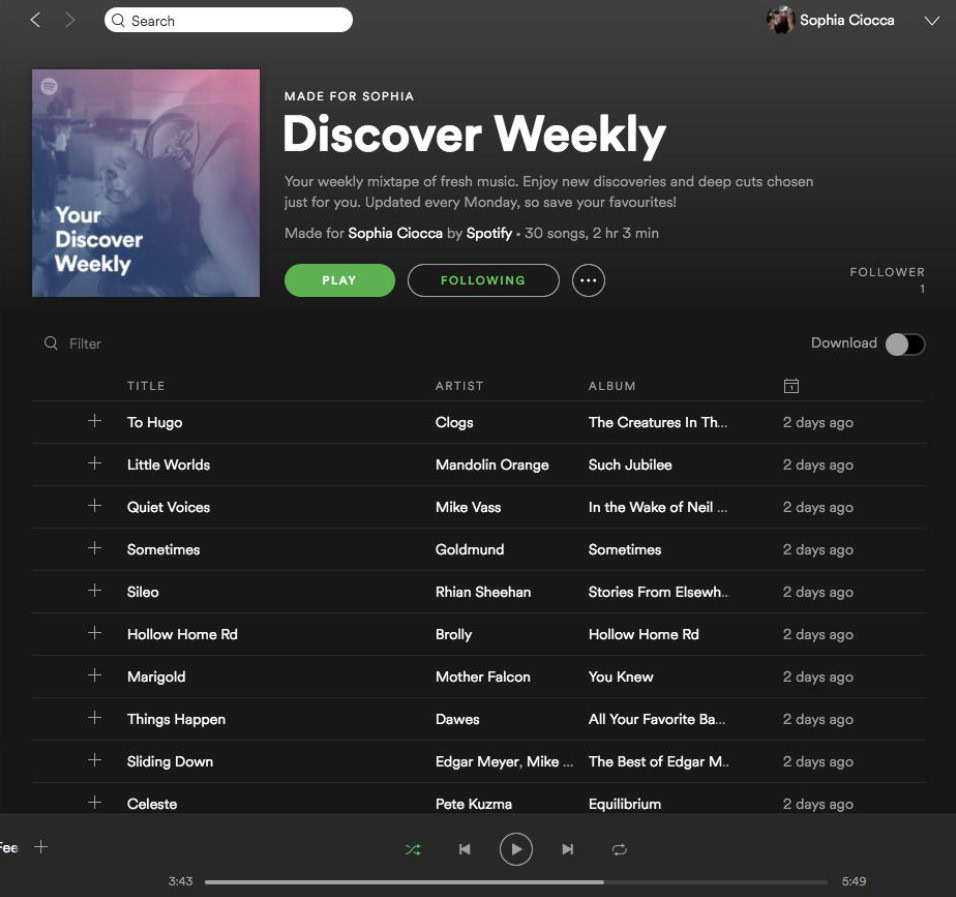
Spotify gives away what most products would immediately lock behind a paywall.
Users can search music, explore playlists, receive highly personalized recommendations, and build listening habits from the very beginning. The recommendation engine becomes the core experience, not a premium feature.
This aligns closely with behavioral research around the endowment effect, which shows that people assign higher value to things they already use and feel ownership over. Once a user builds playlists, listens daily, and sees recommendations improve over time, Spotify becomes embedded in their routine.
At that point, the product is no longer evaluated as a tool. It becomes part of daily life.
This is reflected in conversion patterns. A large percentage of Spotify’s premium users come from long-term free usage, reinforcing the idea that free is not just an acquisition channel. It is the foundation of conversion.
Users don’t upgrade because they understand value.
They upgrade because they’ve already lived it.
2. Strategic Friction: The Science of “Good Enough”
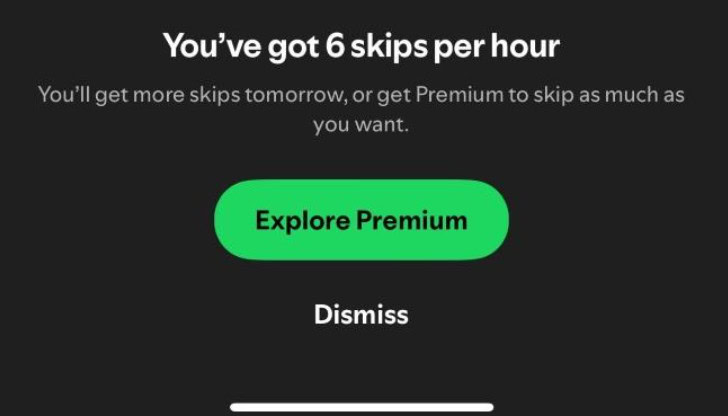
Spotify’s freemium experience is intentionally limited, but never broken.
Users can still listen to music, but with constraints that shape behavior over time. Playback is often shuffled, skips are limited, ads interrupt sessions, and offline listening is unavailable.
This approach reflects findings from freemium research showing that conversion improves when friction is present but tolerable. If friction is too strong, users churn. If it is too weak, they remain free indefinitely.
Spotify operates in the middle.
The experience is good enough to keep users engaged, but imperfect enough to create ongoing tension. Each limitation is small on its own, but together they create a steady accumulation of friction.
Over time, that friction becomes noticeable.
And eventually, it becomes a reason to upgrade.
3. Timing Over Messaging: When Spotify Asks You to Upgrade
Most products focus on crafting better upgrade messages.
Spotify focuses on timing.
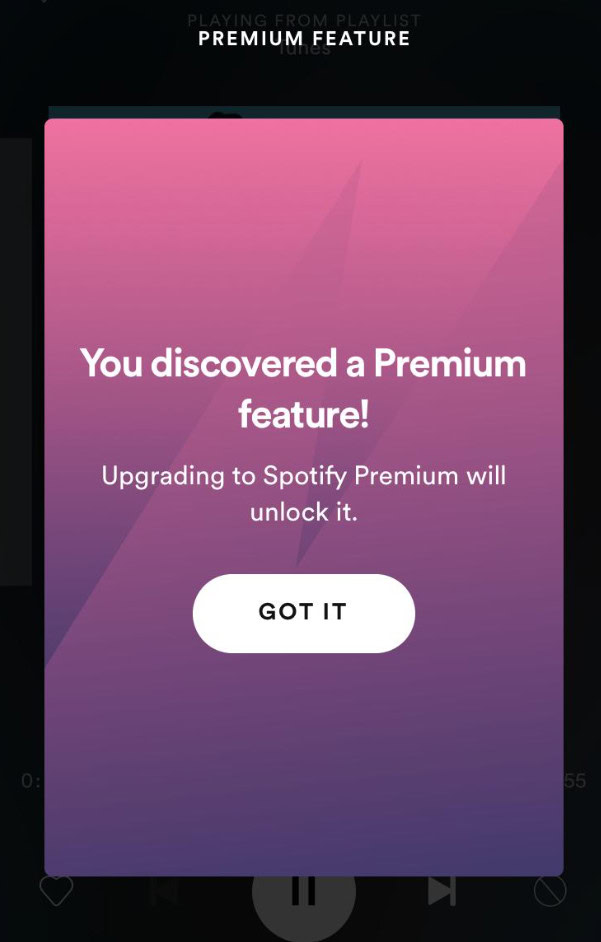
Upgrade prompts appear at moments of intent. When a user hits a skip limit, experiences repeated ads, or attempts to access a locked feature, the system responds immediately with a premium offer.
This aligns with research in conversion psychology showing that prompts triggered by user behavior consistently outperform time-based or generic prompts. When a user already feels friction, the upgrade becomes a logical solution rather than a forced decision.
Spotify also uses data to refine this timing. By analyzing usage patterns such as session frequency, listening duration, and feature interaction, it can identify users who are more likely to convert and engage them at the right moment.
This turns upgrade prompts into something far more effective.
They stop being interruptions and start feeling like assistance.
4. Contextual Nudges: Making Premium Impossible to Ignore

Spotify does not rely heavily on pricing pages or aggressive upsells.
Instead, it embeds premium awareness directly into the product experience.
Users constantly encounter subtle signals. A greyed-out download button. A feature marked as premium. A capability that is visible but just out of reach.
These cues are not disruptive. They are ambient.
Behavioral research supports this approach through the mere exposure effect, where repeated, low-intensity exposure increases familiarity and preference over time. By consistently showing premium features in context, Spotify ensures users remain aware of what they are missing without feeling pressured.
The result is a steady build-up of desire.
Users are not reminded occasionally. They are reminded continuously, in the moments that matter.
Why This System Works
Spotify’s success is not driven by a single tactic. It works because the entire system aligns with human behavior.
It prioritizes habit formation before monetization, recognizing that frequent use is one of the strongest predictors of conversion. It leverages loss aversion by framing premium as a way to remove friction rather than add features. It introduces friction gradually, allowing users to build value perception before feeling limitations. And it continuously refines the experience through data and experimentation.
Most importantly, it treats conversion as a journey, not a moment.
What This Means for Your Product
The real takeaway is not to copy Spotify’s features.
It is to rethink how your UX strategies shape the entire user journey.
Freemium only works when users experience real value early, when friction is introduced gradually, and when upgrade moments are tied to behavior instead of arbitrary timing.
Most products fail because they treat conversion as a single event.
Spotify succeeds because it designs for conversion across the entire experience.
Turn These Insights Into Growth
Spotify’s success didn’t come from a clever pricing trick.
It came from designing an experience where users:
- Feel value early
- Build habits over time
- Encounter friction at the right moments
- See upgrading as the natural next step
That kind of system doesn’t happen by accident. It requires deliberate thinking across UX, product strategy, and behavioral design.
Most products already have the pieces.
What’s missing is how those pieces connect.
If you’re trying to improve conversion, increase upgrades, or rethink your freemium model, the fastest way forward is to step back and redesign the journey as a whole.
That’s exactly what we help with at RAW Studio.
We’ll look at your product, identify where users drop off, where value isn’t clear, and where friction is either too weak or too strong, then map out a clear strategy to fix it.
No pressure, no generic advice. Just a focused breakdown of how to turn your product into a high-converting experience.
Get a UX & CRO Expert’s Eyes on Your Website. Book a free 30-minute UX Teardown and get actionable insights on what’s costing you conversions — no fluff, just fixes you can implement right away.
Book a Free UX Audit

Related posts
What Is a Design System? A Founder’s Guide to Scaling UI
Ask five people in the same company what a design system is and you may get five different answers. A […]

Becoming a Better Product Designer in 2022 with Jacalin Ding
With nearly 100k apps being released every month, product design has really taken off in the last ten years or […]
The Most Important UX Metrics to Track for High-Performing Products in 2026
For years, UX success was measured by surface-level numbers. Clicks, page views, and session counts filled dashboards and presentations. In […]
Creative product design that gets results
Take your company to the next level with world class user experience and interface design.
get a free strategy session
