

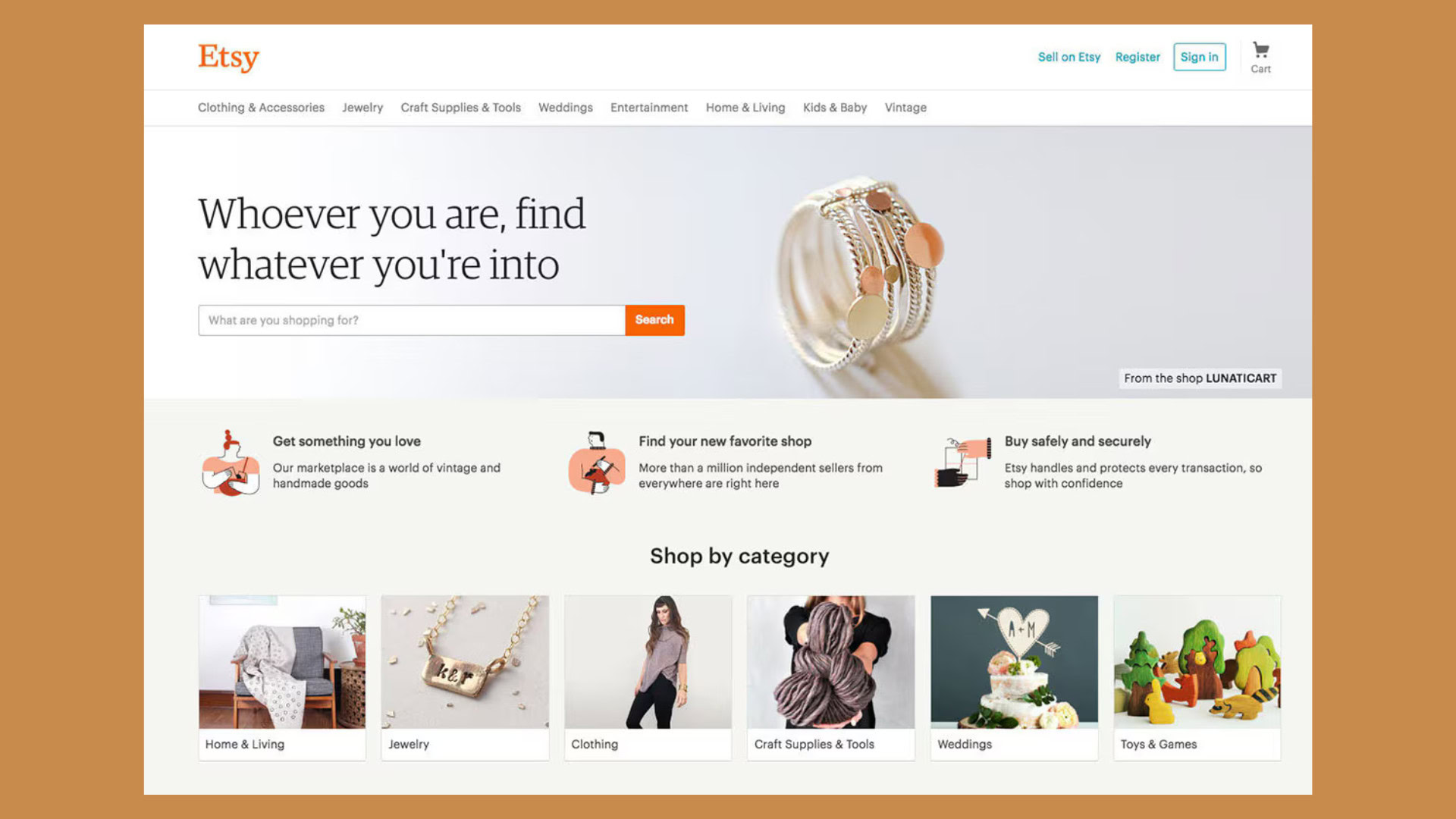
How Etsy Uses 3 Social Proof UX Elements to Increase Conversions

Buying online always involves a degree of uncertainty.
Customers cannot physically inspect a product, speak directly with the seller, or know with complete confidence that an item will match its description. This uncertainty becomes even greater on a marketplace like Etsy, where millions of products are sold by independent creators, small businesses, and individual shop owners.
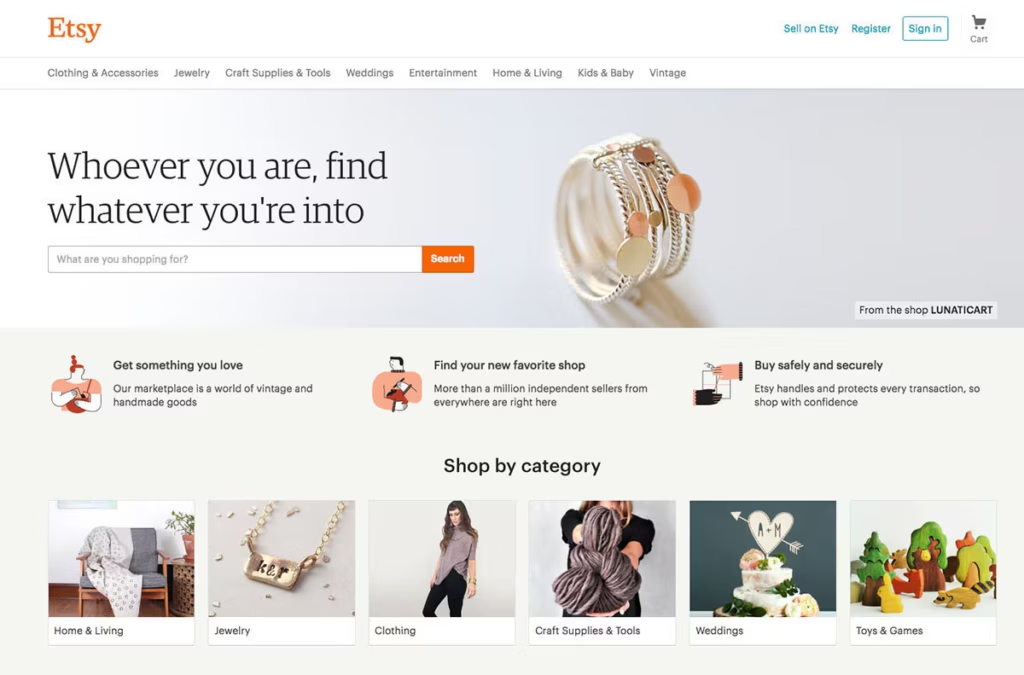
A buyer may love a handmade lamp, personalized necklace, wedding invitation template, or vintage jacket. However, before placing an order, they are likely to ask several important questions.
Does the product look as good in real life? Is the seller reliable? Will the order arrive on time? Have other people had a positive experience?
Etsy UX answers these questions through social proof. Instead of asking shoppers to trust a product description alone, the platform shows evidence from previous customers. Reviews, ratings, and purchase signals help shoppers understand that other people have already taken the same risk and received a satisfactory result.
In this article, we will examine three social proof elements at the center of Etsy UX: customer reviews, visible ratings, and purchase activity signals. We will explore why these elements build confidence, how they support ecommerce conversions, and how other businesses can apply the same principles to their websites and digital products.
Table of Contents
Why Buyers Trust Other Buyers
Every ecommerce product page makes a series of claims.
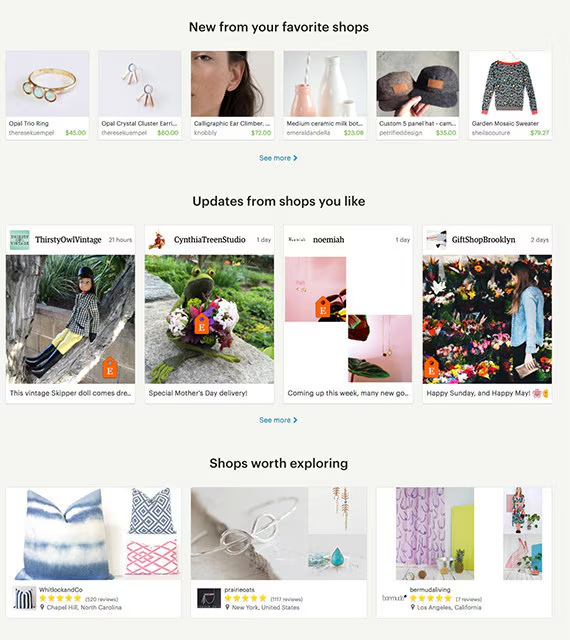
The photographs suggest that the product is attractive. The description explains its benefits. The seller promises quality, reliability, and good service. Yet buyers understand that these messages come from someone who wants to make a sale.
Customer feedback feels different.
A review is written by someone who has already spent money, waited for the delivery, and experienced the product. That customer has less incentive to exaggerate its quality. As a result, shoppers often view feedback from other buyers as more credible than promotional copy.
This is especially important on Etsy because many purchases are emotionally significant or highly personal. People use the marketplace to buy wedding decorations, custom gifts, artwork, clothing, furniture, and handmade products. A poor decision may not only waste money. It could also affect an important celebration, deadline, or relationship.
Etsy reduces this perceived risk by placing evidence from previous customers close to the purchasing decision.
This approach reflects a broader conversion principle discussed in RAW.Studio’s article on PayPal’s trust-building UX. The article explains that customers need more than a technically functional journey. They need enough confidence to complete it.
That confidence is essential in ecommerce. The same RAW.Studio analysis references Baymard Institute research showing that the average documented cart abandonment rate is above 70%. Although shoppers abandon carts for many reasons, trust, uncertainty, payment concerns, and checkout friction can all prevent an interested visitor from becoming a customer.
Etsy’s social proof system addresses uncertainty before the buyer reaches that final stage.
1. Reviews Turn Product Claims Into Customer Evidence

Written reviews are one of the most persuasive elements of Etsy UX.
A product description tells shoppers what the seller wants them to know. Reviews reveal what customers actually experienced.
Buyers can learn whether the product matched its photographs, whether the materials felt high quality, whether the sizing was accurate, and whether the seller communicated clearly. Reviews can also reveal practical details that may not appear in the official description.
For example, someone considering a personalized gift may want to know whether the engraving was accurate. A customer buying printable artwork may want confirmation that the files were easy to download. A shopper ordering an item for a wedding may care more about delivery speed than any other feature.
Reviews answer these context-specific questions.
They also give buyers the language of other buyers. A seller might describe an item as “premium,” “beautiful,” or “carefully made.” Those terms are expected in sales copy. When several customers independently describe the product as sturdy, well packaged, or better than expected, the claims become more believable.
Etsy strengthens this effect by connecting reviews to real transactions. Feedback appears within the context of a shop and its products rather than as an isolated marketing testimonial.
Customer photographs can make reviews even more valuable. Professional product images are carefully composed and edited. A photograph submitted by a buyer shows how the item looks in an ordinary home, under natural lighting, or in actual use.
This visual evidence helps shoppers form realistic expectations. It can answer questions that written copy cannot and reduce the gap between how the product is presented and what the customer expects to receive.
Reviews are therefore not simply compliments displayed below a product. They are an information system that helps people evaluate quality, reliability, and fit.
2. Ratings Make Trust Easy to Evaluate
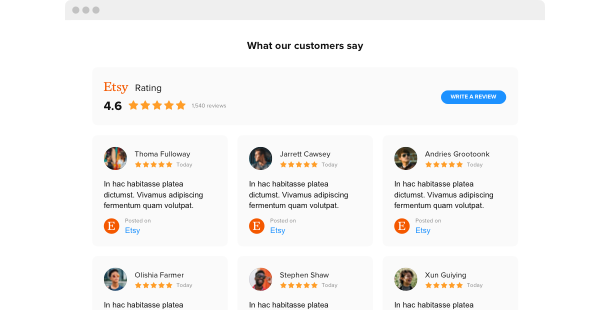
Detailed reviews are useful, but shoppers do not always have time to read every comment. Ratings provide a faster layer of social proof.
A visible star rating gives customers an immediate summary of previous buyer sentiment. In a fraction of a second, shoppers can see whether an item or seller has earned consistently positive feedback.
This speed matters because ecommerce customers often compare multiple products. They scan photographs, prices, delivery estimates, shop information, and product details. Ratings help them narrow their options without reading every page in full.
The number of ratings is also important.
A five-star score based on two purchases does not communicate the same level of confidence as a similar score supported by hundreds or thousands of customer experiences. The score suggests quality, while the volume suggests consistency.
Together, those signals help shoppers answer two different questions:
Is this product good?
Has it been good for enough people that I can trust the pattern?
Etsy places rating information throughout the shopping journey, including search results, shop pages, and individual product listings. This makes social proof available before the customer reaches checkout.
That placement is a major part of its effectiveness. Trust information should appear when shoppers are comparing choices, not only after they have already made a decision.
RAW.Studio’s analysis of IKEA UX and complex buying decisions explains how effective design reduces the mental effort required to evaluate a purchase. Ratings serve that purpose on Etsy. They compress a large collection of individual experiences into a signal that is quick to understand.
However, ratings are most persuasive when they remain connected to deeper evidence. A star score without accessible reviews can feel superficial. Etsy allows shoppers to move from the summary to the details, examining individual comments when they need more reassurance.
This layered design supports different levels of decision-making. A confident customer can use the rating as a shortcut. A cautious customer can investigate the reviews before committing.
3. Purchase Signals Show That Other People Are Taking Action
Reviews and ratings describe past satisfaction. Purchase signals communicate current demand.
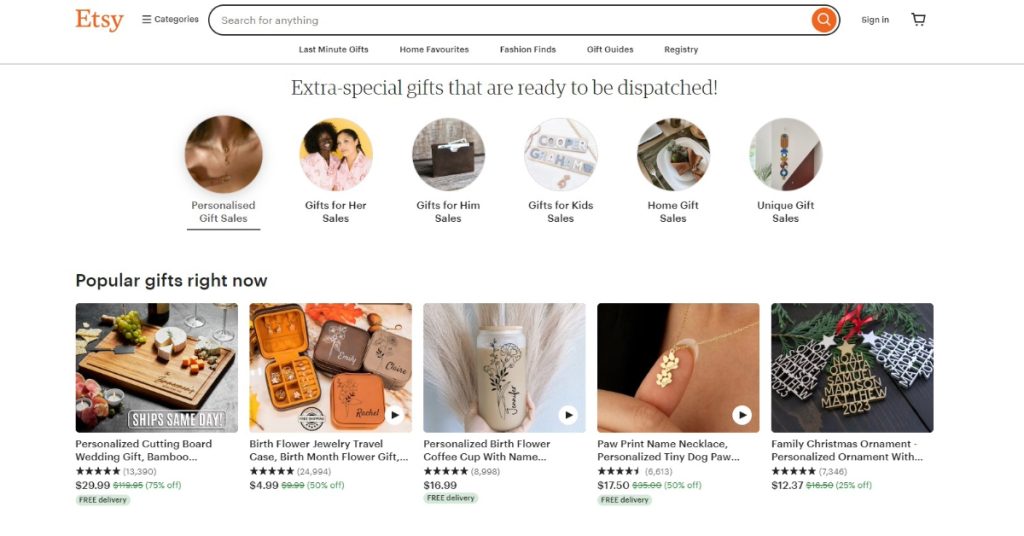
Etsy can show shoppers that an item is in other people’s baskets, has generated significant interest, or has achieved strong sales activity. These messages indicate that other customers are not merely viewing the product. They are actively considering or purchasing it.
That distinction can influence behavior.
A product with visible activity feels less uncertain than one that appears completely untested. The shopper sees evidence that other people find the item appealing enough to move closer to buying it.
Purchase signals can also create urgency. If several people have an item in their baskets and the product has limited availability, a shopper may feel that delaying the decision could mean losing the opportunity.
This mechanism combines social proof with scarcity. Social proof says, “Other people want this.” Scarcity says, “It may not remain available.”
Etsy’s marketplace makes this combination especially powerful because many items are handmade, vintage, personalized, or produced in limited quantities. Low inventory can feel credible rather than manufactured.
Seller-level activity provides another layer of reassurance. A shop with a substantial sales history appears more established than a completely new seller. Previous sales suggest that the business has successfully processed orders, communicated with customers, and delivered products before.
Purchase activity does not prove that every customer will be satisfied. However, it reduces the sense that the buyer is entering an unknown situation alone.
The design lesson is not that every business should pressure visitors with aggressive countdowns or exaggerated demand messages. Activity signals work when they are accurate, relevant, and presented at the right moment.
False scarcity damages trust. Authentic activity strengthens it.
Why Etsy’s Social Proof UX Works
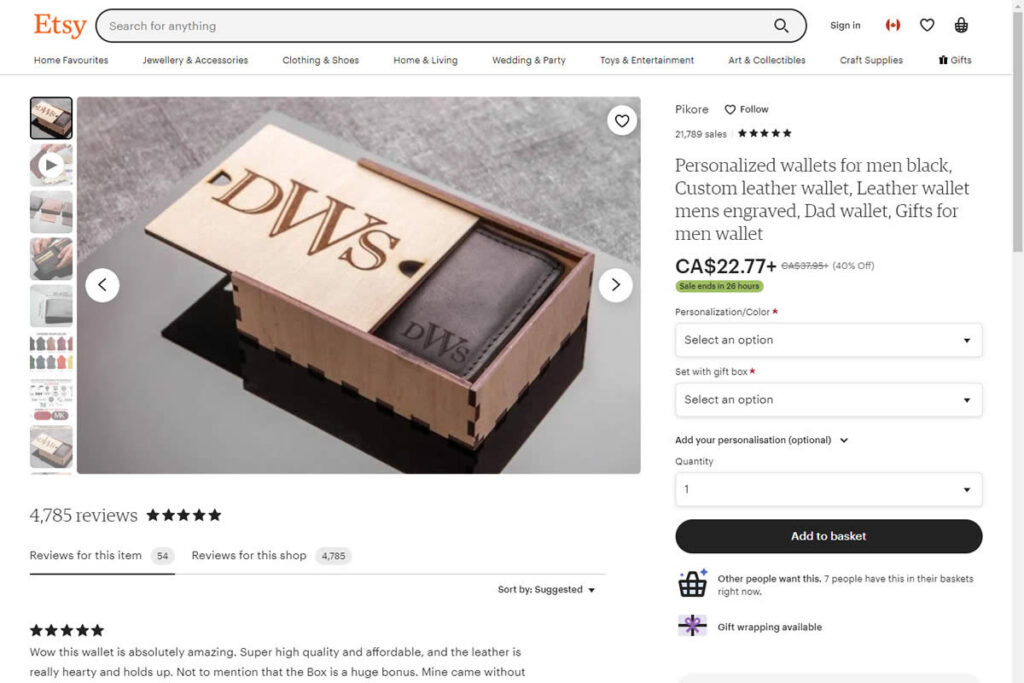
The three elements work because they address different forms of uncertainty.
Reviews provide detailed evidence about product quality and customer experience. Ratings make that evidence easier to scan. Purchase signals show that other customers are currently interested and willing to act.
Together, they create a fuller picture of trust.
A shopper may discover a product through its photographs, notice that it has a high rating, see that hundreds of customers have reviewed the shop, and read several comments confirming good quality and reliable delivery. A purchase activity message may then provide the final reassurance needed to act.
Each signal supports the others.
This is similar to the trust-building system described in RAW.Studio’s LinkedIn UX analysis. High-trust experiences rarely depend on one badge, message, or testimonial. Confidence develops through several consistent signals placed across the journey.
Etsy UX also works because social proof appears close to the product and the buying decision. Customers do not need to leave the page and search for evidence elsewhere.
Removing that extra research step reduces friction. It also helps Etsy keep the decision-making journey inside its platform.
How Other Businesses Can Apply Etsy UX Principles
A business does not need to operate a marketplace to benefit from social proof. The same principles can improve ecommerce stores, SaaS websites, service businesses, booking platforms, and subscription products.

Add Reviews That Answer Real Customer Questions
Begin by collecting feedback from verified customers and displaying it close to the relevant product, service, or plan.
Generic testimonials such as “Great company” provide limited value. Strong reviews contain specific information about the customer’s situation, the problem they wanted to solve, and the result they experienced.
An ecommerce review might discuss sizing, quality, packaging, or delivery. A SaaS review could explain how quickly the customer set up the product or what changed after implementation. A service business could highlight communication, responsiveness, and measurable outcomes.
Make reviews easy to browse, but do not remove all criticism. A perfect collection of vague five-star reviews can appear less credible than balanced feedback containing realistic detail.
Highlight Ratings at Key Decision Points
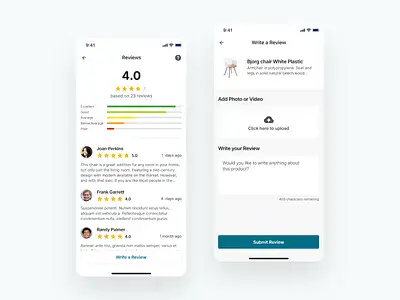
Do not hide ratings at the bottom of a long page.
Show them where users compare options, evaluate prices, or prepare to take action. Relevant locations may include product cards, search results, pricing pages, service pages, booking screens, and checkout summaries.
Connect the average rating to the number of responses so users can evaluate both quality and volume. Where possible, allow visitors to open the underlying reviews rather than presenting a score without supporting evidence.
The goal is to make confidence easy to assess without overwhelming the interface.
Show Authentic Activity
Activity signals can demonstrate that a product or service is trusted and actively used.
An ecommerce store might show recent purchases, stock availability, bestseller status, or the number of customers who have bought an item. A SaaS company could display the number of teams using a feature, recent milestones, or relevant usage data. A booking platform might show remaining availability or how often a service has been reserved.
These signals must be truthful.
Invented purchase notifications and artificial urgency may create short-term pressure, but they weaken long-term trust. Use real data, explain it clearly, and show it only when it helps users make an informed decision.
Final Thoughts
Etsy UX demonstrates that buyers rarely make decisions based on product information alone.
They look for evidence that other people have already chosen the product, trusted the seller, and received a positive result. Etsy provides that evidence through written reviews, visible ratings, and purchase activity signals.
Reviews add depth. Ratings provide speed. Purchase signals create momentum.
Together, these elements reduce uncertainty and make buying from an independent seller feel safer. They transform the product page from a one-sided sales message into a record of real customer behavior.
The wider lesson is simple: do not ask customers to trust your claims without support.
Show what previous buyers experienced. Make satisfaction easy to evaluate. Present authentic signs of customer activity near important decisions. When social proof is clear, specific, and credible, it can turn hesitation into confidence and confidence into conversion.
Build a More Trusted Conversion Experience
Your website may already have strong products, useful services, and steady traffic. However, customers can still leave when the experience does not provide enough proof, clarity, or reassurance.
Request a UX audit and proposal from RAW.Studio to identify where trust is breaking down across your website and discover practical opportunities to improve engagement and conversions.
Get a UX & CRO Expert’s Eyes on Your Website. Book a free 30-minute UX Teardown and get actionable insights on what’s costing you conversions — no fluff, just fixes you can implement right away.
Book a Free UX Audit

Related posts
How to Create User Personas That Teams Will Actually Use
Most user personas have a surprisingly short life. They are created during a workshop, polished into a nice-looking slide, shared […]
How Revolut Uses 4 Onboarding UX Tactics to Activate New Users Faster
Fintech onboarding must feel secure without feeling slow. A banking app cannot remove identity checks, legal consent, or account protections […]

Tech Startup Branding in Days to Weeks for Engineering Founders
If you have early customers, build a minimum viable brand that ties your positioning, pitch deck, and product UI together, […]
Creative product design that gets results
Take your company to the next level with world class user experience and interface design.
get a free strategy session
