


Tech Startup Branding in Days to Weeks for Engineering Founders

If you have early customers, build a minimum viable brand that ties your positioning, pitch deck, and product UI together, not just a logo. Founders who wait until Series A to think about brand usually spend more fixing inconsistency than they would have spent getting it right early. A free checklist can get you moving today.
Table of Contents
Why Tech Startup Branding Actually Moves the Needle

Tech startup branding isn’t decoration you add once the product works. It’s the shortcut that lets buyers, investors, and candidates decide whether to trust you before they’ve read a single line of your documentation.
Think about how a buyer evaluates a new tool. They land on your site, skim for ninety seconds, and decide whether to keep going. A clear, consistent identity shortens that evaluation window because it removes friction: the visitor isn’t decoding mixed messages about what you do or who you’re for. Positioning that’s sharp enough to repeat back word-for-word tends to convert better than positioning that requires explanation.
Investors read brand consistency as a proxy for operational discipline. If your pitch deck, website, and product screenshots look like three different companies made them, that’s a signal, and not a good one. A team that presents consistently across every touchpoint compounds recognition and trust with each interaction, while inconsistent application erodes that credibility early, right when you can least afford it.
Brand also shapes hiring. Candidates researching your company form judgments from the same scattered signals investors do. Clarity about who you are makes it easier for the right engineers and salespeople to self-select in.
For companies chasing enterprise contracts or a fundraising round, brand work has to line up with pitch decks, the website, product UI, and investor materials, because that alignment is what signals credibility to buyers and investors who are sizing up dozens of vendors a month.
What this buys you in practice:
- Faster buyer evaluation and higher signup conversion
- Stronger investor signaling during diligence
- Easier recruiting because your positioning does some of the pitching for you
- Fewer internal debates about tone, since there’s a documented reference to point to
Pro Tip: Ask three people outside your company to describe what you do in one sentence after visiting your site. If you get three different answers, your positioning isn’t done yet.
When Should You Invest in Branding as a Startup?
Branding investment should track company stage, not founder enthusiasm. Spending agency-level budget on a full identity system before you have product market fit is often wasted work, because the positioning will shift once real customers correct your assumptions.
- Pre-seed: Build a minimum viable brand. That means positioning, a working logo, a single-page brand reference, and templates for your three most-used channels, which is enough to launch credibly without over-investing. This is the same scope that a founder’s step-by-step guide recommends for early-stage companies, and it usually takes days, not weeks.
- Seed: Add a messaging architecture, a refined pitch deck, and a working visual system built for your website and product, not just a marketing page. Budget and timeline scale with how many touchpoints you’re covering, but expect something closer to a proper sprint.
- Series A and beyond: Build scalable systems: documented design tokens, a logo family, and guidelines that let a growing team apply the brand without your input on every asset. Full identity projects typically run four to eight weeks depending on scope, with some agencies compressing that into one to six weeks for teams that need launch-ready assets fast.
Stage-specific investment prevents the two failure modes founders actually hit: over-investing before product market fit, or under-investing right when you need credibility with enterprise buyers.
What Makes Up a Tech Startup’s Brand Identity?
A usable brand identity has five working parts, and skipping any one of them is usually what causes the “our brand feels off” complaint six months later.
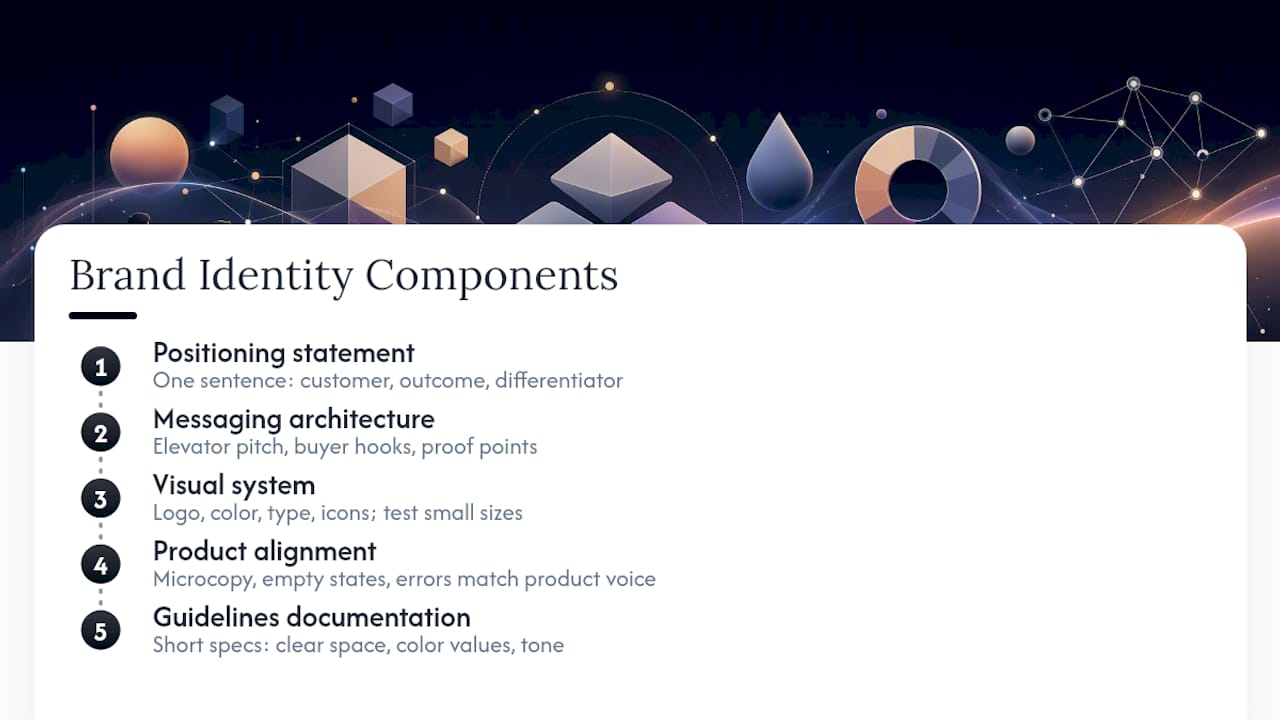
Positioning statement. One sentence: for [target customer], [product] helps [outcome] by [differentiator], unlike [alternative]. If you can’t fill that in without hedging, your team doesn’t actually agree on what you’re selling yet.
Messaging architecture. This is your elevator pitch plus buyer-specific hooks (what a CTO cares about differs from what a CFO cares about) plus the proof points that back each claim, whether that’s a customer count, a benchmark, or a case study number.
Visual system. Logo, color palette, typography, and iconography, tested at small sizes before you finalize anything. A logo that looks great at 400 pixels can turn to mush as a 16 or 32 pixel favicon or app icon, and design tokens paired with small-size testing are what prevent that failure from reaching production.
Product alignment. Microcopy, empty states, and error messages should sound like the same company that wrote your homepage. This is where brand either compounds or contradicts your UX/UI work, depending on whether anyone bothered to check.
Guidelines documentation. A usable version stays short: logo clear space, exact hex/RGB/CMYK values, typography specs, and a page of tone-of-voice direction, because a document nobody opens isn’t a guideline, it’s a file.
A full identity system generally covers positioning, messaging, logo system, color, typography, guidelines, pitch deck styling, website direction, and product UI rules together, not as separate projects handled by separate freelancers months apart.
How Do You Build a Startup Brand From Scratch?
The process runs in four stages, and skipping the first one to jump straight to logo concepts is the single most common way founders waste a design budget.
- Discovery workshop. Output: a positioning statement, a competitor map, and target personas built from actual customer conversations, not guesses.
- Concept development. Two or three creative directions, each with a clear rationale, evaluated against selection criteria the team agreed on before seeing any visuals (this stops decisions from becoming a popularity contest about which logo someone’s spouse liked).
- Refinement and delivery. A logo family (full lockup plus a standalone icon), color and typography tokens, organized Figma files, and a short guidelines document.
- Launch. Roll the identity out across the website, pitch deck, product UI, email templates, and basic on-page SEO elements at the same time, so nothing launches half-updated.
What you’ll typically get out of this:
- A documented positioning statement your whole team can repeat
- A tested logo family that survives small sizes
- Figma source files, not just exported PNGs
- A guidelines doc short enough that people actually read it
Cost and duration depend mostly on scope, not company size. A minimum viable brand can close in days; a full system with product alignment and documentation more commonly runs four to eight weeks, with tighter sprints available for teams racing a launch date.

Where Should the Brand Show Up First?
Consistency matters more than perfection, but it only counts where a buyer, user, or investor actually looks.
Website hero. Run the five-second test: can a stranger tell what you do, who it’s for, and what to click within five seconds? If your headline requires a scroll to make sense, your CTA is fighting an uphill battle regardless of button color.
Product UI. Check iconography, spacing, and microcopy for the same voice as your marketing site. A support-friendly, warm tone on your homepage paired with terse, robotic error messages inside the product reads like two different companies wrote each half.
Pitch deck. Cover slide, section headlines, and proof points should mirror the same positioning language you use publicly, because alignment between deck, site, and product signals operational discipline to investors sizing you up against a dozen other decks that week.
Sales and hiring pages. Templates and job listings should carry the same voice and proof points as everything else. Small checks here catch the design red flags that quietly cost you conversions.
- Hero headline passes the five-second test
- Product microcopy matches marketing tone
- Pitch deck proof points match public claims
- Sales templates use current messaging, not a stale draft
What Branding Mistakes Do Founders Make Most Often?
Most branding failures trace back to sequencing, not taste.
- Logo before positioning. Fix: write the one-sentence positioning statement first. A great logo built on fuzzy positioning just makes the confusion look polished.
- Unrefined AI-generated assets. AI tools are genuinely useful for rapid exploration, but human refinement is what makes an identity original and reliable across sizes and flows. Skipping that step is how you end up with a logo that breaks at favicon size.
- Fragmented brand across product and marketing. Fix: build design tokens once and write a short guidelines doc so every team pulls from the same source.
- DIY versus hiring. DIY works fine for a minimum viable brand at pre-seed. Once you’re aligning pitch decks, product UI, and investor materials simultaneously, that’s usually when outside help pays for itself.
Raw’s Approach to Practical Brand Work
Some agencies run branding engagements through frameworks built for speed without skipping strategy, including a Design Sprint model and a Rapid MVP process that get founders to tested deliverables in compressed timelines instead of open-ended discovery.
If you want a starting point before booking anything, the free Branding Checklist Template walks through the same components covered here, and the Branding service page outlines how engagements are typically scoped.
What Does “Branding” Actually Mean for a Startup?
Branding is the set of decisions that make your company recognizable and trustworthy across every place a customer, investor, or candidate encounters it. That’s narrower than most founders assume.
It’s not the logo. The logo is one visual asset inside a larger system. It’s not “marketing,” either, since marketing is one channel where brand gets applied, alongside product, sales, and hiring.
Branding is the answer to three questions, made consistent everywhere: What do we do? Who is it for? Why should someone believe us over the alternative? Positioning answers the first two. Proof points and messaging answer the third. The visual system, voice, and documentation exist purely to make those answers show up the same way whether someone meets you on Twitter, in a product demo, or on slide two of your deck.
A strong identity ties positioning, messaging, logo system, color, typography, and product UI rules together into one reference, rather than treating each as a separate project handled by whoever’s available that week. That’s the distinction that matters for founders: branding is a system of connected decisions, not a deliverable you check off once.
How Do You Know if Your Branding Is Working?
Branding impact shows up in numbers you’re probably already tracking, just not connected to brand decisions yet.
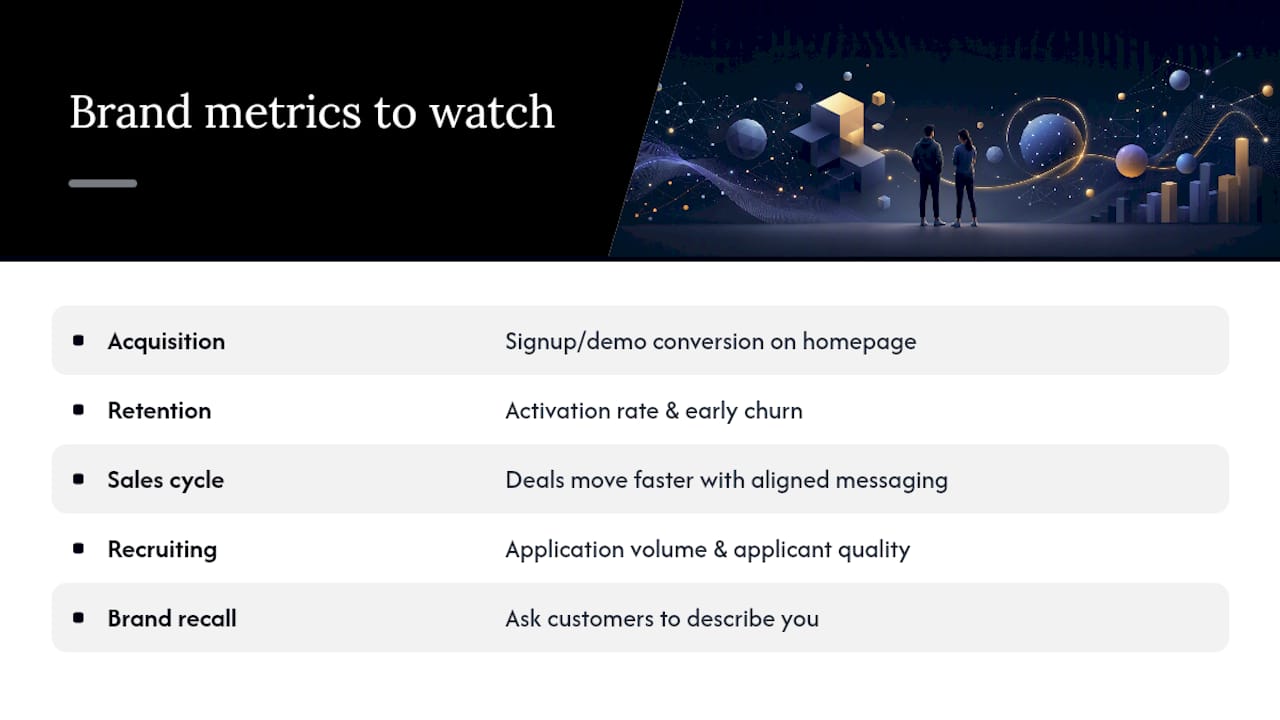
Acquisition metrics. Watch signup or demo conversion rate on your homepage and landing pages. If positioning gets sharper and conversion climbs without a change in traffic quality, that’s your signal. Track this before and after any positioning or messaging change, not just after a visual refresh, since the words usually move the number more than the colors do.
Retention and engagement. Product-side consistency (microcopy, empty states, onboarding tone) tends to show up in activation rate and early churn. A confusing first-run experience often gets blamed on the product when the real issue is inconsistent language between what marketing promised and what the interface delivers.
Sales cycle length. If your pitch deck and website say the same thing your sales team says on calls, deals tend to move faster because prospects spend less time reconciling conflicting claims.
Recruiting funnel quality. Application volume and quality on hiring pages often shift once positioning gets specific, since vague company descriptions attract vague applicants.
Brand recall. Harder to quantify, but worth tracking anecdotally: ask new customers how they’d describe you to a colleague, and check whether that description matches your actual positioning statement.
You don’t need enterprise brand-tracking software to monitor any of this. A spreadsheet tied to your analytics tool, checked quarterly against major brand decisions, tells you almost everything you need to know at startup scale.
How Should Your Brand Evolve as You Grow or Pivot?
Your brand identity should be built to survive a pivot, not just a growth spurt, and that means designing for change from day one rather than treating any brand asset as permanent.
The practical move is separating what’s flexible from what’s structural. Positioning and messaging should flex easily since they respond directly to what you learn from customers. Your visual system should flex less; changing your logo every time your go-to-market strategy shifts trains nobody to recognize you.
Design tokens are what make evolution manageable instead of chaotic. If your colors, spacing, and typography live as documented tokens rather than scattered hex codes copied into a dozen files, updating the system later touches one source instead of every asset your team has ever created.
Watch for the moment your positioning statement stops matching what you actually sell. That’s a pivot signal, not a rebrand-for-its-own-sake signal. A genuine pivot usually calls for revisiting the whole positioning exercise, since the audience, the differentiator, or the outcome you deliver has fundamentally changed.
Scaling teams need documentation more than they need new creative. A five-person startup can keep brand consistency in the founder’s head. A fifty-person company can’t. That’s the point where a short, current guidelines doc stops being a nice-to-have and starts being the only thing keeping five different teams from drifting into five different voices.
Your Branding Checklist: What to Do Next
Start with the smallest version of the work that matches your stage, then expand as your evidence and budget justify it.
This week:
- Write your one-sentence positioning statement and test it on three outside people
- Audit your homepage against the five-second test
- Check your logo at 16px and 32px
This month:
- Build or refine your messaging architecture with buyer-specific hooks
- Align your pitch deck language with your website language
- Document your color values, typography specs, and logo clear space in one short file
This quarter:
- Set up basic tracking on signup conversion tied to any positioning changes
- Review product microcopy against your public voice
- Decide whether your next stage of growth needs outside design support or whether your current team can maintain consistency alone
The order matters more than the speed. Positioning first, visual system second, documentation third, and measurement running the whole time.
Why Engineering-Led Founders Get Branding Wrong
Technical founders tend to treat branding as subjective, which makes it easy to deprioritize behind anything with a clearer return on investment. That instinct is understandable and mostly wrong. Positioning is testable. Conversion rate is measurable. A guidelines doc is documentation, the same category of artifact as an API spec, just for a different audience.
Where conventional branding advice falls short for this audience is its vagueness. Founders get told to “find their brand voice” or “tell a compelling story,” language that means nothing to someone who wants a sprint plan and a deliverable list. What actually works is treating brand like a technical dependency: define it early, document it once, and let every team pull from the same source instead of improvising.
The biggest priority isn’t the logo, and it isn’t even the visual system. It’s the positioning statement, because every other decision, from color to copy to which proof point goes on slide two, depends on getting that one sentence right first. Skip it, and you’re not saving time. You’re deferring the same decision to a more expensive moment, usually right before a fundraising round when you have the least time to fix it.
— Philippe
Get Your Brand Sprint-Ready With a Branding Agency
Some agencies work with founders from seed through Series B who need brand decisions made fast and documented well, whether that’s a standalone positioning and identity engagement or ongoing design support layered into product work already underway. Unlike hiring a full-time designer or piecing together freelancers project by project, these agencies may run branding through a structured sprint model, so you get a working system in weeks with clear deliverables at each step, not an open-ended retainer with no defined end date.
If you’re not ready for a full engagement yet, start with the free Branding Checklist Template and run it against your current site and pitch deck this week. If the gaps you find are bigger than a weekend fix, the Branding service page outlines how a discovery call works and what a typical engagement covers.
Get a UX & CRO Expert’s Eyes on Your Website. Book a free 30-minute UX Teardown and get actionable insights on what’s costing you conversions — no fluff, just fixes you can implement right away.
Book a Free UX Audit

Related posts

10 Best Google Analytics Alternatives in 2026 for Better UX, UI, and Growth Decisions
Choosing the right GA4 alternative in 2026 is no longer just an analytics decision – it is a UX and […]
How Stripe Uses 4 Developer-First UX Principles to Drive Massive Adoption
Stripe UX is one of the clearest examples of how developer-first design can turn a complex technical product into a […]

10 Page Monitoring Tools to Use in 2026
A website can look polished, rank well, and still quietly lose revenue because one important page is broken, slow, insecure, […]
Creative product design that gets results
Take your company to the next level with world class user experience and interface design.
get a free strategy session
